
Ethereum’s $6K Potential vs. Catzilla’s 12,000% ROI: Which Is the Better 2025 Bet?


 Aime Summary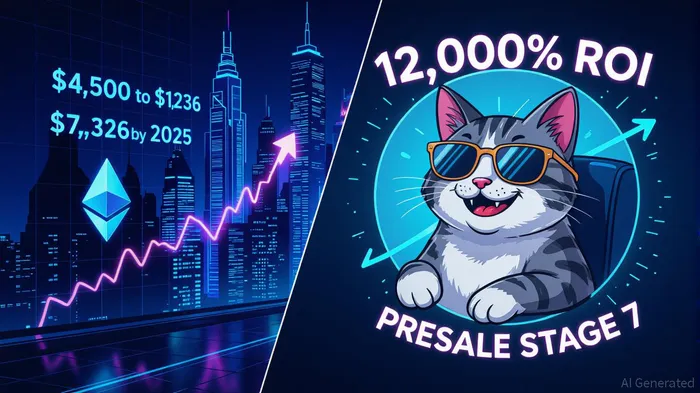
The cryptocurrency market in 2025 is a theater of extremes. On one side stands EthereumETH-- (ETH), the second-largest digital asset by market capitalization, with a price target of $6,000 and a foundation in blockchain innovation. On the other, Catzilla ($CATZILLA), a meme-inspired token, promises a speculative 12,000% return, riding the viral wave of community-driven hype. Both projects operate in a bullish cycle, but their paths—and risks—could not be more different.
Ethereum: The Bedrock of a Maturing Ecosystem
Ethereum’s current price of $4,596.3242 [1] sits below the $6,000 threshold, but analysts project a 33% increase by year-end [1]. This optimismOP-- is rooted in Ethereum’s dominance as the leading smart contract platform, with a market cap of $563.16 billion as of August 2025 [2]. The network’s transition to Ethereum 2.0, coupled with growing adoption in decentralized finance (DeFi) and non-fungible tokens (NFTs), has solidified its role as a foundational layer for innovation.
The price forecasts, ranging from $5,907 to $7,326 [1], hinge on macroeconomic factors such as macroeconomic stability and regulatory clarity. Ethereum’s utility—its role in powering decentralized applications and its deflationary mechanisms—provides a buffer against the volatility that plagues speculative assets. For investors seeking a balance between growth and stability, Ethereum represents a “blue-chip” play in crypto.
Catzilla: The Meme Coin’s High-Stakes Gamble
Catzilla, by contrast, is a study in speculative fervor. At $0.0009 per token in Stage 7 of its 14-stage presale [3], the project has already raised $2.2 million, with a projected 11% price jump in the next phase [3]. The token’s potential to reach $10 by 2025 [4] would represent a 12,000% return from its presale price of $0.0002. Such a surge, however, depends on sustaining the meme coin’s viral appeal and community engagement, which are notoriously fickle.
Catzilla’s presale structure—incremental price increases and a Solana-based blockchain—offers a blend of accessibility and speed, but its lack of tangible utility beyond meme culture raises red flags. Analysts caution that while the token’s deflationary mechanics and staking features could drive short-term momentum [5], its long-term viability remains unproven.
Risk vs. Reward: A Tale of Two Paradigms
The contrast between Ethereum and Catzilla mirrors the broader debate in crypto: should investors bet on established infrastructure or speculative hype? Ethereum’s $6,000 target is achievable within a 2025 bullish cycle, supported by its market leadership and technological upgrades. Catzilla’s 12,000% ROI, meanwhile, requires a perfect storm of sustained community enthusiasm and favorable market conditions—a scenario as likely as a meme coin surviving a bear market.
For risk-averse investors, Ethereum’s growth trajectory aligns with a maturing crypto ecosystem. For those with a higher risk tolerance, Catzilla’s presale offers a high-leverage opportunity, albeit with the volatility of a project built on social media trends.
Conclusion
In 2025, the crypto market is a mosaic of innovation and speculation. Ethereum’s $6,000 potential reflects a measured bet on blockchain’s evolution, while Catzilla’s 12,000% ROI embodies the wild optimism of a meme-driven era. The better bet depends on one’s appetite for risk—and patience for long-term value. For now, the data suggests Ethereum’s ascent is more certain, but Catzilla’s meteoric rise could redefine the rules of the game.
**Source:[1] Ethereum (ETH) Price Prediction 2025 2026 2027 - 2030,
https://changelly.com/blog/ethereum-eth-price-predictions/[2] Ethereum Market Cap - Real-Time & Historical Trends,
https://ycharts.com/indicators/ethereum_market_cap[3] Catzilla's 700% Presale Surge Challenges FLOKI and Bonk,
https://www.ainvest.com/news/catzilla-700-presale-surge-challenges-floki-bonk-meme-coin-market-2507/[4] Catzilla's Meteoric Rise: Could This Coin Surpass $10 in 2025 and Leave in the Dust DogeDOGE-- and Shib?,
https://cryptodnes.bg/en/catzillas-meteoric-rise-could-this-coin-surpass-10-in-2025-and-leave-in-the-dust-doge-and-shib/[5] Catzilla Meme Coin Poised for 30x Gains by 2025,
https://www.ainvest.com/news/catzilla-meme-coin-poised-30x-gains-2025-2503/

Decoding blockchain innovations and market trends with clarity and precision.
Latest Articles
Stay ahead of the market.
Get curated U.S. market news, insights and key dates delivered to your inbox.


AInvest
PRO
AInvest
PRO



Comments
No comments yet