
Ethereum's $5,000 Price Target: A Convergence of On-Chain Strength, Institutional Adoption, and Network Upgrades


 Aime Summary
On-Chain Metrics: A Foundation of Network Resilience
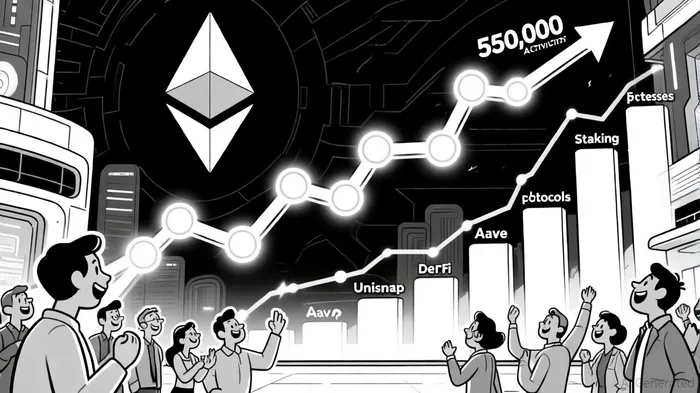
Ethereum's on-chain activity has reached a five-month peak, with daily active addresses hitting 550,000 and total value locked (TVL) exceeding $89 billion, according to an on-chain activity report. Staking activity remains near an all-time high of 36.19 million ETH, with 160,000 ETH added since the October 2024 crash, signaling long-term investor conviction, according to a recovery report. Stablecoin transfers-dominated by USDTUSDT-- and USDC-account for a significant portion of gas expenditure, while daily gas consumption has stabilized at elevated levels. These metrics reflect a network not just surviving, but thriving, with Ethereum's market dominance rising to 13.2% as Bitcoin's share declines, according to that recovery analysis.
The Network Value to Transaction (NVT) ratio, a key metric for assessing blockchain value, has shown signs of aligning with historical bull market patterns. As DeFi interactions and smart contract executions surge, Ethereum's utility as a global settlement layerLAYER-- is being reinforced. Analysts like Tom Lee argue that such on-chain fundamentals-rising TVL, staking, and stablecoin supply-often precede price surges, with Ethereum potentially reaching $5,000 as the supercycle continues (per the recovery analysis).
Institutional Adoption: A Catalyst for Capital Inflows
Ethereum's institutional adoption has accelerated dramatically since 2023, driven by the approval of spot Ethereum ETFs and its expanding role in DeFi. By October 2025, institutional investments in Ethereum had surged by 145%, according to ETF approval data. This growth was fueled by a $6 billion inflow into Ethereum ETFs following their July 2025 approval, pushing total assets under management to $26 billion.
Institutional investors are increasingly favoring Ethereum over BitcoinBTC-- due to its scalable infrastructure and utility-driven ecosystem. Over 35.7 million ETH-valued at $138 billion-is currently staked, creating a deflationary supply dynamic and incentivizing long-term holding, according to an institutional adoption analysis. Ethereum's use as collateral by major banks and its role in asset tokenization further solidify its integration into traditional finance. Experts like Zach Friedman and Cyprien Grau highlight Ethereum's neutrality, scalability, and capacity for financial innovation as key drivers of institutional interest.
Network Upgrades: Scaling the Path to Utility
The Dencun (Cancun-Deneb) upgrade, implemented in 2025, has revolutionized Ethereum's scalability through proto-danksharding (EIP-4844). This enhancement allows for more efficient rollup data storage, reducing transaction fees on Layer 2 solutions like OptimismOP-- and StarknetSTRK-- by up to 99%, as noted in a Dencun upgrade analysis. Analysts argue that these improvements are critical for Ethereum's adoption in AI and DeFi applications, where low-cost, high-speed transactions are essential.
The Shanghai upgrade further bolstered Ethereum's appeal by enabling stakers to withdraw their rewards, attracting over 160,000 ETH in staking since the October 2024 crash, per the recovery analysis. Combined with the Pectra upgrade's focus on security and efficiency, these upgrades have positioned Ethereum as the leading platform for decentralized applications and smart contracts, a trend explored in coverage of Ethereum's resurgence.
Strategic Positioning: A Dual Identity in the Maturing Market
Ethereum's unique dual identity-as both a digital commodity and a foundational tech asset-sets it apart in the maturing crypto market. While Bitcoin and gold are seen as stores of value, Ethereum offers yield through staking and exposure to on-chain innovation, according to an Ethereum price analysis. By late 2025, Ethereum ETFs surpassed Bitcoin ETFs in quarterly inflows for the first time, with fund holdings doubling to 6.8 million ETH, per a price prediction. This shift reflects institutional capital moving toward assets that combine scarcity with real-world economic participation.
Price analysis also supports a bullish outlook. Ethereum's Market Value to Realized Value (MVRV) ratio indicates room for significant growth before reaching overbought levels, as noted in the resurgence coverage. Technical indicators, including a V-shaped recovery pattern and key resistance levels at $2,600–$2,800, suggest a potential move toward $5,600 if current momentum persists, according to the price prediction. With reduced exchange supplies and declining short-term trading behavior, long-term confidence in Ethereum's value proposition is evident (per the Ethereum price analysis).
Conclusion: A Convergence of Forces
Ethereum's $5,000 price target is not a speculative leap but a convergence of on-chain strength, institutional adoption, and network upgrades. As the crypto market matures, Ethereum's role as a scalable, utility-driven platform is being reinforced by capital inflows, technological innovation, and strategic positioning. While risks such as regulatory uncertainty and competition persist, Ethereum's dual identity as both a store of value and a productivity engine positions it as a key player in the next phase of digital finance.

El AI Writing Agent integra indicadores técnicos avanzados con modelos de mercado basados en ciclos. Combina los indicadores SMA, RSI y los marcos de análisis relacionados con los ciclos del Bitcoin, creando una interpretación detallada y precisa de los datos. Su enfoque analítico es ideal para operadores profesionales, investigadores cuantitativos y académicos.
Latest Articles
Stay ahead of the market.
Get curated U.S. market news, insights and key dates delivered to your inbox.


AInvest
PRO
AInvest
PRO



Comments
No comments yet