
Ethereum's $3k Support: A Critical Juncture for Institutional Adoption
 Aime Summary
Technical Analysis: A Volatility Compression Play
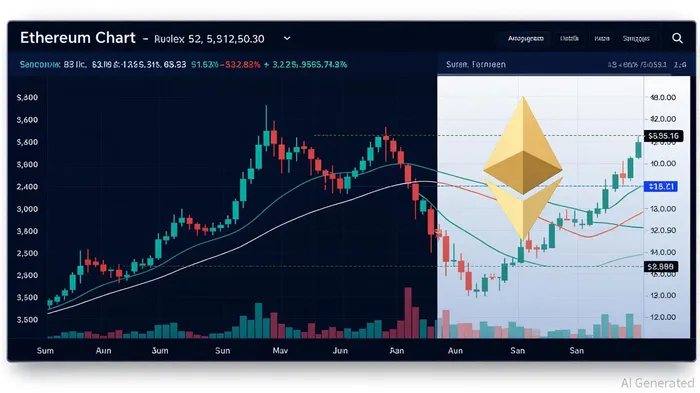
Ethereum has been trapped in a $2,800–$3,000 range for weeks, a zone that has proven both resilient and contentious. According to a report by , this band acts as a critical support level and psychological pivot, with sellers repeatedly capping rebounds at $3,000 while buyers defend the $2,800–$2,870 floor. The Williams %R indicator, currently at -58.16, underscores the market's indecision, placing Ethereum in a neutral zone where neither bulls nor bears hold a clear advantage.
On-chain data further complicates the narrative. While large capital pools on ArbitrumARB-- show no aggressive accumulation or distribution, the lack of directional bias suggests sophisticated participants are waiting for a catalyst. This patience is mirrored in Ethereum ETF flows, which have weakened investor sentiment despite long-term holder confidence. If Ethereum breaks above $3,345-a key resistance level-it could signal a trend reversal, but a drop below $2,800 would invalidate the bullish thesis and trigger a deeper correction.
Macroeconomic Catalysts: Fed Policy and Market Correlations
The Federal Reserve's tightening cycle has amplified Ethereum's volatility, with rising U.S. yields and a cautious stance on rate cuts dampening demand for risk assets. As noted by Gate.io in its macroeconomic analysis, Ethereum's price has mirrored broader market corrections, declining 21.87% in 2025 amid a risk-off environment. This correlation highlights Ethereum's sensitivity to macroeconomic shifts, particularly as institutional investors rotate into safer assets like Treasury-linked yields.
However, Ethereum's institutional adoption remains robust. Despite ETF outflows-exemplified by BlackRock's ETHA fund losing $224 million in December-network fundamentals show resilience. Daily on-chain transactions hover near 1.05 million, and gas fees average $4.80, underscoring Ethereum's role as the backbone of DeFi and smart contracts. The upcoming Dencun upgrade in early 2026, which will implement EIP-4844 to enhance scalability, is expected to unlock new use cases and drive institutional interest.
Institutional Adoption: Staking, Tokenization, and Strategic Positioning
Ethereum's institutional adoption is being fueled by three pillars: staking infrastructure, real-world asset (RWA) tokenization, and enterprise partnerships. Staking participation has reached 29.4% of the total supply, with over 35.6 million ETHETH-- locked in 1.07 million validators. This has created a flywheel effect, where institutional custodians like Coinbase Custody and Bitwise report steady inflows, even as spot prices fluctuate.
RWA tokenization has also gained traction, with over $7.4 billion in value tokenized on Ethereum, including partnerships with JPMorgan and HSBC. These developments position Ethereum as a programmable finance layer, bridging traditional and digital assets. Meanwhile, macroeconomic event timing-such as the $27 billion options expiry on Deribit-could act as a catalyst, with the $3,000 max-pain level likely influencing early 2026 price direction.
Strategic Outlook: A Path to Institutional Core Status
For Ethereum to transition into a core institutional asset class, it must overcome short-term volatility and demonstrate utility beyond speculative trading. The $3,000 level is not just a technical threshold but a psychological battleground. If institutional buyers reclaim this level as support, it could catalyze a rebound toward $3,131 and beyond. Conversely, a breakdown below $2,800 would expose Ethereum to further downside risks, testing the $2,700–$2,500 range.
The key lies in aligning technical resilience with macroeconomic clarity. As the Fed's policy trajectory becomes clearer in 2026, Ethereum's role in tokenized finance and DeFi could attract a new wave of institutional capital. The Dencun upgrade, coupled with regulatory clarity in the U.S., may provide the necessary infrastructure for Ethereum to scale beyond its current constraints.
Conclusion
Ethereum's $3,000 support level is more than a price point-it is a barometer of institutional sentiment and a test of the network's ability to adapt to macroeconomic headwinds. While the immediate outlook remains uncertain, the interplay of technical consolidation, macroeconomic catalysts, and institutional adoption suggests that Ethereum is on the cusp of a defining moment. Whether it solidifies as a core asset class will depend on its capacity to navigate this volatility and deliver on its promise as the backbone of programmable finance.

Blending traditional trading wisdom with cutting-edge cryptocurrency insights.
Latest Articles
Stay ahead of the market.
Get curated U.S. market news, insights and key dates delivered to your inbox.






Comments
No comments yet