
Ethereum's $30 Billion Restaking Shift: A Strategic Entry Point for Institutional-Grade Yield Opportunities?


 Aime Summary
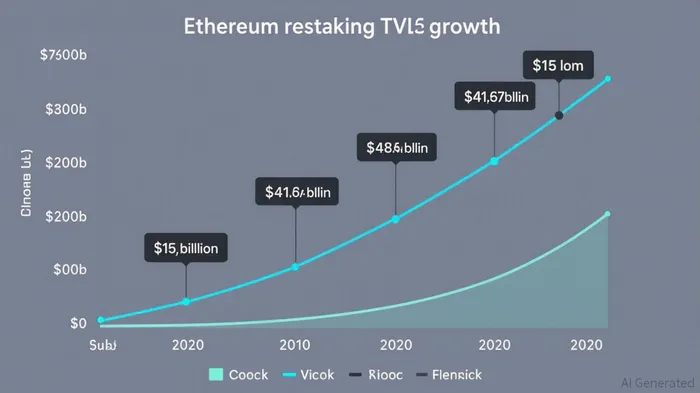
Ethereum’s restaking ecosystem has emerged as a pivotal force in the decentralized finance (DeFi) landscape, with Total Value Locked (TVL) surging to $86 billion in Q3 2025—a 95% increase for platforms like Lido, which now holds $41.07 billion in assets [2]. This growth is driven by liquid staking derivatives (LSTs) and liquid restaking protocols, which enable stakers to compound yields exceeding 12% while maintaining liquidity [2]. For institutional investors, this represents a compelling capital reallocation opportunity, but it also raises critical questions about risk-adjusted returns and regulatory alignment in a rapidly evolving market.
The Mechanics of Restaking and Institutional Appeal
Restaking protocols, such as EigenLayer, have redefined Ethereum’s utility by allowing ETH holders to generate multiple revenue streams through Avail Services (AVSs) [3]. By April 2025, EigenLayer’s TVL surpassed $15 billion, illustrating the protocol’s role in transforming ETH from a passive asset into a dynamic infrastructure component [3]. This innovation aligns with institutional demand for yield generation, particularly as EthereumETH-- ETFs like BlackRock’s iShares Ethereum Trust (ETHA) attract $10.2 billion in assets under management (AUM) by Q2 2025 [1]. These ETFs offer 3–6% annualized staking yields, a feature absent in BitcoinBTC-- ETFs, and outperform traditional assets like the S&P 500 in risk-adjusted metrics [1].
The appeal is further amplified by Ethereum’s deflationary supply model and technological upgrades, including the Pectra and Dencun/Verge upgrades, which reduced gas fees by 90%, enabling scalable DeFi applications [1]. Institutional investors are also drawn to Ethereum’s dominance in tokenized real-world assets (RWAs), where it controls 50% of the market share [3]. This infrastructure-grade positioning, combined with regulatory clarity under the U.S. CLARITY Act and the EU’s MiCA framework, has positioned Ethereum as a bridge between traditional finance and decentralized systems [1].
Risk-Adjusted Returns: A Comparative Edge
Ethereum’s risk-adjusted returns outshine traditional assets, with the iShares Ethereum Trust (ETHA) posting a Sharpe ratio of 1.15 and a Sortino ratio of 1.88—well above the S&P 500’s 0.85 and 1.27, respectively [1]. This performance is attributed to Ethereum’s dual-income model: price appreciation and yield generation through staking and DeFi integration. Liquid staking derivatives like stETH and LsETH further enhance liquidity, allowing institutions to maintain exposure while compounding returns [3].
However, challenges persist. Institutional adoption of restaking remains constrained by operational complexities, such as quantifying slashing risks across AVSs and the lack of standardized risk assessment tools [4]. Protocols like EigenLayer and P2P.org’s SSV Network are mitigating these risks through distributed validator technology (DVT), which spreads key management across nodes to reduce slashing vulnerabilities [4]. Despite these advancements, the absence of historical slashing data and on-chain insurance mechanisms continues to deter large-scale allocations [4].
Strategic Entry Points and Market Dynamics
The $30 billion restaking shift reflects a broader capital reallocation trend, with Ethereum capturing over 50% of DeFi TVL ($97 billion as of August 2025) [1]. Layer 2 networks like Arbitrum and Base contribute $16.28 billion to this growth, underscoring Ethereum’s role as a scalable settlement layer [1]. For institutions, the strategic entry point lies in curated vaults and permissioned lending pools, which balance control with operational efficiency [4]. These structures address concerns around legal enforceability and liquidity, particularly in tokenized private credit platforms offering 9–12% yields [4].
A critical question remains: How do institutions balance Ethereum’s high-risk, high-reward profile with their fiduciary obligations? The answer lies in incremental adoption, leveraging Ethereum ETFs as a gateway to restaking while hedging against volatility through stablecoin infrastructure and tokenized RWAs [3]. As Deutsche Bank’s ZKsync-based rollup and Sony’s Soneium Layer 2 demonstrate, Ethereum’s integration into traditional finance is accelerating, further validating its institutional-grade potential [3].
Conclusion
Ethereum’s restaking revolution is not merely a technical innovation but a strategic repositioning of digital assets as infrastructure-grade investments. While institutional adoption is still nascent, the combination of attractive yields, regulatory progress, and risk-mitigation tools positions Ethereum as a viable capital reallocation target. For investors willing to navigate the complexities of slashing risks and operational overhead, the $30 billion restaking shift offers a unique opportunity to capitalize on Ethereum’s evolving role in the DeFi ecosystem.
**Source:[1] Ethereum's Institutional Takeoff: A Strategic Shift in Digital Asset Allocation [https://www.ainvest.com/news/ethereum-institutional-takeoff-strategic-shift-digital-asset-allocation-2508/][2] Ethereum's Staking Renaissance: How Yield Innovation ... [https://www.ainvest.com/news/ethereum-staking-renaissance-yield-innovation-institutional-adoption-reshaping-crypto-landscape-2508/][3] Ethereum at a Crossroads | Institutional Outlook [https://www.xbto.com/resources/ethereum-at-a-crossroads-institutional-adoption-vs-market-underperformance][4] Challenges and opportunities for institutional integration of restaking in 2025: Report [https://cointelegraph.com/news/challenges-and-opportunities-for-institutional-integration-of-restaking-in-2025-report]

Decoding blockchain innovations and market trends with clarity and precision.
Latest Articles
Stay ahead of the market.
Get curated U.S. market news, insights and key dates delivered to your inbox.
AInvest
PRO
AInvest
PRO



Comments
No comments yet