
Ethereum's $3,500 Threshold: A Strategic Entry Point or Precursor to a Larger Correction?
 Aime Summary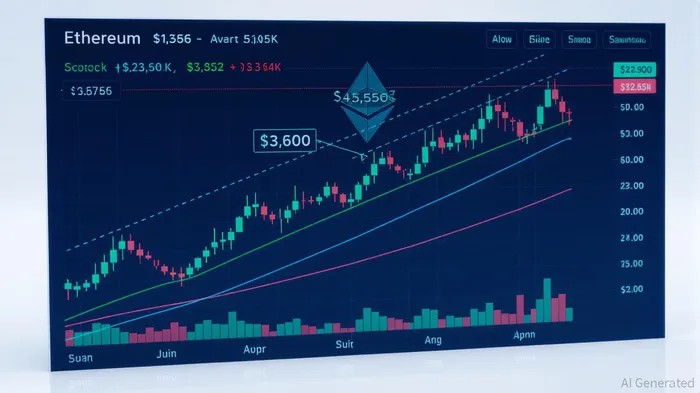
Ethereum (ETH) has long been a barometer for the broader crypto market, and its current positioning around the $3,500 level in August 2025 presents a critical juncture for investors. This price point, once a psychological floor during the 2024 bear market, now serves as a battleground between short-term volatility and long-term bullish fundamentals. To assess whether this threshold is a strategic entry point or a warning sign of deeper correction, we must dissect technical indicators, macroeconomic tailwinds, and on-chain dynamics.
Technical Analysis: A Test of Resilience
Ethereum's price action around $3,500 reveals a complex interplay of support and resistance. On the daily chart, the $3,500 level acts as a pivotal pivot point, with a consolidation phase observed between $3,500 and $3,650. A successful hold above this level could trigger a retest of the $3,800–$4,000 resistance zone, which has historically acted as a gateway to higher targets. Fibonacci extensions suggest that a breakout above $4,000 could extend the rally toward $4,500 and even $6,000, aligning with the 2021 all-time high.
However, the 4-hour chart tells a different story. EthereumETH-- has faced minor selling pressure near the $4,772 resistance, a former 2021 peak. A breakdown below $3,500 could reignite bearish momentum, with the next support levels at $3,350 and $3,144. The Relative Strength Index (RSI) currently hovers near 57, indicating neutral momentum, while the Average Directional Index (ADX) suggests strong bullish bias—though overbought conditions on the weekly timeframe caution against complacency.
Macroeconomic Tailwinds: A Crypto-Friendly Environment
The macroeconomic backdrop in 2025 has been increasingly favorable for Ethereum. U.S. inflation has cooled to 2.7% year-over-year, raising expectations for Federal Reserve rate cuts. With an 82% probability of a September cut priced into the market, risk assets like Ethereum have benefited from reduced capital costs and increased speculative flows.
Institutional adoption has further bolstered Ethereum's fundamentals. Spot Ethereum ETFs have attracted nearly $3 billion in inflows since mid-July 2025, with total assets under management reaching $19.2 billion. This surge reflects growing legitimacy in traditional finance, as Ethereum's role as a “digital oil” for decentralized applications (dApps) and Layer 2 networks (e.g., Arbitrum, Optimism) strengthens. Regulatory clarity, including the U.S. government's exploration of crypto in retirement accounts and the GENIUS Act for stablecoin oversight, has also reduced uncertainty, attracting a broader investor base.
On-Chain Metrics: Accumulation Amid Volatility
On-chain data paints a nuanced picture. The Market Value to Realized Value (MVRV) ratio, a key metric for assessing overvaluation, remains above the 365-day simple moving average, suggesting Ethereum is not yet overbought. Whale activity has been robust, with 170 large addresses accumulating over 1.7 million ETH in the past month. Corporate treasuries, including SharpLink GamingSBET-- and Bit DigitalBTBT--, have added to their holdings, staking a significant portion of newly acquired ETH—a sign of long-term conviction.
Exchange reserves are declining, while open interest in Ethereum futures has surged to $7.85 billion, signaling speculative positioning. The Taker Buy/Sell Ratio on Binance crossed 1.00, indicating stronger buyer pressure. However, the MVRV Long/Short Difference remains above 12.36%, highlighting that long-term holders are holding onto unrealized gains, which could provide a buffer against short-term selloffs.
Short-Term Risks vs. Long-Term Fundamentals
While Ethereum's technical and macroeconomic fundamentals are robust, short-term risks persist. The recent $1.5 billion Bybit hack in early 2025 and the asset's 234% rally from $1,300 to $4,700 have created a volatile environment. Overbought conditions on the weekly timeframe and the potential for profit-taking near $4,000 could trigger a pullback. Additionally, a breakdown below $3,500 might test the $3,350 support, with further downside risks to $3,144.
However, the long-term case for Ethereum remains compelling. Institutional inflows, Layer 2 adoption, and the Pectra network upgrade in May 2025—aimed at enhancing scalability—position Ethereum to outperform BitcoinBTC-- in a risk-on environment. The growing TVL (Total Value Locked) in Ethereum-based DeFi protocols and the asset's role as a settlement layer for NFTs and decentralized finance further reinforce its utility.
Investment Advice: Strategic Positioning
For investors, Ethereum's $3,500 threshold offers a strategic entry point, but caution is warranted. A breakout above $3,600 with strong volume could signal the start of a new uptrend, with $4,000 as the next target. Conversely, a breakdown below $3,500 would necessitate a reassessment of risk exposure.
- Bullish Scenario: If Ethereum holds above $3,500 and breaks out of the $3,800–$4,000 consolidation zone, investors should consider adding to positions, particularly with the Fed's dovish stance and ETF inflows supporting the asset.
- Bearish Scenario: A sustained drop below $3,350 would invalidate the bullish case, prompting a reevaluation of risk-reward ratios.
In conclusion, Ethereum's $3,500 level is a critical inflection point. While short-term volatility and overbought conditions pose risks, the long-term fundamentals—driven by institutional adoption, regulatory clarity, and technological innovation—suggest a continuation of the bullish trend. Investors should monitor key support/resistance levels, on-chain flow data, and macroeconomic signals to navigate this pivotal phase. For those with a medium-term horizon, Ethereum's current positioning offers a compelling opportunity, provided risk management remains a priority.

Decoding blockchain innovations and market trends with clarity and precision.
Latest Articles
Stay ahead of the market.
Get curated U.S. market news, insights and key dates delivered to your inbox.






Comments
No comments yet