
Ethereum's $3,000 Support: A Critical Test for Bear Market Resilience
 Aime Summary
Technical Analysis: A Volatility Compression Play
Ethereum's price has been trapped in a narrow $2,800–$3,000 range for weeks, a pattern often referred to as "volatility compression" in technical circles. This consolidation phase, marked by diminishing price swings and fading bearish momentum, suggests a market in limbo. On the 4-hour chart, ETH remains below both its 50-period and 200-period moving averages, with the latter currently at $3,012.68, forming a key resistance layer just above $3,000 according to technical analysis. The Williams %R indicator, at -58.16, underscores a neutral momentum environment, where neither bulls nor bears hold clear dominance as technical indicators suggest.
Hourly charts reveal a more dynamic narrative. EthereumETH-- briefly reclaimed $2,950 on December 29, forming a bullish trend line with support at $2,930 and crossing above the 100-hourly simple moving average. This recovery has positioned $3,000 as the next critical threshold. A clean break above this level could trigger a rally toward $3,030 and $3,050, with $3,120 and $3,200 as longer-term targets according to market analysis. However, repeated failures to surpass $3,200-a key resistance cluster-highlight the fragility of this bullish scenario.
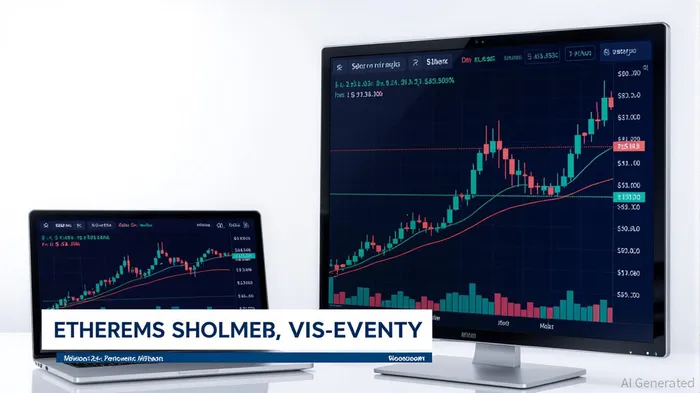
Conversely, a breakdown below $3,000 would likely see ETH retest $2,940 and $2,880, with the $2,800 level acting as a final line of defense according to technical indicators. On-chain data from ArbitrumARB-- further complicates the outlook, showing muted activity that suggests sophisticated capital is neither aggressively dumping nor accumulating ETH at these levels according to on-chain analysis. This lack of conviction among institutional players reinforces the idea that the $3,000 level is a battleground for market psychology rather than a catalyst for a sustained reversal.
Market Sentiment: Fear, Uncertainty, and Mixed Signals
The Fear & Greed Index, a widely followed sentiment indicator, remains in "Extreme Fear" territory, reflecting risk aversion among investors. This aligns with broader macroeconomic headwinds, including potential interest rate hikes and regulatory uncertainties, which have dampened risk-on appetite across asset classes. Institutional behavior has been similarly mixed: while some Ethereum ETFs, like BlackRock's, have seen inflows, others have experienced outflows, signaling divergent views on ETH's near-term prospects according to market data.
On the technical front, the December options expiry has added a structural layer of complexity. $3,000 is identified as the "max-pain" zone, where the largest number of options buyers stand to lose value according to technical analysis. This creates a self-fulfilling dynamic, as market participants may strategically push or pull price toward this level to minimize losses. Meanwhile, on-chain metrics such as rising exchange reserves and elevated leverage ratios suggest continued distribution pressure, with sellers retaining the upper hand in the short term according to on-chain data.
Yet, there are glimmers of resilience. Ethereum's year-to-date technological advancements-particularly the PoS transition and EIP-1559 upgrade-have attracted institutional interest, especially from ESG-focused funds according to market analysis. These upgrades not only enhance energy efficiency but also create a deflationary tailwind by burning transaction fees, a factor that could support long-term price appreciation. However, such fundamentals are unlikely to offset immediate macroeconomic pressures unless Ethereum breaks above $3,200 and reclaims its 50-day EMA, a critical technical milestone according to technical indicators.
The Path Forward: A High-Stakes Test
Ethereum's ability to hold the $3,000 support level will hinge on two key factors: the strength of institutional participation and the resolution of macroeconomic uncertainties. A successful defense of this level, coupled with a breakout above $3,200, could signal a shift from a "relief bounce" to a genuine recovery wave. Conversely, a breakdown below $2,800 would likely deepen the bearish narrative, forcing ETH into a lower trading range until new catalysts emerge.
For now, the market remains in a state of anticipation. The 2-hour chart's converging triangle pattern-bounded by $2,800 and $3,050-suggests a decisive move is imminent, with buyers defending $2,900 and sellers capping rallies at descending resistance according to price analysis. The 20 and 50 EMAs provide near-term support around $2,955, while the 100 and 200 EMAs form layered resistance near $2,958 and $2,981 according to technical indicators. These technical layers will be critical in determining whether Ethereum's bear market resilience holds or succumbs to renewed selling pressure.
Conclusion
Ethereum's $3,000 support level represents more than a technical threshold-it is a litmus test for the broader market's willingness to embrace risk in a volatile macroeconomic environment. While on-chain data and sentiment indicators suggest a fragile equilibrium, the asset's fundamental strengths and institutional appeal offer a counterbalance to bearish forces. Investors must remain vigilant, as the outcome of this critical test will likely shape Ethereum's trajectory into 2026.

Blending traditional trading wisdom with cutting-edge cryptocurrency insights.
Latest Articles
Stay ahead of the market.
Get curated U.S. market news, insights and key dates delivered to your inbox.


AInvest
PRO
AInvest
PRO



Comments
No comments yet