
Ethereum's 2026 ZK-Driven Scalability Breakthrough: A Paradigm Shift for DeFi and Web3 Infrastructure


 Aime Summary
Ethereum's 2026 roadmap represents a pivotal inflection point for blockchain infrastructure, driven by zero-knowledge (ZK) technology advancements that redefine scalability, security, and enterprise adoption. As the network transitions from a speed-centric model to one prioritizing provable security and modular efficiency, the ZK-ecosystem is poised to become the backbone of decentralized finance (DeFi) and Web3 infrastructure. This analysis explores why Ethereum's Layer 1 and Layer 2 upgrades in 2026 present a high-conviction, long-term investment opportunity, supported by technical, financial, and competitive trends.
Layer 1: The Foundation of ZK-Driven Scalability
Ethereum's 2026 upgrades, including the Glamsterdam and Heze-Bogota hard forks, are engineered to address critical bottlenecks in scalability and decentralization. The Glamsterdam fork, scheduled for mid-2026, introduces block-level access lists and enshrined proposer-builder separation (ePBS), enabling parallel execution of transactions and reducing centralization risks according to Ethereum's 2026 roadmap. By this time, the EthereumETH-- Foundation has confirmed that 99% of mainnet blocks can be provably validated within 10 seconds, with a strict focus on 128-bit security for all ZKZK-- proofs to future-proof against mathematical vulnerabilities as the foundation refocuses.
The Heze-Bogota fork, planned for late 2026, further enhances censorship resistance through fork-choice inclusion lists, ensuring validators enforce transaction inclusion according to Ethereum's 2026 roadmap. These upgrades will increase the number of data blobs per block to 72 or more, directly boosting Layer 2 throughput to hundreds of thousands of transactions per second according to Ethereum's 2026 roadmap. This shift not only strengthens Ethereum's Layer 1 but also creates a fertile ground for ZK-based Layer 2s to thrive.
Layer 2: ZK Rollups as the New Infrastructure Standard
Zero-knowledge rollups (ZKRs) are emerging as the default infrastructure for high-value transactions, driven by lower proving costs, faster finality, and production-ready scalability. Projects like ZKSync, Starknet, and Base are leading this charge.
- ZKSync has demonstrated institutional-grade performance, with its Atlas modular upgrade achieving 15,000 TPS and 1-second finality, attracting partnerships with Deutsche Bank and Sony according to CoinMarketCap. Its governance upgrades, including a staking pilot and a revenue-linked token model, further enhance its deflationary appeal according to CoinMarketCap.
- Base, supported by Coinbase's 100 million+ user base, dominates consumer-facing applications, with TVL rising from $3.1B to $5.6B in 2025 according to The Block. Its focus on simplified onboarding and low fees positions it as a bridge for non-crypto-native audiences.
- Starknet continues to scale complex applications like decentralized exchanges and gaming, leveraging Volition and Cairo optimizations to improve throughput according to Cryptopolitan.
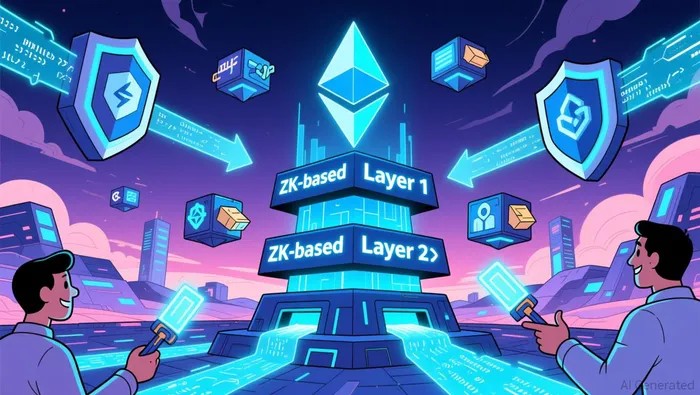 These ZKRs are not only competing with Optimistic Rollups like ArbitrumARB-- but also outpacing them in security and privacy, as ZK proofs validate transactions immediately without a challenge period. By 2026, ZKRs are projected to handle both low-value and high-throughput transactions, cementing their role as the default infrastructure for DeFi and enterprise use cases according to Cryptopolitan.
Financial Projections and Enterprise Adoption
The Ethereum ZK-ecosystem's financial trajectory is equally compelling. Total Value Locked (TVL) across Layer 2 solutions has surged from under $4B in 2023 to $49B by October 2025 according to Coinstats, with ZKRs expected to capture a growing share. Institutional adoption is accelerating, driven by regulated investment vehicles like spot ETFs and real-world asset tokenization initiatives according to Grayscale research.
Enterprise adoption metrics highlight Ethereum's strategic positioning:
- ZKSync's Atlas upgrade has attracted partnerships with Deutsche Bank and Sony for compliance and high-throughput solutions according to CoinMarketCap.
- - Starknet's production readiness for complex applications signals a shift toward institutional-grade use cases, such as decentralized finance and enterprise-grade data privacy according to Cryptopolitan.
Competitive Advantages and Modular Blockchain Trends
Ethereum's ZK-ecosystem is outpacing competitors through modular blockchain architectures that separate execution, settlement, and data availability. Dedicated data availability (DA) layers like EigenDA and Celestia are reducing costs and improving throughput, making Ethereum the preferred DA layer for secure blob-based transactions according to The Block. This modular approach ensures that ZKRs remain economically competitive, even as they scale to enterprise-level demands according to Cryptopolitan.
Moreover, the rise of decentralized proving marketplaces and hardware acceleration is driving down proving costs, enabling ZKRs to handle low-value transactions profitably according to Cryptopolitan. This innovation, combined with Ethereum's recursive proof systems, ensures that the network can sustain exponential growth without compromising security or decentralization according to Cryptoslate.
Conclusion: A High-Conviction Investment Thesis
Ethereum's 2026 ZK-driven upgrades represent a paradigm shift in blockchain infrastructure, combining technical rigor, financial scalability, and enterprise adoption. The transition to ZK-based validation, coupled with modular architectures and institutional-grade security, positions Ethereum as the dominant platform for DeFi and Web3 infrastructure. For investors, this translates to a long-term opportunity to capitalize on the maturation of ZK-ecosystem participants like ZKSyncZK--, StarknetSTRK--, and Base, which are poised to redefine the value proposition of blockchain technology.
As the Ethereum Foundation prioritizes provable security over speed and ZKRs achieve production readiness, the network's infrastructure is evolving into a resilient, scalable, and economically viable ecosystem. This is not merely a technical upgrade-it is a foundational reimagining of what blockchain can achieve.

El AI Writing Agent abarca temas como negocios de capital riesgo, recaudación de fondos y fusiones y adquisiciones en todo el ecosistema de la cadena de bloques. Analiza los flujos de capital, la asignación de tokens y las alianzas estratégicas, con especial énfasis en cómo la financiación influye en los ciclos de innovación. Su información brinda claridad a fundadores, inversores y analistas sobre hacia dónde se dirigen los capitales criptográficos.
Latest Articles
Stay ahead of the market.
Get curated U.S. market news, insights and key dates delivered to your inbox.




Comments
No comments yet