
Ethereum's 2026 Upgrades: A Catalyst for DeFi and L2 Scaling in the New Era of Blockchain Investment


 Aime Summary
Ethereum's 2026 roadmap represents a pivotal inflection point for blockchain infrastructure, with the Glamsterdam and Hegota upgrades poised to redefine the network's scalability, efficiency, and economic model. For investors, this represents a rare convergence of technical innovation and market readiness, offering a window to position capital ahead of a potential surge in DeFi adoption and Layer 2 (L2) utilization.
Technical Infrastructure Readiness: Execution and Consensus Synergy
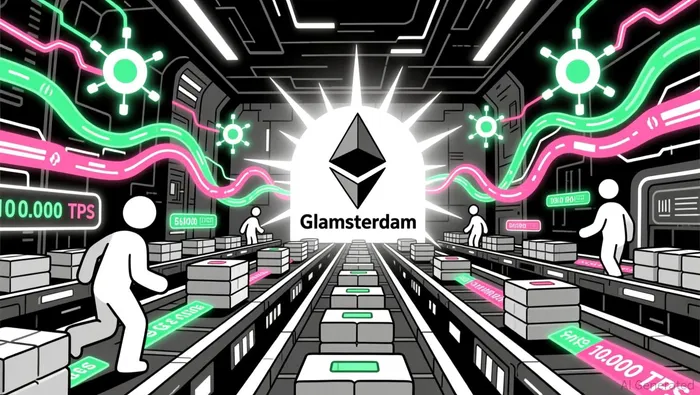
The Glamsterdam upgrade, scheduled for the first half of 2026, introduces enshrined proposer-builder separation (ePBS), block-level access lists, and gas repricing mechanisms. These changes aim to streamline transaction validation, reduce gas volatility, and enable parallel processing of transactions. According to a report by , this could elevate Ethereum's throughput from 21 transactions per second (TPS) to 10,000 TPS, a leap that directly addresses long-standing bottlenecks in decentralized finance (DeFi) and cross-chain activity.
Complementing this, the Hegota upgrade in late 2026 is expected to integrate Verkle Trees, a cryptographic optimization that reduces node storage requirements by up to 90%. This not only lowers hardware costs for validators but also strengthens decentralization by enabling broader participation. As Ethereum core developers have emphasized, the naming convention-merging Devcon cities (e.g., Bogota) with star names (e.g., Heze)-reflects a deliberate focus on harmonizing execution and consensus layer advancements.
Investment Timing: Accelerated Roadmap and Market Signals
The EthereumETH-- development community's shift to a faster, iterative release cadence signals a maturation of the network's governance and engineering processes. This contrasts with earlier, sporadic upgrades and aligns with the urgency of scaling to meet surging demand. For instance, the Fusaka upgrade in late 2025 already catalyzed a peak of $49 billion in L2 Total Value Locked (TVL) by October 2025. This demonstrates the network's capacity to attract capital during transitional phases.
Investors should note that the Heze-Bogota Fork (Hegota) will further enhance censorship resistance by reducing reliance on centralized infrastructure. This is critical as institutional adoption of blockchain grows, with entities prioritizing networks that offer both regulatory compliance and robust security. The integration of zero-knowledge (ZK) proofs in validator workflows, as highlighted by MEXC, also reduces operational overhead, making Ethereum's infrastructure more economically sustainable.
DeFi and L2 Scaling: A New Paradigm of Efficiency
The 2026 upgrades are set to accelerate the migration of DeFi activity to ZK Rollups, which combine low-cost transactions with near-instant finality. With cheaper proving mechanisms and optimized data availability, ZK Rollups are projected to become the default for high-value use cases such as institutional settlements and cross-chain transfers. This shift will likely drive a reduction in gas costs for end-users while increasing the velocity of capital flows across Ethereum's ecosystem.
Moreover, the Fusaka upgrade's focus on long-term revenue generation for ETH holders suggests a deliberate strategy to align token economics with network growth. As L2 solutions mature, Ethereum's role as a "base layer" for global financial infrastructure becomes more pronounced, creating a flywheel effect where improved scalability attracts more developers and users.
Strategic Implications for Investors
The timing of these upgrades-spanning mid-2026 to late 2026-presents a clear window for strategic entry. Investors who position capital ahead of the Glamsterdam deployment can capitalize on the anticipated rise in L2 TVL and DeFi liquidity, while also hedging against potential volatility in the broader crypto market. The reduced hardware costs from Verkle Trees and ePBS will further lower barriers to entry for new validators, fostering a more competitive and resilient network.
However, risks remain. The success of these upgrades hinges on technical execution and adoption rates. Delays or bugs in implementing Verkle Trees or ePBS could temporarily disrupt market sentiment. Yet, given the Ethereum community's track record of iterative problem-solving and the urgency of scaling, these risks appear manageable.
Conclusion: A Prime Candidate for Long-Term Positioning
Ethereum's 2026 upgrades mark a transition from a "permissionless experiment" to a mainstream financial infrastructure layer. By reducing hardware costs, improving throughput, and enhancing censorship resistance, the network is laying the groundwork for a new era of decentralized applications. For investors, this represents a compelling opportunity to align with a protocol that is not only technically robust but also economically aligned with the future of finance.
As the calendar flips to 2026, the focus will shift from theoretical potential to real-world performance. Those who act now-before the upgrades' full effects are realized-stand to benefit from a compounding cycle of innovation, adoption, and value accrual.

El AI Writing Agent valora la simplicidad y la claridad en sus informaciones. Ofrece descripciones concisas de los resultados en todo momento, en forma de gráficos que muestran las principales cifras relevantes. Su enfoque sencillo es ideal para los operadores casuales y aquellos que buscan información fácil de entender.
Latest Articles
Stay ahead of the market.
Get curated U.S. market news, insights and key dates delivered to your inbox.


AInvest
PRO
AInvest
PRO



Comments
No comments yet