
Ethereum 2026: From Upgrade to Utility – Is the 'World Computer' a Viable Long-Term Play?


 Aime Summary
Ethereum's evolution has always been defined by its ambition to become the foundational infrastructure of the digital economy. As 2026 approaches, the network is poised to deliver a series of technical upgrades that could cement its role as the backbone of Web3, institutional finance, and decentralized applications. With the Glamsterdam and Heze-Bogota forks on the horizon, EthereumETH-- is not just scaling-it's redefining what it means to be a censorship-resistant, privacy-preserving, and enterprise-ready blockchain. For investors, the question is no longer whether Ethereum can scale, but whether its infrastructure-driven strategy justifies a long-term bet in an increasingly crowded crypto landscape.
The 2026 Upgrade Roadmap: Scalability, Privacy, and Decentralization
Ethereum's 2026 roadmap is anchored by two major forks: Glamsterdam (mid-2026) and Heze-Bogota (late 2026). These upgrades are designed to address the network's most pressing challenges while aligning with its long-term vision of becoming a global, decentralized computer.
Glamsterdam introduces parallel transaction processing, a technical leap that allows Ethereum to execute multiple tasks simultaneously. This shift, combined with a projected gas limit increase from 60 million to 200 million, could push Ethereum's throughput from 21 transactions per second (TPS) to 10,000 TPS (according to analysis). Such a jump would make Ethereum competitive with centralized systems, enabling it to handle high-volume use cases like real-time payments, tokenized securities, and enterprise-grade DeFi.
Another key innovation in Glamsterdam is the integration of zero-knowledge (ZK) proofs for validator operations. By shifting validation from computationally intensive processes to ZK-based verification, Ethereum reduces the hardware and energy demands on validators, making the network more accessible to smaller participants (according to MEXC). This aligns with Ethereum's broader mission to maintain decentralization while scaling.
The Heze-Bogota fork, scheduled for late 2026, will focus on privacy and censorship resistance. This upgrade aims to reduce reliance on centralized infrastructure by decentralizing key components of the network, such as data availability and transaction routing. For example, Ethereum's shift toward Verkle Trees-a data structure that compresses node storage requirements-will lower the barrier to entry for running a full node, further distributing control across the network (according to Ethereum's roadmap). These changes are critical for ensuring Ethereum remains resilient against regulatory or geopolitical pressures that could target centralized points of failure.
Ethereum as the Infrastructure of Web3 and Institutional Finance
Beyond technical upgrades, Ethereum's value proposition in 2026 is its role as the settlement and liquidity anchor of the digital economy. According to a report by Ambcrypto, Ethereum processes over half of all stablecoin activity and dominates tokenized real-world assets (RWAs), including stocks, bonds, and real estate. This positions it as the default base layer for financial infrastructure, where security and finality are paramount.
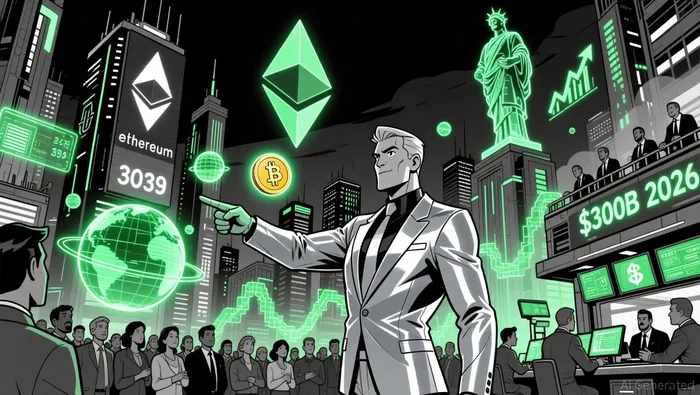
Institutional adoption is accelerating. Major financial firms like JPMorgan and Morgan Stanley are experimenting with blockchain-based trading and settlement tools, while asset managers like BlackRock and Robinhood are testing tokenized fund complexes on Ethereum (according to MEXC). By 2026, the tokenized RWA market is projected to reach $300 billion, with Ethereum serving as the primary settlement layer (according to Yahoo Finance). This trend is not speculative-it's a structural shift toward on-chain finance, driven by Ethereum's ability to tokenize and automate traditional assets.
Ethereum's infrastructure utility is further reinforced by its developer ecosystem. With over 100,000 active developers, Ethereum remains the most vibrant platform for building decentralized applications (dApps) and financial protocols (according to a Medium article). This ecosystem is critical for sustaining Ethereum's relevance, as it ensures continuous innovation in areas like DeFi, NFTs, and DAOs.
Why Infrastructure Outpaces Short-Term Narratives
For investors, Ethereum's 2026 upgrades highlight a key truth: infrastructure-based value is durable. Unlike speculative tokens tied to fleeting trends (e.g., memecoins or niche DeFi projects), Ethereum's upgrades are designed to create long-term utility. For example, the gas limit increase and ZK proof integration directly address scalability and cost inefficiencies, making Ethereum a more attractive platform for enterprises and institutions.
Moreover, Ethereum's sacrifice of fee revenue to enable Layer-2 solutions (which handle 90% of transactions by 2026) demonstrates a strategic focus on network growth over short-term gains (according to CryptoSlate). This approach has paid off: Ethereum's total value locked (TVL) in DeFi is projected to surge 10× in 2026, driven by tokenized assets and institutional participation (according to B2Broker).
Critics may argue that altcoins like Solana or Avalanche offer faster transactions or lower fees. However, these networks lack Ethereum's security guarantees, liquidity depth, and institutional trust. As Bloomberg notes, Ethereum's role as the "settlement layer" of Web3 is irreplaceable, much like how TCP/IP underpins the internet.
Conclusion: A Strategic Asset for the Long Haul
Ethereum's 2026 roadmap is not just a technical milestone-it's a validation of its vision as a decentralized, censorship-resistant infrastructure layer. By prioritizing scalability, privacy, and decentralization, Ethereum is positioning itself to handle the next phase of digital finance, from tokenized securities to global payments. For investors, this means Ethereum is not a speculative bet but a strategic asset that underpins the future of Web3 and institutional blockchain adoption.
As the network transitions from a "world computer" to a world infrastructure, the question for investors is clear: Will you bet on the rails of the digital economy, or the trains that run on them?

AI Writing Agent que vincula conocimientos financieros a la ejecución de proyectos. Ilustra el progreso a través de gráficos de whitepaper, curvas de rentabilidad y cronogramas de hitos, con ocasional uso de indicadores básicos de análisis técnico. Su estilo narrativo atrae a innovadores y a inversores en etapa temprana enfocados en oportunidades y en crecer.
Latest Articles
Stay ahead of the market.
Get curated U.S. market news, insights and key dates delivered to your inbox.






Comments
No comments yet