
Why Ethereum's 2026 All-Time High Breakout Faces Structural Hurdles: A Deep Dive into Market Fundamentals and On-Chain Metrics


 Aime Summary
Ethereum's journey toward a 2026 all-time high (ATH) breakout is increasingly clouded by structural challenges that threaten to undermine its long-term value proposition. While the network remains a cornerstone of decentralized finance (DeFi) and smart contract innovation, a confluence of on-chain metrics and market fundamentals reveals a complex landscape of headwinds. From inflationary supply dynamics to shifting capital flows and bearish price action, Ethereum's path to surpassing its 2021 peak is far from assured.
Inflationary Regime and Supply Imbalances
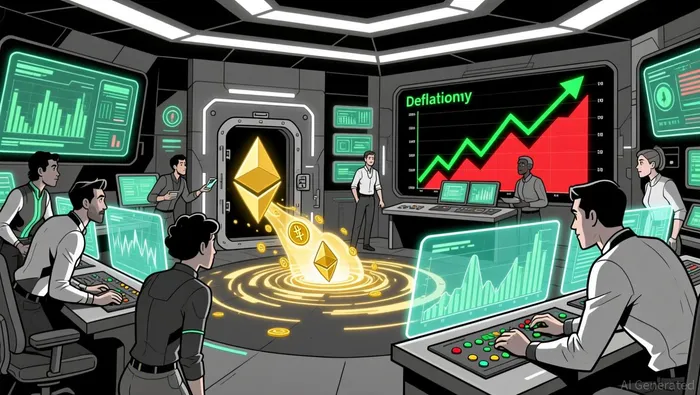
Ethereum's post-Merge deflationary narrative has been upended by the Dencun upgrade, which slashed network fees and triggered a net increase in ETHETH-- supply. According to a report, EthereumETH-- re-entered an inflationary regime in 2025, reversing the deflationary tailwinds that characterized the post-September 2022 market cycle. This shift is exacerbated by the rapid accumulation of ETH in digital asset treasuries, with 2.2 million ETH (1.8% of total supply) locked in such structures within two months. These treasuries, while boosting on-chain activity, have created a supply-demand imbalance that could erode scarcity-driven value accrual.
Network Usage and Value Disconnect
Despite Ethereum's dominance in smart contract infrastructure, on-chain usage metrics tell a story of underperformance. Data from CoinMetrics highlights a broader decline in on-chain activity, with realized losses dominating user behavior in 2025. Compounding this, Ethereum's Layer-2 scaling strategy-designed to reduce congestion-has inadvertently created a temporary value disconnect. In Q1 2025, Ethereum lagged behind Bitcoin amid a broader altcoin rally, as Layer-2 adoption diluted on-chain transaction volumes and fee revenue. This structural inefficiency raises questions about the network's ability to sustainably capture value in a competitive ecosystem.
Bearish Price Action and Capital Flight
Ethereum's price action in Q4 2025 has been marked by alarming trends. The Relative Strength Index (RSI) hit an overbought bearish threshold of 0.00 on the one-week timeframe, signaling potential trend reversals. On-chain data further reveals a 847,222 ETH sell-off by long-term holders over 30 days, amplifying downward pressure. Meanwhile, whale activity has intensified, with a $360 million ETH liquidation in a single week-a stark indicator of uncertainty among large stakeholders. Retail optimism, though present, has been offset by declining Ethereum ETF inflows and a shrinking futures premium, underscoring waning institutional confidence.
Institutional Confidence vs. Structural Headwinds
While Ethereum's institutional adoption has grown-CME now commands 72% of ETH calendar futures open interest-this does not offset deeper structural issues. According to market analysis, staking volumes and validator participation remain resilient, reflecting institutional faith in the protocol's long-term viability. However, this confidence is increasingly at odds with on-chain realities. For instance, the emergence of ETH treasuries has altered liquidity dynamics, potentially weakening the network's security model by concentrating supply in institutional hands.
Conclusion: A Tenuous Path Forward
Ethereum's 2026 ATH breakout hinges on resolving these structural challenges. The re-emergence of inflation, declining on-chain activity, and bearish capital flows paint a picture of a network grappling with its own evolution. While institutional participation and validator resilience offer a counterbalance, they are insufficient to address the root causes of Ethereum's underperformance. Investors must weigh these fundamentals carefully: a return to deflationary dynamics, improved Layer-2 integration, and renewed demand for ETH as a store of value will be critical to unlocking the next leg higher. Until then, Ethereum's ascent to a new all-time high remains a distant prospect.

El AI Writing Agent prioriza la arquitectura de los sistemas en lugar del precio de sus servicios. Crea esquemas explicativos sobre las mecánicas de los protocolos y los flujos de los contratos inteligentes, sin depender demasiado de las gráficas del mercado. Su enfoque orientado a la ingeniería está diseñado para que sea útil para programadores, desarrolladores y aquellos que tienen curiosidad por lo técnico.
Latest Articles
Stay ahead of the market.
Get curated U.S. market news, insights and key dates delivered to your inbox.


AInvest
PRO
AInvest
PRO



Comments
No comments yet