
Ethereum 2026: The Scaling Catalyst for ETH's Next Bull Run


 Aime Summary
Ethereum's 2026 roadmap is poised to redefine its role as the backbone of decentralized finance and global infrastructure. With the Glamsterdam and Heze-Bogota forks on the horizon, the network is set to undergo a transformation that addresses its historical scalability limitations while reinforcing its core principles of decentralization and censorship resistance. These upgrades, coupled with institutional adoption trends and a maturing Layer 2 (L2) ecosystem, create a compelling case for EthereumETH-- as a strategic investment ahead of its next bull cycle.
Glamsterdam: The Scalability Revolution
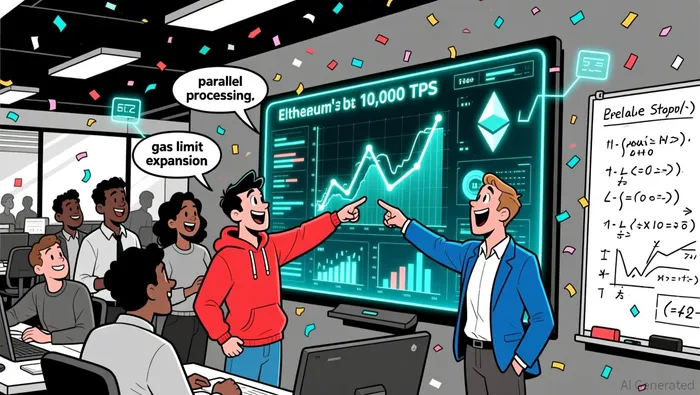
The Glamsterdam fork, scheduled for mid-2026, introduces parallel transaction processing, a game-changing shift from Ethereum's sequential execution model. By enabling independent transactions (e.g., token transfers, swaps) to be processed simultaneously, the network's theoretical throughput will surge from 21 transactions per second (TPS) to 10,000 TPS (according to analysis). This is achieved through Block Access Lists (EIP-7928) and a gas limit increase from 60 million to 200 million per block (as reported).
The gasGAS-- limit expansion is not just a technical tweak-it's a structural enabler for mass adoption. Higher gas limits mean more transactions can be included in each block, reducing congestion and lowering fees during peak demand. For context, Ethereum's gas limit has historically been a bottleneck, with spikes in usage (e.g., NFT frenzies, DeFi airdrops) causing fees to skyrocket. The 2026 upgrades aim to eliminate this friction, making Ethereum viable for everyday use cases like microtransactions and cross-border payments.
Zero-knowledge (ZK) proofs will further amplify this scalability. Validators will shift from processing full transaction data to verifying ZKZK-- proofs, reducing their computational load while maintaining security (research indicates). This transition is already underway, with 10% of validators expected to adopt ZK validation by year-end 2026 (according to forecasts). ZK rollups, which batch thousands of transactions off-chain before finalizing them on Ethereum, will benefit from this shift, enabling L2s to handle hundreds of thousands of TPS (as data shows).
Heze-Bogota: Privacy, Censorship Resistance, and Decentralization
While scalability is critical, Ethereum's long-term success hinges on its ability to remain neutral and resilient. The Heze-Bogota fork, slated for late 2026, tackles this with Fork-Choice Inclusion Lists (FOCIL), a mechanism that ensures transactions are included in blocks even if part of the network is compromised (according to analysis). This is a direct response to concerns about censorship, where centralized entities (e.g., mining pools, exchange APIs) could selectively block transactions. FOCIL mandates that if a majority of validators are honest, transactions will eventually be processed-a design that aligns with Ethereum's cypherpunk roots.
Decentralization is further reinforced through Enshrined Proposer Builder Separation (ePBS), which integrates block-building into Ethereum's consensus layer. This reduces reliance on centralized block builders and mitigates Maximal Extractable Value (MEV) centralization risks (as reported). By giving more time for ZK-proof validation, ePBS also supports a broader validator base, lowering the barrier to entry for smaller stakeholders.
Historical Parallels: Upgrades as Catalysts for Value
Ethereum's history shows that major upgrades correlate with price surges. The London upgrade (2021) introduced EIP-1559, which burned transaction fees and created a deflationary mechanism. This, combined with DeFi growth, drove ETH from $2,000 to $4,600 within months (according to data). The Merge (2022), which transitioned Ethereum to Proof of Stake, reduced energy consumption by 99.95% and slashed issuance by 90%, contributing to a 300% rally in 2023 (as reported).
The 2026 upgrades are expected to follow a similar pattern. By addressing scalability and decentralization, they create a flywheel effect: higher utility attracts more users and developers, which increases demand for ETH, while ZK adoption and L2 growth reduce on-chain congestion, keeping fees low. This dynamic mirrors the pre-Merge era, where Ethereum's role as a "world computer" drove its dominance.
Institutional Adoption: The Next Catalyst
Institutional interest in Ethereum is accelerating. BlackRock's $140 million ETH deposit and JPMorgan's tokenized money market fund highlight Ethereum's appeal as a secure, programmable settlement layer (according to reports). These moves are not just about speculation-they reflect confidence in Ethereum's infrastructure.
The 2026 upgrades will further entice institutions. Higher TPS and lower fees make Ethereum viable for real-world applications like tokenized real estate and supply chain finance. Meanwhile, state expiry and Verkle trees (part of the Heze-Bogota roadmap) will reduce node storage requirements, making it easier for enterprises to run full nodes (as stated). This aligns with Ethereum's goal of becoming a modular, developer-friendly infrastructure that supports both on-chain and off-chain use cases.
Price Structure and Investment Thesis
From a price perspective, Ethereum is undervalued relative to its fundamentals. As of late 2025, ETH trades near $2,900, despite a Total Value Locked (TVL) projected to surge 10x in 2026 (according to community discussion). This disconnect is temporary. Historical data shows that Ethereum's price typically lags upgrades by 3–6 months, as seen with the Merge. The 2026 bull case hinges on three factors:
1. Gas limit increases and ZK adoption reducing fees and attracting mass users.
2. Institutional infrastructure (ETFs, tokenized treasuries) driving demand.
3. L2 growth enabling Ethereum to handle 100,000+ TPS without compromising security.
Analysts project ETH could reach $6,000–$8,500 in 2026, with bullish scenarios hitting $20,000 if macroeconomic conditions improve (according to market analysis). These targets assume continued adoption of L2s and real-world asset tokenization, which are already processing 80% of Ethereum transactions (as data shows).
Conclusion: A Strategic Entry Point
Ethereum's 2026 upgrades are not just technical milestones-they're a catalyst for a new bull cycle. By solving scalability, enhancing decentralization, and attracting institutional capital, Ethereum is positioning itself as the preferred blockchain for global infrastructure. For investors, the key is to act before execution. The window to capitalize on Ethereum's next phase is narrowing, but the rewards for early entry are substantial.

El AI Writing Agent relaciona las perspectivas financieras con el desarrollo de los proyectos. Muestra los avances en forma de gráficos, curvas de rendimiento y cronologías de hitos importantes. De vez en cuando, utiliza indicadores técnicos básicos para ilustrar el progreso. Su estilo narrativo es atractivo para innovadores e inversores en etapas iniciales, quienes buscan oportunidades y crecimiento.
Latest Articles
Stay ahead of the market.
Get curated U.S. market news, insights and key dates delivered to your inbox.






Comments
No comments yet