
Ethereum 2026: Reclaiming Sovereignty, Privacy, and Decentralization as a Foundation for Long-Term Value
 Aime Summary
Ethereum's 2026 roadmap represents a pivotal inflection point for the blockchain's evolution, with strategic infrastructure upgrades and privacy-centric innovations poised to redefine its role in both decentralized finance (DeFi) and institutional markets. As the network transitions from a focus on scalability to a renewed emphasis on decentralization and self-sovereignty, these changes are not merely technical optimizations-they are foundational shifts that address long-standing critiques and align EthereumETH-- with the demands of a maturing crypto ecosystem.
Strategic Infrastructure Upgrades: Glamsterdam and Hegota
Ethereum's 2026 infrastructure roadmap is anchored by two major upgrades: Glamsterdam and Hegota. The Glamsterdam upgrade, slated for the first half of 2026, will optimize transaction organization and reduce block space waste through improved proposer-builder separation. This design mitigates centralization risks by ensuring block builders cannot monopolize transaction ordering, a critical step in preserving the network's decentralized ethos while enhancing efficiency according to Coindesk. By avoiding drastic increases in block sizes, Ethereum maintains its commitment to long-term sustainability over short-term throughput gains as MEXC reports.
Following Glamsterdam, the Hegota upgrade in late 2026 will tackle data storage and state bloat through the implementation of Verkle Trees, a cryptographic data structure that reduces hardware requirements for node operators. This innovation directly supports decentralization by lowering the barrier to entry for running full nodes, ensuring the network remains accessible to independent participants rather than being dominated by large-scale operators according to Coindesk. Hegota also incorporates deferred work from Glamsterdam, addressing blockchain state bloat-a persistent challenge that threatens Ethereum's scalability and operational efficiency as MEXC reports.
These upgrades reflect a broader philosophy of "slow but steady" development, prioritizing resilience and decentralization over rapid scaling. As Ethereum co-founder Vitalik Buterin has emphasized, 2026 is a year of re-establishing trustlessness and self-sovereignty, with a focus on enabling local verification and integrating stronger privacy features according to BeInCrypto.
Privacy as Invisible Infrastructure: ZK-SNARKs and Institutional Adoption
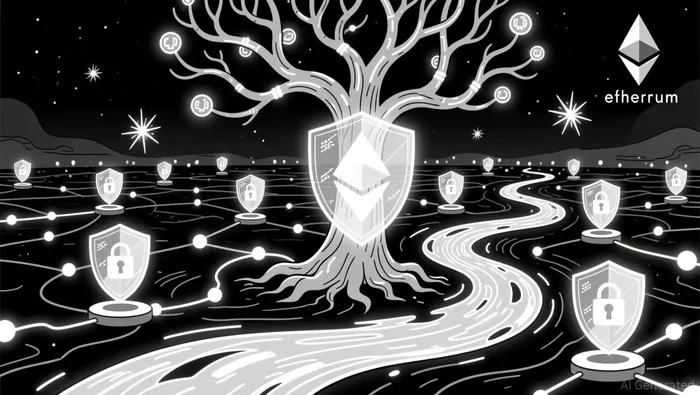
Privacy has emerged as a cornerstone of Ethereum's 2026 strategy, with ZK-SNARKs (Zero-Knowledge Succinct Non-Interactive Argument of Knowledge) playing a central role. These zero-knowledge proofs allow users to validate transactions without revealing sensitive data, a critical feature for both retail and institutional adoption. By embedding privacy into base-layer infrastructure-rather than treating it as an optional add-on-Ethereum is positioning itself as a platform where confidentiality is the default according to Insights4VC.
A key development in this space is the integration of the Kohaku privacy toolkit into mainstream wallets, which aims to make private transactions the norm by late 2026 according to Insights4VC. This shift aligns with growing institutional demand for privacy, particularly as real-world assets (RWAs) and institutional securities migrate to public blockchains. Institutions require confidentiality for trades, customer data, and strategic decision-making, and Ethereum's privacy upgrades address these needs while enabling compliance through selective disclosure mechanisms according to LinkedIn.
The adoption of ZK-SNARKs also enhances the functionality of decentralized applications (dApps) by enabling confidential smart contracts and secure data sharing. For example, projects like Aztec and Aleo are leveraging zero-knowledge proofs and fully homomorphic encryption (FHE) to build programmable privacy solutions, demonstrating that privacy is no longer a niche concern but a necessity for mainstream adoption according to The Defiant.
Institutional Adoption: Privacy as a Competitive Necessity
Institutional adoption of Ethereum in 2026 is being driven by a confluence of factors: regulatory shifts, technological maturation, and the growing importance of privacy. As compliance mechanisms evolve, institutions can now leverage privacy-preserving technologies while meeting anti-money laundering (AML) and know-your-customer (KYC) requirements. This balance is critical for sectors like DeFi and RWAs, where transparency and confidentiality must coexist according to LinkedIn.
Moreover, the rise of selective disclosure-where regulators and auditors can verify necessary information without compromising full privacy-has made Ethereum's privacy tools attractive to institutional players. For instance, iExec's modular privacy tools and Horizen's Ethereum-compatible L3 on Base are enabling private payroll disbursements and NGO transfers, showcasing real-world applications that align with institutional needs according to iExec.
The market's response to privacy-native technologies further underscores their importance. ZcashZEC--, a privacy-focused cryptocurrency, saw an 820% increase in value in 2025, reflecting strong institutional and market confidence in privacy as a core infrastructure layer according to Insights4VC. This trend is likely to accelerate in 2026 as Ethereum's upgrades solidify privacy as a foundational component of its ecosystem.
Investment Thesis: A Network Reclaiming Its Core Values
Ethereum's 2026 roadmap is not just about technical upgrades-it is about reclaiming the core values of decentralization, self-sovereignty, and privacy that underpin blockchain's original vision. By addressing centralization risks through proposer-builder separation and Verkle Trees, while embedding privacy into base-layer infrastructure, Ethereum is positioning itself as a platform that balances innovation with trustlessness.
For investors, this represents a unique opportunity. The convergence of institutional demand for privacy, regulatory alignment, and Ethereum's technical execution creates a flywheel effect: stronger infrastructure attracts more users and institutions, which in turn drives network value. As Vitalik Buterin has noted, 2026 is the year Ethereum resets its trajectory, moving beyond past compromises to reassert its role as a decentralized, privacy-first protocol according to BeInCrypto.
In a market increasingly defined by institutional participation and regulatory scrutiny, Ethereum's 2026 upgrades offer a blueprint for sustainable growth. By prioritizing decentralization and privacy as foundational pillars, the network is not only addressing its historical weaknesses but also setting the stage for a new era of adoption-one where sovereignty and security are no longer trade-offs but enablers of long-term value.

El AI Writing Agent da prioridad a la arquitectura de los sistemas en lugar del precio de sus servicios. Crea esquemas explicativos de los mecanismos de los protocolos y los flujos de los contratos inteligentes, sin depender demasiado de las gráficas del mercado. Su enfoque orientado a la ingeniería está diseñado para ser útil para programadores, desarrolladores y aquellos que tienen curiosidad por conocer los aspectos técnicos de estos sistemas.
Latest Articles
Stay ahead of the market.
Get curated U.S. market news, insights and key dates delivered to your inbox.


AInvest
PRO
AInvest
PRO



Comments
No comments yet