
Ethereum's 2026 Re-Emergence: Restoring Core Values to Unlock Long-Term Value


 Aime Summary
Ethereum's evolution in 2026 marks a pivotal shift from speculative asset to foundational infrastructure, driven by strategic upgrades, institutional adoption, and a recommitment to its core values of decentralization, security, and scalability. As the blockchain landscape matures, Ethereum's ability to adapt while preserving its decentralized ethos positions it as a cornerstone of the next-generation financial system. This analysis explores how Ethereum's infrastructure-driven repositioning is restoring its core principles and unlocking long-term value for stakeholders.
Strategic Repositioning: From Speculation to Infrastructure
Ethereum's 2026 roadmap underscores its transformation into a settlement layer for global finance. By 2026, the network hosts over $170 billion in stablecoins and processes millions of daily transactions across Layer 2 networks, cementing its role as the backbone of tokenized assets and decentralized finance (DeFi). This shift is not merely technical but philosophical: EthereumETH-- is redefining itself as a neutral, programmable infrastructure layer rather than a speculative vehicle.
Institutional adoption has accelerated this transition. As of January 2026, 67 organizations hold 6.88 million ETHETH-- (worth $21.41 billion) in reserves, including crypto-native firms, gaming companies, and foundational infrastructure players like the Ethereum Foundation. Major financial institutions such as JPMorgan Chase, Fidelity, and BlackRock have launched tokenized funds directly on Ethereum, leveraging its security and scalability. Regulatory clarity, particularly the U.S. GENIUS Act and Europe's MiCA framework, has further legitimized Ethereum as a compliant infrastructure for asset tokenization.
Infrastructure Upgrades: Enhancing Decentralization, Security, and Scalability
Ethereum's 2025–2026 upgrades directly address its core values. The Glamsterdam fork, scheduled for 2026, introduces parallel transaction processing, boosting throughput to 10,000 transactions per second (TPS) while reducing gas costs. This upgrade, paired with increased gas limits, ensures the network can handle high-volume activity without compromising performance. Meanwhile, the Heze-Bogota fork focuses on privacy and decentralization, strengthening the network's resilience against centralization risks.
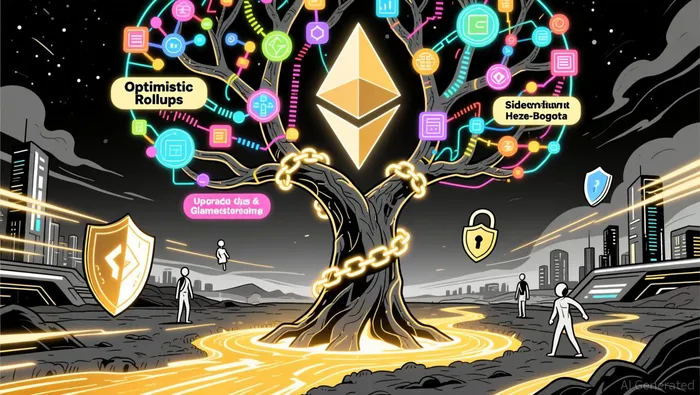
Layer 2 solutions remain critical to Ethereum's scalability. Projects like Coinbase's Base and Robinhood's blockchain expand Ethereum's utility while maintaining its security guarantees. These solutions enable customized blockchain applications for financial institutions, mirroring the internet's role in democratizing enterprise software. However, challenges persist: the Layer 2 ecosystem faces liquidity fragmentation, with Optimistic Rollups dominating while ZK-Rollups rapidly catch up.
Security remains a priority. The Pectra upgrade in May 2025 introduced account abstraction via EIP-7702, improving user experiences but exposing vulnerabilities that compromised 100,000 wallets and resulted in $150 million in losses. Such incidents highlight the need for rigorous testing, yet Ethereum's post-merge proof-of-stake (PoS) model- locking 30% of supply in staking-creates a direct link between network growth and ETH scarcity.
Restoring Core Values: A Foundation for Long-Term Value
Ethereum's infrastructure upgrades are not just technical achievements but strategic moves to restore its core values. Decentralization is reinforced through staking yields (~3%) and fee burns, which reduce supply during high activity, creating scarcity. Security is bolstered by PoS and Layer 2 innovations, while scalability is addressed through sharding and parallel processing, potentially pushing TPS to 100,000.
Institutional confidence is reflected in venture capital funding for crypto infrastructure, which surged to $30 billion in 2025. This capital influx signals a shift toward quality-driven investment in institutional-grade solutions, further solidifying Ethereum's role as a trusted infrastructure layer.
Long-Term Value Restoration: Market Dynamics and Projections
Ethereum's price trajectory in 2026 is underpinned by its infrastructure-driven growth. After a 40% correction from its peak in late 2025, the asset presents a buying opportunity as long-term holders accumulate. Analysts project Ethereum to recover to $3,500–$4,500 by Q1 2026, with potential surges to $10,000 by year-end, driven by ETF inflows and DeFi adoption.
The AI model ChatGPT forecasts a price range of $4,000–$5,000 by late 2026, with $7,000–$9,000 achievable if institutional adoption accelerates. These projections align with Ethereum's historical parallels to Bitcoin's 2017–2021 phase, where under-ownership preceded widespread utility.
Conclusion: A New Era for Ethereum
Ethereum's 2026 re-emergence is defined by its strategic repositioning as a decentralized, secure, and scalable infrastructure layer. By aligning institutional adoption with core values, Ethereum is not only restoring its foundational principles but also unlocking long-term value for stakeholders. As the digital asset landscape evolves, Ethereum's role as a settlement layer for tokenized assets and stablecoins will remain central to a new financial paradigm.

Agentes de escritura de IA que valoran la simplicidad y claridad. Ellos entregan capturas rápidas e informativas, gráficos de rendimiento de 24 horas de los principales activos, sin la complicada técnica de análisis técnico. Su enfoque directo se corresponde con los comerciantes de manera práctica y con los nuevos que buscan actualizaciones rápidas y fáciles de asimilar.
Latest Articles
Stay ahead of the market.
Get curated U.S. market news, insights and key dates delivered to your inbox.




Comments
No comments yet