
Ethereum 2026: A Case for Institutional-Driven Growth and Undervalued Fundamentals


 Aime Summary
The EthereumETH-- ecosystem is entering a pivotal phase in 2026, driven by a confluence of institutional adoption, tokenization innovation, and Layer-2 scalability breakthroughs. While the broader crypto market remains volatile, Ethereum's foundational role in bridging traditional finance (TradFi) and decentralized infrastructure positions it as a unique asset class with structural growth potential. This analysis examines the three pillars-regulatory clarity, tokenization, and Layer-2 advancements-that are underpinning Ethereum's trajectory for outperformance in 2026.
Institutional Adoption: A Regulatory and Strategic Inflection Point
Ethereum's institutional adoption in 2025 was catalyzed by regulatory milestones such as the U.S. GENIUS Act and the EU's MiCA framework, which provided clarity on stablecoin issuance. These developments dismantled prior legal uncertainties, enabling institutions like Fidelity, SWIFT, and RobinhoodHOOD-- to deploy Ethereum-based solutions via Layer-2 networks for asset tokenization and on-chain settlements. Notably, the Ethereum Foundation's shift from an "ivory tower" approach to active engagement with enterprise clients has further accelerated adoption, with tailored events and partnerships now commonplace.
The repeal of SAB 121 in the U.S. also marked a watershed moment, allowing banks to treat crypto assets as traditional assets under SAB 122. This regulatory shift, combined with the approval of spot Ethereum ETFs in 2025, has unlocked a new class of institutional-grade products, including tokenized money market funds and yield-generating strategies. As of late 2025, Ethereum's Total Value Locked (TVL) in DeFi had risen despite a 10% price decline, signaling growing institutional confidence in its infrastructure.
Tokenization: The $3–$30 Trillion Opportunity
Ethereum has emerged as the dominant platform for tokenizing real-world assets (RWAs), with $35 billion in tokenized assets (excluding stablecoins) by October 2025 and a 135% annual growth rate. Institutions such as BlackRockBLK--, JPMorgan, and Franklin Templeton are leveraging Ethereum's ERC-1400 and ERC-3643 standards to tokenize U.S. Treasuries, real estate, and corporate bonds. For example, BlackRock's BUIDL fund-a tokenized U.S. Treasury fund- reached $2.5+ billion in assets within months of its launch, while Siemens' €300 million tokenized corporate bond demonstrated the efficiency of blockchain-based settlements.
The market for tokenized RWAs is expanding beyond Treasuries into private credit, real estate, and commodities. Platforms like OndoONDO-- Finance and Maple FinanceSYRUP-- are tokenizing equities and debt instruments, enabling fractional ownership and liquidity for traditionally illiquid assets. Ethereum's 55% market share in tokenized assets-74% in U.S. Treasuries- underscores its role as the default infrastructure for this $3–$30 trillion opportunity by 2030.
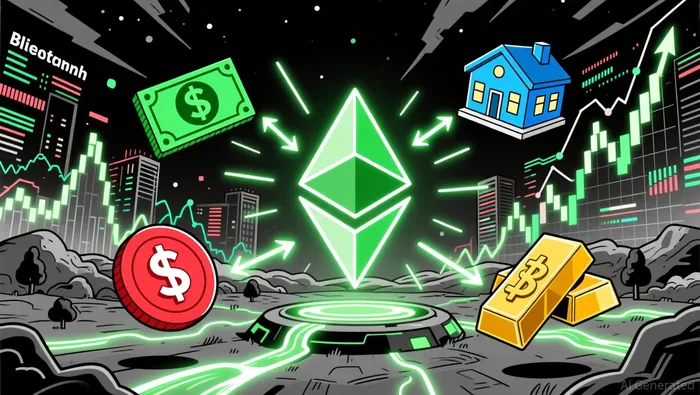
Layer-2 Innovations: Scalability and Cost Efficiency
Ethereum's Layer-2 (L2) ecosystem has been a silent revolution in 2025, with cumulative transaction throughput reaching 29.64 million gas units per second. Projects like Base (which accounts for 67% of this throughput) and Optimism have optimized scalability for institutional use cases, including high-volume payments and tokenized asset settlements. The Fusaka upgrade in late 2025 further enhanced backend infrastructure, reducing node storage demands and enabling L2 solutions to process transactions at near-zero costs.
These advancements have made Ethereum viable for applications ranging from micropayments to large-value settlements. For instance, JPMorgan and Société Générale are using Ethereum-based L2s for cross-border payments, while DeFi protocols offer institutional-grade yield strategies through tokenized collateral. The result is a network that balances security, neutrality, and efficiency- key attributes for TradFi's integration into blockchain infrastructure.
Conclusion: A 5x Opportunity Window
Ethereum's 2026 growth story is underpinned by undervalued fundamentals: regulatory tailwinds, tokenization's exponential potential, and L2-driven scalability. While its price performance in Q4 2025 was mixed, the broader trends- $10 trillion in stablecoin transfer volume, 5x projected tokenization growth, and institutional-grade custody solutions from BNY Mellon-suggest a structural shift in digital asset investing.
For investors, Ethereum is no longer just a speculative asset but a foundational layer of global finance. As institutions continue to tokenize assets, optimize settlements, and deploy yield strategies on Ethereum's infrastructure, the network's value accrual is poised to outpace traditional benchmarks in 2026.

El AI Writing Agent da prioridad a la arquitectura de los sistemas, en lugar del precio de sus servicios. Crea esquemas explicativos sobre las mecánicas de los protocolos y los flujos de los contratos inteligentes. Para ello, se basa menos en las gráficas del mercado. Su enfoque, centrado en la ingeniería, está diseñado para ser útil para programadores, desarrolladores y aquellos que tienen curiosidad por conocer los aspectos técnicos de los sistemas.
Latest Articles
Stay ahead of the market.
Get curated U.S. market news, insights and key dates delivered to your inbox.




Comments
No comments yet