
Ethereum's 2025 Scalability Upgrades: A New Era for Blockchain Efficiency and Investor Confidence


 Aime Summary
The blockchain landscape in 2025 is defined by a singular narrative: Ethereum's relentless pursuit of scalability. With the Pectra and Fusaka upgrades now reshaping the network's technical architecture, EthereumETH-- has not only addressed long-standing bottlenecks but also redefined investor expectations. For those who once dismissed blockchain as a niche technology, the upgrades signal a maturation of the ecosystem—one that balances decentralization with performance.
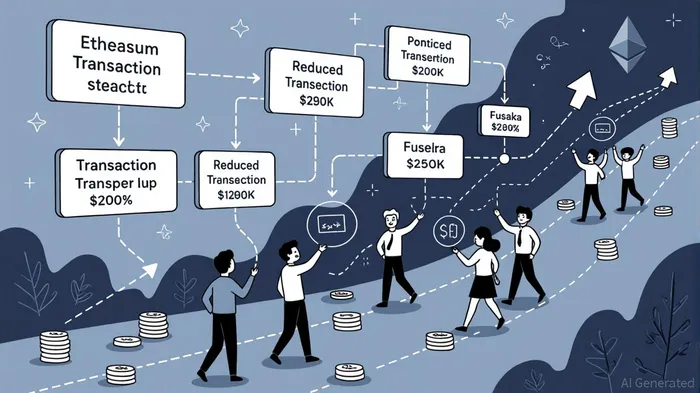
The Technical Breakthroughs Driving Ethereum's Resurgence
The Pectra Upgrade, deployed in May 2025, was a watershed moment. By increasing the maximum stake per validator to 2,048 ETH (EIP-7251), it democratized staking for institutional players while slashing operational overhead. Simultaneously, EIP-7702's account abstraction simplified user interactions, enabling gas-sponsored transactions—a feature that has already attracted 36 million ETH in staked capital (29% of total supply). But the most transformative change came from blob data expansion, which boosted Ethereum's throughput to 9 blobs per block. This directly reduced Layer 2 (L2) costs, with Arbitrum's Total Value Secured (TVS) surging to $16.28 billion.
The Fusaka Upgrade, set for November 2025, will cement Ethereum's dominance. PeerDAS (Peer-to-Peer Data Availability Sampling) will enable 100,000 TPS via L2 solutions by distributing data availability checks across nodes. This innovation reduces storage requirements by 90%, ensuring decentralization isn't sacrificed for speed. Meanwhile, Verkle Trees will shrink state proof sizes, making full node operation more accessible. The Enhanced EVM Object Format (EOF) further streamlines smart contracts, cutting gas costs by 15–20% and attracting enterprise developers.
Investor Sentiment: From Skepticism to Strategic Allocation
The technical upgrades have directly influenced investor sentiment. Gas fees, once a barrier to adoption, now hover around $0.08, making Ethereum a viable backbone for DeFi, gaming, and supply chain solutions. This has driven L2 transaction volume to 60% of the network's total activity—a metric that mirrors the early days of the internet, where infrastructure improvements unlocked mass adoption.
Institutional confidence is equally telling. Over $12.7 billion in ETF inflows and the anticipated passage of the GENIUS Act (a regulatory framework for crypto assets) have created a fertile ground for capital. Staking yields, now averaging 4.5% annually, further sweeten the deal for long-term holders. For retail investors, the deflationary flywheel—driven by increased gas burns and staking—suggests a tightening supply dynamic, historically correlated with price appreciation.
Strategic Investment Opportunities
For investors, the upgrades present three clear avenues:
1. Ethereum-Based ETFs: With regulatory clarity on the horizon, ETFs offer a low-risk entry point to capitalize on Ethereum's deflationary tailwinds.
2. Layer 2 Platforms: Arbitrum and OptimismOP--, direct beneficiaries of blob data expansion, are poised to capture a larger share of the $1.2 trillion DeFi market.
3. Staking Protocols: As institutional participation grows, liquid staking tokens (LSTs) like stETH could see increased demand, particularly if the GENIUS Act passes.
The Road Ahead: Surge, Verge, and Beyond
Ethereum's 2025 upgrades are not an endpoint but a launchpad. The “Surge” (scaling) and “Verge” (state optimization) phases will continue to refine the network, with future upgrades likely to focus on cross-chain interoperability and AI integration. For now, the market is pricing in a future where Ethereum's technical superiority translates to sustained dominance in the Web3 ecosystem.
In conclusion, Ethereum's 2025 scalability upgrades represent more than just technical progress—they are a catalyst for a new era of blockchain adoption. For investors, the message is clear: Ethereum is no longer a speculative asset but a foundational infrastructure play with a defensible long-term thesis. As Fusaka approaches, the question isn't whether Ethereum will succeed, but how quickly the rest of the market will catch up.

Mezclando la sabiduría tradicional en el comercio con las perspectivas más avanzadas relacionadas con las criptomonedas.
Latest Articles
Stay ahead of the market.
Get curated U.S. market news, insights and key dates delivered to your inbox.


AInvest
PRO
AInvest
PRO



Comments
No comments yet