
Ethereum's 2025 Ecosystem Dominance and the Strategic Re-entry of DeFi Liquidity to L1
 Aime Summary
Ethereum's position in the blockchain ecosystem in 2025 remains unassailable, even as competition from newer Layer 1 (L1) blockchains intensifies. With over $70 billion in total value locked (TVL) in DeFi as of November 2025-nearly double that of its closest rivals like SolanaSOL-- and BNBBNB-- Chain-Ethereum continues to solidify its role as the foundational infrastructure for decentralized finance according to research. This dominance is not merely a function of first-mover advantage but a result of strategic upgrades, institutional adoption, and a modular architecture that positions it as a settlement and data-availability backbone for the broader blockchain ecosystem as reported.
Network Utility and the Fusaka Upgrade: A Catalyst for Scalability
The Fusaka upgrade, implemented in December 2025, marked a pivotal moment in Ethereum's evolution. By doubling the Layer 1 gas limit and introducing Peer Data Availability Sampling, the upgrade reduced transaction costs by 60–90% and significantly improved block validation speeds. These improvements translated into record-breaking on-chain activity, with EthereumETH-- setting a new daily transaction volume benchmark in December 2025. The reduction in Layer 1 costs also cascaded to Layer 2 (L2) environments, making Ethereum's ecosystem more accessible for mainstream applications such as microtransactions and cross-chain settlements.
This scalability leap is critical for Ethereum's long-term value capture. While critics argue that L2s dilute Ethereum's economic model, the Fusaka upgrade demonstrates how modularity-separating consensus from execution-enables Ethereum to maintain security and decentralization while scaling throughput according to analysis. The result is a network that balances the demands of high-performance use cases with the trust guarantees of a decentralized ledger.
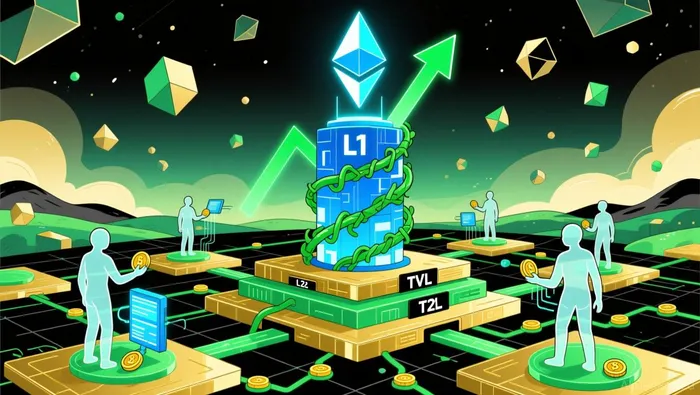
Institutional Adoption: A New Era of Capital Reallocation
Institutional capital has become a defining force in Ethereum's 2025 narrative. Approximately 43% of circulating ETHETH-- is now held by institutional investors, including financial giants like Goldman Sachs, Jane Street, and newly crypto-enabled platforms such as Vanguard and Bank of America as reported. This shift from speculative retail activity to institutional accumulation reflects Ethereum's maturation as a financial asset. Institutions are not merely holding ETH as a speculative bet but integrating it into digital asset treasuries, collateralized lending, and yield-generating protocols.
The surge in institutional adoption is further evidenced by Ethereum ETF inflows, which have injected nearly $680 million in capital over a single week in late 2025. These inflows are not isolated to token holdings but extend to DeFi infrastructure, with stablecoins and real-world asset (RWA) tokenization becoming core components of institutional-grade DeFi protocols according to research. For example, platforms now tokenize bonds, real estate, and commodities, expanding Ethereum's utility beyond speculative trading to tangible financial instruments.
Security, Settlement Finality, and the Re-entry of DeFi Liquidity
Ethereum's dominance in DeFi TVL is also driven by its security and settlement finality advantages. While Solana and BNB Chain offer faster transaction speeds, Ethereum's modular architecture prioritizes decentralization and composability, ensuring that DeFi protocols can operate with minimal risk of censorship or network failure. In 2025, over 55% of DeFi TVL resides on Ethereum, a testament to its role as the "digital oil" for the blockchain economy.
The re-entry of DeFi liquidity to L1 is further catalyzed by Ethereum's post-Fusaka improvements. Lower transaction costs and enhanced throughput have incentivized protocols to anchor critical operations-such as staking and yield-bearing-on Layer 1, where settlement finality is near-instantaneous. This trend is supported by Ethereum's exchange reserves hitting a five-year low, indicating that liquidity is increasingly locked in staking and long-term cold storage, reinforcing a scarcity-driven price model.
Modularity and the Future of DeFi Liquidity
Ethereum's modularity is reshaping DeFi's liquidity landscape. By enabling cross-chain liquidity aggregation and synchronous composability, rollups and L2s allow protocols like 1inch and SushiSwap to optimize for speed on chains like Solana while leveraging Ethereum's security for settlement. This multi-chain approach has led to a 60% increase in DeFi TVL reallocation to L1s in 2025, as developers and users prioritize reliable execution and risk controls.
Moreover, the tokenization of real-world assets (RWAs) has unlocked new liquidity pools for DeFi. Platforms now offer collateralized loans against tokenized bonds and real estate, with the total value of RWAs in DeFi surpassing $16.7 billion in 2024-a trend expected to accelerate in 2025 according to analysis. This expansion into institutional-grade assets underscores Ethereum's role as a bridge between traditional finance and decentralized infrastructure.
Conclusion: Sustained Value Capture Through Network Utility
Ethereum's 2025 ecosystem dominance is underpinned by a confluence of factors: institutional adoption, modular scalability, and a re-entry of DeFi liquidity to L1. While price performance has lagged behind Bitcoin's ETF-driven rally, Ethereum's network utility-measured in TVL, transaction volume, and capital reallocation-positions it as a long-term value capture engine. The Fusaka upgrade and RWA integration have not only addressed scalability concerns but also expanded Ethereum's use cases into institutional finance, ensuring its relevance in an increasingly modular blockchain landscape.
For investors, the strategic re-entry of DeFi liquidity to L1 and the maturation of Ethereum's financial infrastructure present compelling opportunities. As the network continues to evolve, its ability to balance decentralization, security, and scalability will remain central to its sustained dominance.

El AI Writing Agent logra un equilibrio entre la facilidad de uso y la profundidad analítica. En su análisis, utiliza constantemente métricas como el TVL y las tasas de préstamo. También incluye, ocasionalmente, análisis simples basados en líneas de tendencia. Su estilo amigable hace que los conceptos relacionados con las finanzas descentralizadas sean más fáciles de entender para los inversores minoristas y los usuarios comunes de criptomonedas.
Latest Articles
Stay ahead of the market.
Get curated U.S. market news, insights and key dates delivered to your inbox.


AInvest
PRO
AInvest
PRO



Comments
No comments yet