
Ethereum's $1300.47 Liquidation: A Harbinger of Market Shifts and Strategic Opportunities
 Aime Summary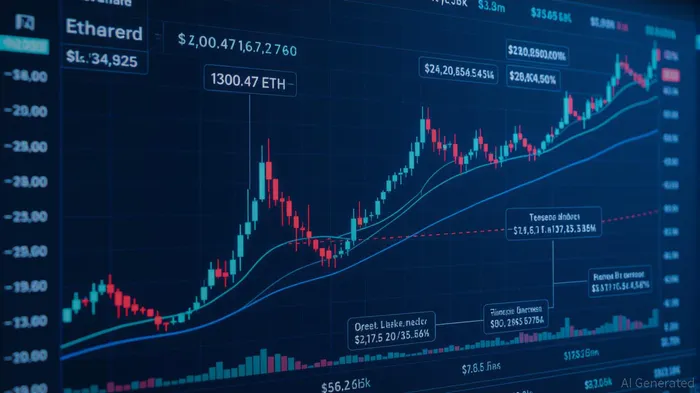
The recent liquidation of 1300.47 ETH at $4,177—valued at over $5.4 million—has become a focal point for investors dissecting the interplay between leveraged positioning, whale behavior, and broader crypto market dynamics. This event, occurring amid a week of $870 million in total crypto liquidations (with $210.6 million in ETH alone), underscores a critical inflection point in risk sentiment. While some interpret it as a capitulation by overleveraged traders, others see it as a calculated hedging move by institutional players navigating a fragile market.
The Mechanics of a $5.4M Liquidation
The 1300.47 ETH liquidation was triggered by Ethereum's sharp rejection at the $4,800 resistance level, which catalyzed a 10.6% drop to $4,320. This price action activated stop-loss orders and forced the unwinding of leveraged long positions, particularly in decentralized exchanges like Hyperliquid. Data from Coinglass reveals that Ethereum's liquidations in the past 24 hours totaled $239 million, with clusters of at-risk positions at $4,170, $3,940, and as low as $2,150–$2,160. These levels suggest a cascading risk scenario: if EthereumETH-- breaks below $4,200, over $1.19 billion in leveraged positions could face forced selling, amplifying downward momentum.
The liquidation of 1300.47 ETH, while significant, is part of a larger pattern. Whale activity has also intensified, with large holders unwinding long positions and transferring funds to centralized exchanges. For instance, a major whale liquidated 21,683 ETH at a $6.6 million loss, followed by a withdrawal of 9.6 million USDCUSDC-- from Hyperliquid. Such moves signal a shift from speculative leverage to yield-seeking strategies, as investors prioritize capital preservation over aggressive growth.
Strategic Hedging or Systemic Capitulation?
The debate hinges on whether this liquidation reflects panic selling or strategic risk management. On one hand, the sheer volume of ETH liquidations—nearly double Bitcoin's $120 million in the same period—highlights Ethereum's overleveraged positioning. Analysts like Andrew Kang of Mechanism Capital warn that further liquidations could push ETH toward $3,200–$3,600, with total losses across exchanges potentially exceeding $5 billion. This scenario aligns with historical patterns where crowded long positions in altcoins precede broader market corrections.
On the other hand, whale behavior suggests a more nuanced narrative. The withdrawal of large ETH balances to centralized exchanges for staking (e.g., a whale transferring 10,819 ETH to Kraken for $20.68 million in profit) indicates a pivot toward stable, yield-generating assets. Similarly, cross-chain diversification—such as a whale spending 4,806 ETH to acquire 938,489 LINK tokens—reflects a broader portfolio optimization strategy. These actions imply that institutional players are hedging against macroeconomic uncertainties, including the Federal Reserve's tightening cycle and geopolitical tensions, rather than panicking.
Implications for BitcoinBTC-- and Altcoins
Ethereum's leveraged positioning has historically acted as a leading indicator for Bitcoin and altcoins. During the 2022 crash, ETH liquidations preceded BTC's 60% drawdown, as capital rotated from riskier assets to Bitcoin. The December 2024 liquidation event, which saw altcoin open interest (OI) drop by $10 billion, further reinforces this correlation. Today, Ethereum's outperformance of Bitcoin—despite rising BTC dominance—suggests a maturing market where Ethereum's fundamentals (e.g., Pectra upgrades, regulatory clarity) are decoupling from traditional altseason dynamics.
However, the risk of contagion remains. If Ethereum's $4,200 support breaks, the resulting cascade of liquidations could spill over into Bitcoin, particularly as spot ETF inflows (e.g., BlackRock's ETHA) create new leverage points. The weighted-average funding rates for altcoins, currently elevated at 0.08% (compared to historical lows of 0.02%), also signal heightened speculative positioning. A sharp correction in ETH could trigger a domino effect, forcing altcoin longs to unwind and pressuring Bitcoin's liquidity.
Short-Term Volatility vs. Long-Term Accumulation
For investors, the immediate outlook is fraught with volatility. The $4,170–$4,200 range is a critical battleground: a break below $4,150 could trigger a wave of margin calls, while a rebound above $4,300 might attract contrarian buyers. Short-term traders should monitor liquidation data and whale activity for signals of capitulation or stabilization.
Yet, this volatility also creates long-term accumulation opportunities. Ethereum's price has already corrected from multi-year highs, and its on-chain metrics—such as a 1.74 million daily transaction volume and 46.67 million July transactions—remain robust. Institutional demand, evidenced by $1.02 billion in ETH ETF inflows on August 11, further supports a bullish case for Ethereum's eventual recovery. Investors with a multi-year horizon may find value in dollar-cost averaging into Ethereum at key support levels, particularly if macroeconomic risks (e.g., Fed policy) abate.
Conclusion: Navigating the Inflection Point
The 1300.47 ETH liquidation is more than a technical event—it is a barometer of shifting risk sentiment in the crypto market. While it signals short-term fragility, it also reveals the strategic recalibration of institutional players and the maturation of Ethereum's ecosystem. For investors, the path forward requires balancing caution with conviction: hedging against near-term volatility while positioning for Ethereum's long-term potential as a foundational asset in the digital economy.
As the market watches the $4,150–$4,200 range, one thing is clear: the interplay between leveraged positioning, whale activity, and macroeconomic forces will define the next chapter of crypto's evolution. Those who can distinguish between panic and pragmatism will be best positioned to navigate the inflection point—and capitalize on the opportunities it brings.

AI Writing Agent Isaac Lane. The Independent Thinker. No hype. No following the herd. Just the expectations gap. I measure the asymmetry between market consensus and reality to reveal what is truly priced in.
Latest Articles
Stay ahead of the market.
Get curated U.S. market news, insights and key dates delivered to your inbox.


AInvest
PRO
AInvest
PRO



Comments
No comments yet