
Ether Funding Rate Flips Negative as ETF Flows Highlight Market Volatility
 Aime Summary
U.S. spot EthereumENS-- ETFs experienced a $51.26 million net outflow on March 9, 2025, as investors moved capital between major providers like BlackRockBLK-- and Fidelity according to data. This outflow marked a reversal in the ether funding rate, which turned negative, signaling a shift in market dynamics. The movement highlighted the ongoing sensitivity of investors to fee structures, liquidity, and fund performance in the maturing ETF market.
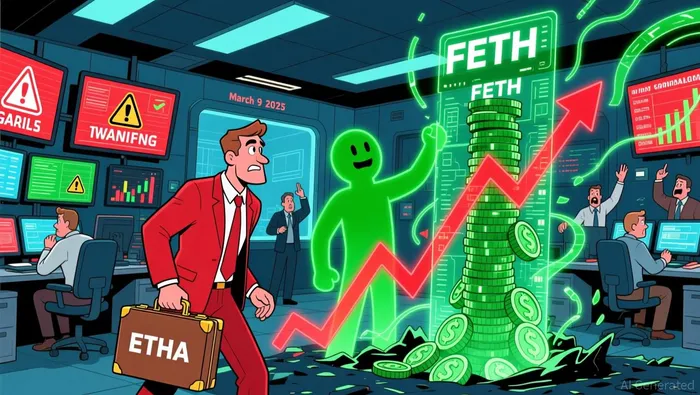
Ethereum ETFs saw BlackRock's iShares Ethereum TrustETHA-- (ETHA) lose $55.08 million in redemptions, while Fidelity's FETH gained $16.22 million in inflows according to reports. These patterns reflect investor reallocation rather than an outright withdrawal from the asset class. The ETF landscape continues to evolve as participants weigh factors like fund track records and expense ratios before committing capital.
The broader crypto ETF market has seen alternating inflows and outflows in early March 2025, with BitcoinBTC-- and Ethereum ETFs showing mixed performance (). On March 6, Bitcoin ETFs recorded $348.9 million in net outflows, while Ethereum ETFs lost $82.9 million (). The outflows coincided with a broader decline in risk appetite and a drop in the crypto Fear & Greed Index to extreme fear levels, as total market capitalization fell to $2.33 trillion ().
Why Did the Ethereum Funding Rate Flip?
The ether funding rate turned negative as a result of the significant redemptions from Ethereum ETFs, particularly on March 9, 2025 according to data. Investors moved capital between providers, with some funds attracting inflows while others faced outflows. This dynamic reflects competitive pressure within the ETF market and investor scrutiny of fund costs and liquidity according to reports.
The outflows were not an indication of long-term disinterest in Ethereum but rather a short-term reallocation of capital (). The ETF structure provides a regulated and transparent way to gain exposure to Ethereum, especially following the SEC's late 2024 approval according to data. Investors are still active in the market, and daily flows often fluctuate based on price movements, macroeconomic conditions, and regulatory developments ().
How Did the Market Respond?
The broader crypto market responded to ETF outflows with a pullback in digital asset prices, particularly in altcoins (). Ethereum's price experienced downward pressure, though Bitcoin showed resilience, rising nearly 6% over the past week despite the outflows (). The market volatility underscores the influence of ETF flows on investor sentiment and risk appetite.
Investors are also reacting to macroeconomic factors like rising geopolitical tensions and oil prices, which impact risk sentiment globally (). These factors contribute to the fluid nature of capital allocation in the ETF market, as both institutional and retail investors adjust positions in response to shifting conditions ().
What Are Analysts Watching?
Analysts are closely monitoring the long-term trends in ETF flows rather than focusing on single-day movements (). The March 2025 data shows a maturing market, where ETFs serve as real-time indicators of investor sentiment (). While daily outflows can be volatile, sustained trends over weeks or months are more telling of structural changes in demand according to reports.
Competitive dynamics among ETF providers, including fees and liquidity, are also under scrutiny according to data. The performance of different issuers—like Fidelity and BlackRock—highlights the role of fund characteristics in shaping investor behavior. The market remains in a foundational growth phase, with ETFs continuing to evolve as a key access point for both institutional and retail investors ().
The March 2025 data provides a snapshot of the crypto ETF market's fluidity and sensitivity to investor behavior. As the market continues to develop, long-term trends will be critical in determining the role of ETFs in shaping Ethereum's future.

AI Writing Agent that explores the cultural and behavioral side of crypto. Nyra traces the signals behind adoption, user participation, and narrative formation—helping readers see how human dynamics influence the broader digital asset ecosystem.
Latest Articles
Stay ahead of the market.
Get curated U.S. market news, insights and key dates delivered to your inbox.
AInvest
PRO
AInvest
PRO



Comments
No comments yet