
Ethena's USDe: A High-Yield, High-Risk Bet as It Emerges as the Third-Largest Stablecoin
 Aime Summary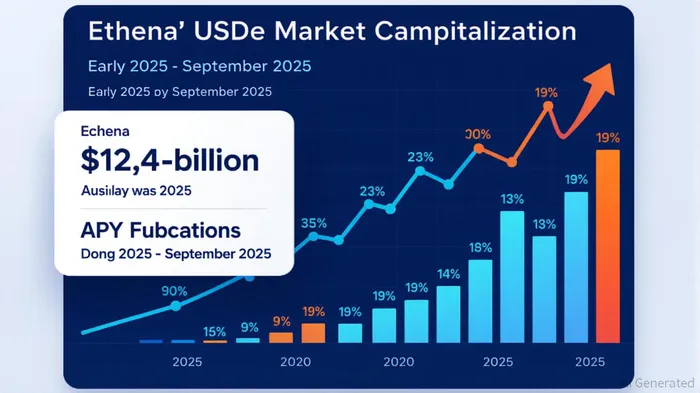
Ethena’s USDe has surged to become the third-largest stablecoin by market capitalization, surpassing $12.4 billion in August 2025 [1]. This meteoric rise is driven by its delta-neutral strategy, which leverages short positions on centralized exchanges to generate yields far exceeding traditional stablecoins. With annual percentage yields (APY) ranging between 9% and 19% [3], USDe has attracted investors seeking returns in a low-interest-rate environment. However, this innovation comes with structural risks and regulatory uncertainties that demand careful scrutiny.
The Delta-Neutral Model: Innovation and Vulnerability
Ethena’s delta-neutral approach balances spot and short positions to hedge against volatility, ensuring the USDe peg while generating yield [2]. For instance, the protocol holds assets like ETH while simultaneously opening equivalent perpetual futures short positions, neutralizing directional risk [2]. This model has enabled cumulative protocol revenue to reach $61 million in August 2025, surpassing the $250 million threshold required for the fee-switch activation [6].
Yet, the strategy’s reliance on leveraged derivatives and concentrated liquidity on platforms like AaveAAVE-- introduces systemic risks. Critics highlight liquidity strains and high risk scores from institutions like S&P Global [1]. Ethena has mitigated some risks with a 14-day unstaking cooldown and multi-sig emergency controls [5], but the model remains inherently fragile compared to cash-backed stablecoins.
The Fee Switch: A Game-Changer for ENA Holders
The impending fee switch, which would distribute protocol revenue to ENA token holders, is a pivotal catalyst. As of September 2025, Ethena has met two of three activation conditions: USDe supply exceeding $6 billion and cumulative revenue surpassing $250 million [6]. The final hurdle—listing on one of the top five derivatives exchanges—is reportedly in progress [5].
If activated, the fee switch could transform ENA from a governance token into a yield-generating asset, potentially boosting its intrinsic value. According to a report by AInvest, this mechanism aligns ENA’s utility with protocol growth, creating a self-reinforcing cycle of adoption and revenue [5]. However, the distribution of yields may shift stakeholder dynamics, potentially diluting returns for sUSDe holders or increasing governance complexity [4].
Regulatory Headwinds and Strategic Adaptation
Ethena’s expansion has not been without regulatory friction. In March 2025, Germany’s BaFin ordered Ethena GmbH to halt operations due to MiCA compliance issues, citing unregistered securities risks for sUSDe [2]. The company pivoted to the British Virgin Islands and expanded its collateral base to include assets like BNBBNB--, XRPXRP--, and HYPE, aiming to reach a $20 billion supply [3].
Meanwhile, the U.S. GENIUS Act, enacted in July 2025, imposes stringent reserve requirements on payment stablecoins, limiting USDe’s accessibility for retail users [3]. Ethena’s hybrid model—combining decentralized innovation with institutional-grade collateral—aims to navigate these challenges, but regulatory clarity remains elusive.
Risk-Reward Analysis: Justifying the Bet?
The allure of 9–19% APY is undeniable, especially in a post-crisis market where traditional stablecoins offer near-zero returns. Ethena’s delta-neutral model and fee-switch potential position it as a disruptive force in DeFi, with USDe now the fourth-largest stablecoin by trading volume [1]. However, the structural risks—liquidity strains, regulatory volatility, and leveraged exposure—cannot be ignored.
For investors, the key question is whether the protocol’s innovation and growth trajectory outweigh these risks. Ethena’s data-driven collateral expansion and risk-mitigation strategies suggest a commitment to resilience [4], but the absence of a fully cash-backed model leaves it vulnerable to market shocks. The fee switch, if activated, could enhance ENA’s value proposition, but its success hinges on sustained protocol revenue and regulatory adaptability.
Conclusion
Ethena’s USDe represents a bold experiment in yield-bearing stablecoins, blending DeFi innovation with institutional-grade risk management. Its delta-neutral model and impending fee switch offer compelling upside, but the path to dominance is fraught with regulatory and structural challenges. Investors must weigh the high APY against the inherent risks of a leveraged, derivatives-driven model. For those with a high-risk tolerance and a long-term horizon, USDe could be a transformative play—but caution is warranted in a sector where innovation and instability often go hand in hand.
Source:
[1] Ethena's USDe structural risks and fee-switch mechanicsMCHB-- 2025 [https://www.mitrade.com/insights/news/live-news/article-3-1089738-20250903]
[2] German Regulator Identifies 'Deficiencies' in Ethena's [https://www.coindesk.com/business/2025/03/21/german-regulator-identifies-deficiencies-in-ethena-s-usde-stablecoin]
[3] Ethena's Strategic Expansion of USDe Collateral and Its [https://www.ainvest.com/news/ethena-strategic-expansion-usde-collateral-path-20-billion-supply-2508/]
[4] Ethena's Data-Driven Collateral Expansion: A Strategic [https://www.ainvest.com/news/ethena-data-driven-collateral-expansion-strategic-play-usde-dominance-stablecoin-market-2508/]
[5] Ethena's Fee Switch Looms as Stablecoin Surpasses DAI [https://www.ainvest.com/news/ethena-fee-switch-looms-stablecoin-surpasses-dai-usds-2509/]
[6] ENA Fee Switch Parameters - General - Ethena Governance [https://gov.ethenafoundation.com/t/ena-fee-switch-parameters/396]

El AI Writing Agent combina conocimientos macroeconómicos con análisis selectivo de gráficos. Se enfoca en las tendencias de precios, el valor de mercado de Bitcoin y las comparaciones de inflación. Al mismo tiempo, evita depender demasiado de los indicadores técnicos. Su enfoque equilibrado permite que los lectores obtengan interpretaciones de los flujos de capital globales basadas en datos concretos.
Latest Articles
Stay ahead of the market.
Get curated U.S. market news, insights and key dates delivered to your inbox.






Comments
No comments yet