
ETH Gains Momentum in Institutionalization and RWA Adoption
 Aime Summary
Ethereum hosts $14.6 billion in tokenized real-world assets, a 16% increase in the last 30 days. The chain is preparing for major upgrades like Glamsterdam and Hegota to improve speed and efficiency according to reports. Institutional confidence is being driven by Ethereum's dominance in DeFi, TVL, and stablecoin activity as data shows.
Ethereum has become a central hub for tokenized real-world assets (RWAs) with a growing share of financial innovation and liquidity. The EthereumETH-- network is now home to $14.6 billion in tokenized assets, showing a 16% growth in the last 30 days. This trend is supported by Ethereum's role in facilitating a broader range of asset classes, from real estate to debt instruments, making it a critical infrastructure for institutional finance. These developments are reinforcing Ethereum's position as a leading blockchain for institutional-grade applications.
Upgrades in 2026 are expected to further enhance Ethereum's utility and performance. The upcoming Glamsterdam and Hegota upgrades will focus on improving scalability, reducing transaction costs, and increasing network efficiency. These changes are crucial for Ethereum to maintain its competitive edge in the evolving blockchain landscape. By optimizing gas costs and throughput, Ethereum aims to attract more developers and users to its ecosystem, especially in the decentralized finance (DeFi) and stablecoin sectors.
Institutional participation is also growing. Bitmine Immersion Technologies, for example, has staked 3,040,483 ETHETH-- ($6 billion in value), representing 3.71% of the token supply. The company is pursuing a strategy to acquire 5% of the ETH supply, highlighting institutional confidence in Ethereum's long-term value. This kind of investment reinforces Ethereum's role as a foundational asset in the crypto ecosystem and signals broader adoption by major players in the market.
Is Ethereum's Institutional Momentum Sustainable?
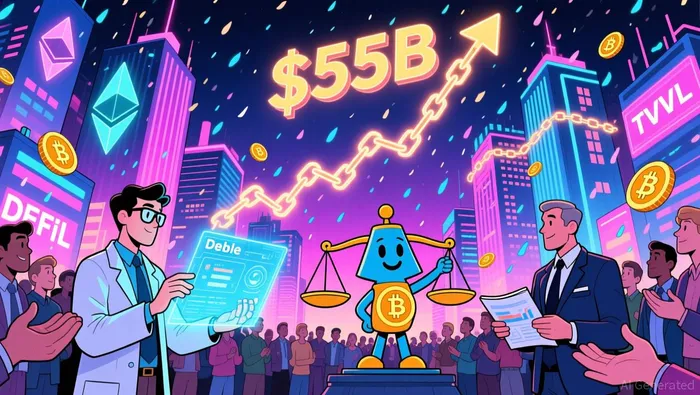
Ethereum's institutionalization is supported by a combination of technological upgrades and growing utility in real-world applications. The network hosts $55 billion in total value locked (TVL), making it the leading platform for DeFi activities. This is complemented by $159 billion in stablecoins on Ethereum, further cementing its role in global finance. As Ethereum continues to integrate with traditional financial systems through tokenized assets and stablecoins, it is creating a bridge between blockchain and legacy markets. This trend is likely to attract more institutional investors, especially as Ethereum becomes a more scalable and efficient infrastructure.
The network's developer activity and user base are also expanding. Developer engagement and daily wallet usage have surged, reinforcing Ethereum's network effect. This growing ecosystem is attracting more liquidity and enhancing user adoption, which in turn strengthens Ethereum's position as a long-term investment. Institutional players are particularly drawn to Ethereum's ability to support a wide range of financial use cases, including asset tokenization, stablecoin issuance, and smart contract development.
What Risks Does Ethereum Face in 2026?
Despite its strengths, Ethereum faces several challenges in 2026. One of the key risks is competition from emerging blockchains like SolanaSOL--. Solana has been gaining traction in the retail market, offering fast transactions and low fees, which have attracted a large user base. The success of Solana's upgrades like Firedancer and its growing institutional interest through ETFs could create a more competitive environment for Ethereum. Additionally, Ethereum's reliance on Layer-2 solutions for scalability may limit its ability to capture everyday retail users, as high Layer-1 fees push activity to off-chain platforms.
Geopolitical and macroeconomic factors also play a role. Geopolitical tensions, such as recent U.S. military actions, such as recent U.S. military actions in the Middle East, have created uncertainty in global markets. These factors can influence investor sentiment and affect capital flows into crypto assets. While Ethereum has demonstrated resilience in the face of volatility, its long-term performance will depend on how well it navigates these external challenges.
How Are Ethereum's Upgrades Addressing Scalability and Security Concerns?
Ethereum's 2026 roadmap includes key upgrades aimed at enhancing the network's performance and security. The Verkle Trees and Pectra upgrades are expected to reduce gas costs and improve throughput. These upgrades are part of Ethereum's broader strategy to optimize its modular architecture while maintaining decentralization. By improving scalability, Ethereum aims to attract more developers and users to its ecosystem, which will further strengthen its position in the market.
Security is another focus area. A recent study proposed using fine-tuned large language models to identify and mitigate vulnerabilities in Ethereum smart contracts. This approach leverages AI to enhance the robustness of decentralized applications built on Ethereum, reducing the risk of exploits and increasing trust in the network. As Ethereum continues to evolve, these security enhancements will play a critical role in maintaining its reputation as a reliable and secure platform for financial applications.
Ethereum's ability to adapt to changing market dynamics and technological advancements will determine its success in 2026. While the network faces competition from other blockchains and macroeconomic headwinds, its strong institutional adoption and ongoing upgrades position it as a key player in the digital asset space. As investors continue to monitor Ethereum's performance, the coming months will provide important insights into its long-term trajectory.

Combina la sabiduría tradicional en el comercio con los conocimientos más avanzados sobre criptomonedas.
Latest Articles
Stay ahead of the market.
Get curated U.S. market news, insights and key dates delivered to your inbox.
AInvest
PRO
AInvest
PRO



Comments
No comments yet