
ETH Faces Critical 2026 Upgrades Amid Whale Accumulation and Solana Threat
 Aime Summary
- Ethereum prepares for Glamsterdam fork upgrades targeting scalability amid validator risks. According to market analysis
- Record 8.7 million smart contracts deployed in Q4 2025 signal robust developer activity. Ethereum deployed record 8.7 million smart contracts in Q4 2025.
- Whale accumulation patterns mirror 2017 bull market signals. Whale accumulation patterns mirror 2017 bull market signals.
- Solana's transaction throughput poses competitive pressure. Solana's transaction throughput poses competitive pressure.
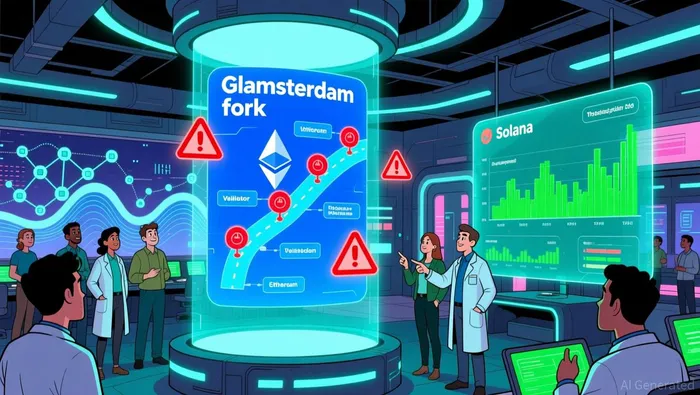
Ethereum (ETH) enters 2026 facing pivotal network upgrades and intensifying market competition. The Glamsterdam fork promises enhanced scalability through parallel processing and increased gas limits according to Cointelegraph, while validator risks introduce complexity as reported by CoinMarketCap. These developments unfold as institutional investors accumulate ETHETH-- despite price consolidation. Whale activity patterns resemble those preceding previous bull markets according to analysis, though Solana's low-fee architecture threatens Ethereum's dominance as noted in MEXC analysis.
Can Ethereum's 2026 Upgrades Address Scalability and Validator Risks?
The Glamsterdam fork aims to boost Ethereum's capacity with a 200 million gas limit and expanded data blobs according to Cointelegraph. This upgrade seeks to transition 10% of network activity to ZK rollups, potentially slashing transaction fees. However, the complexity escalates validator responsibilities beyond previous expectations according to CoinMarketCap. Governance hurdles and security vulnerabilities could emerge during implementation. The EthereumETH-- Foundation proposes safeguards to mitigate these operational challenges according to market analysis.
What Do Record On-Chain Metrics Reveal About ETH's Valuation?
Ethereum processed 8.7 million smart contracts in Q4 2025 despite price stagnation according to Yellow. Daily transactions exceeded 1 million while active addresses nearly doubled year-to-date according to AInvest analysis. This surge coincides with average gas fees stabilizing at $0.17—a 70% drop from 2021 peaks according to AInvest analysis. The Network Value to Transactions ratio remains below its historical range according to AInvest analysis. When coupled with ETF inflows reaching $28.6 billion by Q3 2025 according to AInvest analysis, these metrics suggest possible undervaluation. The data contrasts sharply with declining mainnet volume as Layer 2 adoption accelerates.
Will Institutional Demand Drive ETH to $10,000 Despite Competition?
Institutional ETH accumulation mirrors 2017 bull market patterns according to AInvest analysis. Whale entities acquired 218,470 ETH in late 2025 after temporary sell-offs according to on-chain data. Some analysts project a $5,000-$7,000 breakout by mid-2026 according to AInvest analysis, with a $10,000 target gaining attention according to AInvest analysis. That said, SolanaSOL-- processes 65,000 transactions per second at $0.00025 fees according to MEXC analysis, directly challenging Ethereum's utility. Daily active Solana users reached 2 million while developer count grew 30% year-over-year according to MEXC analysis. Ethereum's staking participation remains strong at 29.4% of supply according to on-chain data. Macroeconomic conditions will influence whether ETH can reclaim its valuation premium against BitcoinBTC-- according to on-chain analysis.

Blending traditional trading wisdom with cutting-edge cryptocurrency insights.
Latest Articles
Stay ahead of the market.
Get curated U.S. market news, insights and key dates delivered to your inbox.






Comments
No comments yet