
ETF Yield Volatility in a Recession-Ready Portfolio: Balancing Risk and Reward in High-Yield Strategies
 Aime Summary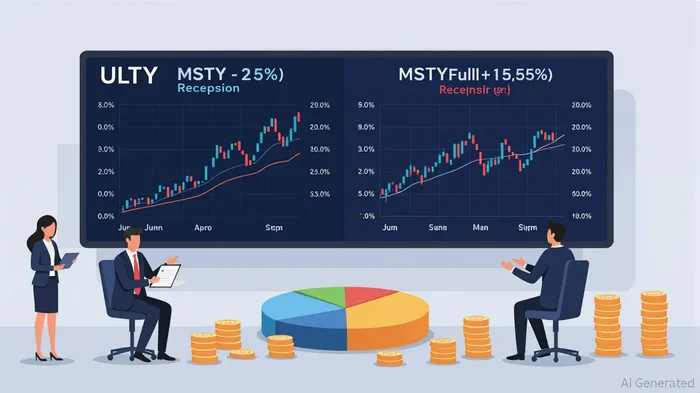
In an era where economic uncertainty looms large, investors are increasingly scrutinizing the resilience of high-yield ETFs in the face of market stress. The recent performance of YieldMax's ULTYULTY-- and MSTY—two funds designed to generate income through options strategies—offers a compelling case study in the trade-offs between yield, volatility, and risk-adjusted returns. As central banks tighten monetary policy and recession signals flicker on the horizon, the question is no longer whether these funds can deliver income, but whether they can do so without exposing portfolios to catastrophic drawdowns.
The Divergence of Strategies: ULTY vs. MSTY
ULTY, the YieldMax Ultra Option Income Strategy ETF, and MSTYMSTY--, the YieldMax MSTRMSTR-- Option Income Strategy ETF, represent two distinct approaches to income generation. ULTY spreads its bets across a diversified basket of volatile stocks, while MSTY concentrates its exposure on a single asset: MicroStrategy (MSTR). This structural difference has profound implications for risk and return.
From February 2024 to August 2025, MSTY delivered a staggering 109.89% return, dwarfing ULTY's 26.30%. However, MSTY's volatility metrics tell a different story. With a daily standard deviation of 72.09% and a maximum drawdown of -40.82%, MSTY's performance is akin to a rollercoaster—thrilling in upswings but perilous in downturns. ULTY, by contrast, exhibited a more measured volatility profile (27.39% standard deviation, -26.85% drawdown), reflecting the stabilizing effect of diversification.
Risk-Adjusted Returns: The Sharpe and Sortino Divide
The true test of an investment lies in its risk-adjusted returns. MSTY's Sharpe ratio of 1.57 outperforms ULTY's 1.00, suggesting it generates more return per unit of risk. The Sortino ratio, which focuses on downside volatility, further favors MSTY (2.14 vs. ULTY's 1.54). These metrics highlight MSTY's efficiency in converting risk into reward—a critical attribute in a recession-ready portfolio.
Yet, these numbers mask a deeper vulnerability. MSTY's reliance on MSTR—a stock prone to extreme price swings—means its performance is inextricably tied to the fortunes of a single company. During the 2008 financial crisis, for instance, MSTY (then as a standalone strategy) plummeted by 60.96% in a single year. While it rebounded sharply in 2009 (+153.22%), such volatility underscores the fragility of concentrated strategies in systemic downturns. ULTY, with its diversified approach, would likely weather such storms with less severe erosion of capital.
The Correlation Conundrum: Diversification in a Volatile World
The 0.61 correlation between ULTY and MSTY suggests moderate diversification benefits. However, both funds employ similar options-based strategies, meaning they share common risk factors—namely, sensitivity to market-wide volatility and liquidity constraints. In a recession, when correlations often rise and liquidity dries up, the distinction between these funds may blur.
Consider the 2020 pandemic: MSTY surged by 172.42% as markets rebounded, but its volatility during the initial crash (a -9.09% drop in 2010) highlights the double-edged sword of concentration. ULTY, though not yet in existence during 2008 or 2020, would likely have offered a smoother ride, albeit with lower upside. For investors seeking to hedge against tail risks, the choice between these funds hinges on their willingness to tolerate extreme volatility for the promise of outsized returns.
A Recession-Ready Framework: Lessons for Investors
- Diversification Within Income Strategies: While MSTY's high Sharpe ratio is tempting, its single-asset focus makes it a speculative bet. A recession-ready portfolio should balance such high-risk, high-reward instruments with diversified alternatives like ULTY.
- Dynamic Risk Management: Investors must monitor macroeconomic signals and adjust allocations accordingly. For example, increasing exposure to MSTY during growth phases and scaling back during tightening cycles.
- Leverage Behavioral Insights: Behavioral finance reminds us that investors often overestimate their risk tolerance. A disciplined approach—such as using stop-loss orders or rebalancing thresholds—can mitigate emotional decision-making during downturns.
The Bottom Line: Income at What Cost?
High-yield ETFs like ULTY and MSTY offer a tantalizing mix of income and growth potential, but their suitability in a recession-ready portfolio depends on a nuanced understanding of risk. MSTY's superior risk-adjusted returns come at the cost of extreme volatility, while ULTY's stability limits its upside. For investors with a long-term horizon and a tolerance for turbulence, MSTY may be a compelling addition. For those prioritizing capital preservation, ULTY's diversified approach provides a safer harbor.
In the end, the key to navigating a recession lies not in chasing the highest yield, but in aligning one's portfolio with the realities of market cycles. As the old adage goes: “Don't let the pursuit of income blind you to the cost of volatility.”

Delivering real-time insights and analysis on emerging financial trends and market movements.
Latest Articles
Stay ahead of the market.
Get curated U.S. market news, insights and key dates delivered to your inbox.
AInvest
PRO
AInvest
PRO



Comments
No comments yet