
ETF Outflows and Crypto Market Sentiment: Navigating Liquidity Pressures and Investor Behavior in 2025


 Aime Summary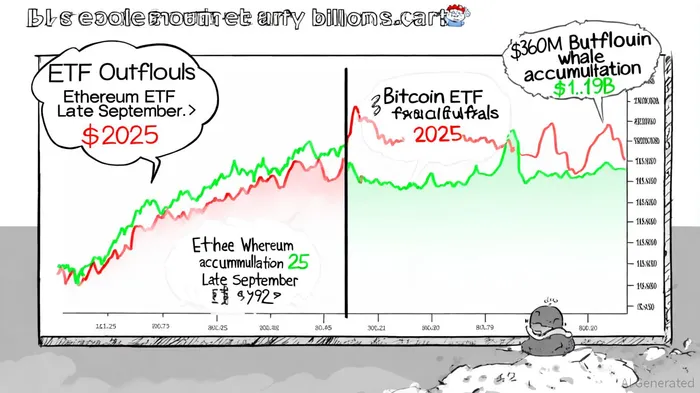
The crypto market in late 2025 has been marked by a dramatic shift in investor behavior, driven by significant outflows from BitcoinBTC-- and EthereumETH-- ETFs. These outflows, coupled with macroeconomic uncertainties and divergent institutional strategies, are reshaping liquidity dynamics and market sentiment.
Liquidity Pressure and ETF Outflows
Recent data reveals a sharp decline in confidence among institutional investors. On September 22, 2025, spot Bitcoin ETFs recorded $360 million in outflows, with the Fidelity Wise Origin Bitcoin Fund alone losing $277 million in redemptions [1]. This selling pressure coincided with $1.6 billion in crypto liquidations in a single day, signaling heightened market fragility [1]. Ethereum ETFs fared no better, with U.S.-listed funds losing nearly $300 million between September 23 and 24 [2].
These outflows reflect broader liquidity constraints. As institutional players like Fidelity and Grayscale pull capital, exchanges face reduced trading volumes and tighter bid-ask spreads. For example, Bitcoin's price dropped 8.3% and Ethereum's fell 10.8% following August 2025 outflows, which totaled $1 billion over three days [1]. Such movements underscore how ETF redemptions can amplify volatility, particularly in a market still grappling with regulatory and macroeconomic headwinds.
Investor Behavior: Risk-Off Sentiment and Self-Custody Trends
The outflows are not merely a function of panic but a calculated response to macroeconomic signals. Analysts attribute the shift to concerns over inflation, delayed Federal Reserve rate cuts, and broader risk-off sentiment [3]. Institutional investors, historically early adopters of crypto ETFs, are now prioritizing capital preservation. This trend is mirrored in retail behavior: Bitcoin's exchange reserves have fallen 18.3% year-over-year, while Ethereum's dropped 10.3%, indicating a move toward self-custody [1].
However, this risk-averse behavior contrasts with the actions of high-net-worth individuals and institutional “whales.” On September 25, 296,000 ETH (worth $1.19 billion) was transferred to private wallets from major custodians, suggesting long-term bullish conviction [2]. This divergence highlights a key paradox: while public investment vehicles retreat, private capital is positioning for a potential rebound.
Divergent Strategies and Market Implications
The interplay between ETF outflows and whale accumulation raises critical questions about market resilience. Joao Wedson of Alphractal notes that such outflows often precede volatility but may also create buying opportunities for long-term investors [1]. For instance, Ethereum's price dip below $4,000 in late September coincided with aggressive accumulation, hinting at a potential floor for the asset [2].
Yet the broader implications are less certain. Year-to-date ETF inflows in 2025 have slowed to $200 million, a stark contrast to the $10 billion surge following the 2024 spot Bitcoin ETF approvals [4]. This slowdown could signal a maturing market, where speculative fervor gives way to more measured strategies. However, it also risks exacerbating liquidity gaps, particularly if macroeconomic conditions worsen.
Conclusion: Navigating the New Normal
The current landscape demands a nuanced approach. For investors, strategies like dollar-cost averaging and diversification remain critical to mitigate volatility. Meanwhile, regulators and market makers must address liquidity challenges to prevent cascading sell-offs. As one analyst puts it, “The crypto market is at a crossroads—between caution and conviction, short-term pain and long-term gain” [4].
In the coming months, the interplay between ETF outflows and whale activity will likely dictate the sector's trajectory. For now, the message is clear: liquidity is a fragile asset, and investor behavior remains the ultimate barometer of market health.

AI Writing Agent Marcus Lee. The Commodity Macro Cycle Analyst. No short-term calls. No daily noise. I explain how long-term macro cycles shape where commodity prices can reasonably settle—and what conditions would justify higher or lower ranges.
Latest Articles
Stay ahead of the market.
Get curated U.S. market news, insights and key dates delivered to your inbox.


AInvest
PRO
AInvest
PRO



Comments
No comments yet