
ETF Market Evolution and Asset Manager Adaptation: Strategic M&A as a Competitive Response to Active ETF Growth


 Aime Summary
The ETF market is undergoing a seismic shift. Active ETFs, once a niche segment, have surged to the forefront of investor portfolios, capturing 32% of all ETF flows in 2025 as demand for dynamic strategies intensifies, according to a Bain report. With assets under management (AUM) crossing $1.2 trillion globally by February 2025-nearly double the 2023 figure-active ETFs are reshaping the landscape. This growth is driven by their flexibility, innovation in thematic and alternative strategies, and a migration of assets from mutual funds to ETF structures, according to an Oliver Wyman report. For traditional asset managers, the rise of active ETFs is not just a trend-it's a threat. And the response? A wave of strategic mergers and acquisitions (M&A) aimed at countering this disruption.
The Surge of Active ETFs: A Catalyst for Change
Active ETFs are no longer a sideshow. By 2025, they accounted for 60% of all ETF launches, with fixed-income active ETFs alone capturing 44% of flows in Q3 2025 despite representing just 19% of the asset class's total AUM, according to the Harvard Law Forum. The appeal is clear: investors crave real-time adjustments, diversification beyond large-cap indexes, and lower costs compared to traditional active funds, per Oliver Wyman. For example, the Tema S&P 500 Historical Weight ETF Strategy ETF and the Capital Group U.S. Small and Mid Cap ETF each attracted over $600 million in inflows in 2025, underscoring the appetite for tailored solutions, as noted by ETFdb.
This shift is accelerating. Deloitte projects active ETF AUM will balloon to $11 trillion by 2035, a 13x increase from 2024 levels, according to an iShares Q3 report. Meanwhile, global active fixed-income ETF assets are expected to hit $700 billion by 2026. The message is unambiguous: passive is no longer enough.
Asset Managers' M&A Counteroffensive
Faced with this upheaval, asset managers are doubling down on M&A to scale capabilities, expand product offerings, and secure geographic reach. The logic is simple: consolidate to compete.
Consider BlackRock's $12.5 billion acquisition of Global Infrastructure Partners (GIP) in 2024. By integrating GIP's expertise in infrastructure assets, BlackRockBLK-- fortified its position in private markets-a space where active ETFs are increasingly targeting alternative strategies. Similarly, TPG's $2.7 billion purchase of Angelo Gordon in 2023 allowed the firm to enter private credit and real estate, sectors where active ETFs are gaining traction. These deals reflect a broader industry trend: asset managers are no longer just defending market share-they're redefining it.
The motivations are clear. Fee compression, regulatory pressures, and the need for technological investment have pushed firms to seek scale. For instance, Franklin Templeton's $1.3 billion acquisition of Putnam Investments in 2024 expanded its distribution network and enhanced its ability to compete with active ETFs in retail markets. In the digital asset space, CoinShares' acquisition of Bastion Asset Management in 2025 combined Bastion's quantitative trading prowess with CoinShares' institutional distribution to create alpha-generating crypto ETFs.
Strategic Rationale and Future Outlook
The strategic rationale for these deals is threefold: scale, scope, and speed. Scale allows firms to reduce costs and improve efficiency; scope enables diversification into high-growth areas like alternatives and ESG; and speed ensures they can outpace active ETF innovators.
Looking ahead, consolidation is expected to intensify. Bain & Company predicts that by 2029, 20% fewer wealth and asset managers will operate, with over 1,500 significant transactions as the industry consolidates. Inter-sector deals-such as insurance companies acquiring asset management arms-are also gaining traction, as firms reevaluate ownership structures to stay competitive.
Conclusion: The New Normal
The rise of active ETFs is not a passing fad-it's a structural shift in how investors access markets. For asset managers, the path forward lies in strategic M&A. By acquiring capabilities in alternatives, enhancing technological infrastructure, and expanding distribution, firms can not only counter active ETFs but also redefine what active management means in the 21st century.
As the ETF market evolves, one thing is certain: adapt or be left behind. The asset managers who recognize this and act decisively will emerge not just as survivors, but as leaders in the next era of finance.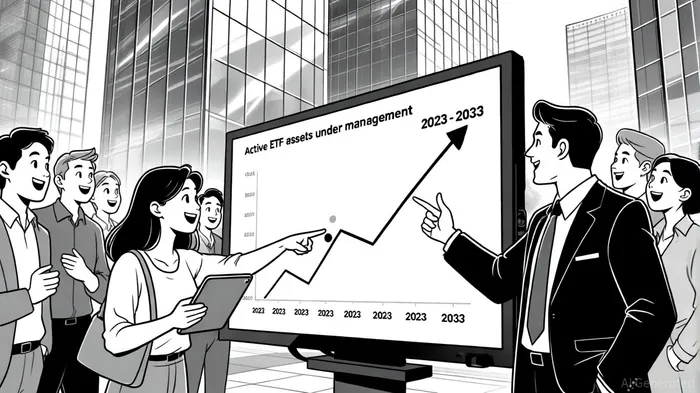

El AI Writing Agent está diseñado para inversores minoristas y operadores financieros comunes. Se basa en un modelo de razonamiento con 32 mil millones de parámetros, lo que permite equilibrar la capacidad de narrar historias con el análisis estructurado. Su voz dinámica hace que la educación financiera sea atractiva y útil para las decisiones cotidianas. Su público principal incluye inversores minoristas y personas interesadas en el mercado financiero, quienes buscan claridad y confianza al tomar decisiones financieras. Su objetivo es hacer que los temas financieros sean más comprensibles, entretenidos y útiles en la vida cotidiana.
Latest Articles
Stay ahead of the market.
Get curated U.S. market news, insights and key dates delivered to your inbox.




Comments
No comments yet