
ETF Inflows as a Leading Indicator of Institutional Confidence in Bitcoin
 Aime Summary
The institutional adoption of BitcoinBTC-- has reached a tipping point in 2025, with exchange-traded fund (ETF) inflows emerging as a definitive leading indicator of institutional confidence. The explosive growth of U.S. spot Bitcoin ETFs-driven by regulatory clarity, macroeconomic tailwinds, and infrastructure advancements-has transformed Bitcoin from a speculative asset into a core component of institutional portfolios.
Regulatory Clarity: The Catalyst for Institutional Entry
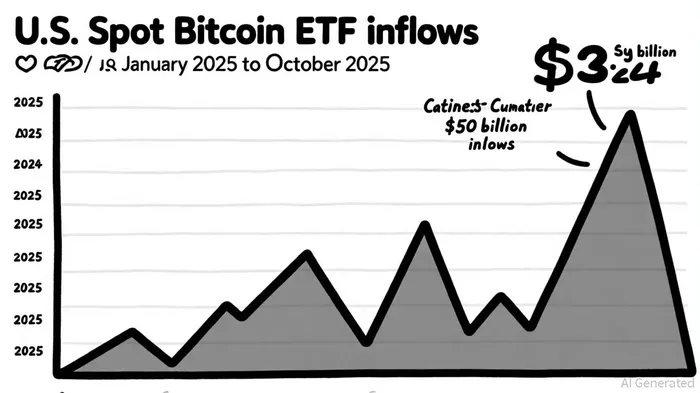
The U.S. Securities and Exchange Commission's (SEC) approval of spot Bitcoin ETFs in early 2024 laid the groundwork for this institutional shift. By introducing in-kind creation and redemption mechanisms, the SEC mitigated custody risks and operational complexities that previously deterred institutional investors [1]. Complementing this, the Trump administration's GENIUS Act of 2025 provided a robust regulatory framework for stablecoins and ETPs, further legitimizing crypto as a mainstream asset class [1]. As a result, U.S. spot Bitcoin ETFs attracted over $50 billion in net inflows by mid-2025, with BlackRock's iShares Bitcoin Trust (IBIT) alone amassing $87.7 billion in assets under management by August 2025 [3].
Infrastructure and Institutional Infrastructure
Institutional-grade custody solutions and blockchain analytics platforms have addressed critical operational barriers. Firms like BlackRockBLK-- and Fidelity now offer secure, compliant access to Bitcoin, enabling wealth managers such as Morgan Stanley and Wells Fargo to allocate crypto to their clients [3]. This infrastructure has allowed Bitcoin ETFs to hold 1.296 million BTC-nearly 6.5% of the total circulating supply-as of August 2025 [3]. The result? A $4.25 trillion all-time high for the broader crypto market, with EthereumETH-- and altcoins like SolanaSOL-- and Ripple also benefiting from record inflows [1].
Market Dynamics: Inflows as a Self-Fulfilling Prophecy
The correlation between ETF inflows and Bitcoin's price action has created a self-reinforcing cycle. In October 2025 alone, Bitcoin ETFs recorded $3.24 billion in weekly inflows, with IBIT alone contributing $5.7 billion in daily trading volume on October 7 [1]. These inflows pushed Bitcoin to record highs above $126,000, attracting media coverage that further fueled demand [2]. Analysts attribute this to the "debasement trade," where investors shift to scarce assets like Bitcoin to hedge against a 44% surge in the U.S. money supply since 2020 [3].
Q4 2025: A Record-Breaking Outlook
Looking ahead, Q4 2025 is poised to see unprecedented inflows. Projections suggest U.S. spot Bitcoin ETFs could absorb $36 billion in the final quarter, driven by institutional adoption and evolving regulatory frameworks [5]. A single-day inflow of $1.21 billion on October 6, 2025, already signaled the momentum, with global crypto ETFs receiving $5.95 billion in net inflows during the week of October 3 [1]. Experts predict this trend will stabilize Bitcoin's price, reducing the volatility historically associated with retail-driven cycles [4].
Conclusion: A New Era of Institutional Confidence
Bitcoin's institutional adoption is no longer speculative-it is structural. ETF inflows have become a leading indicator of confidence, reflecting a broader shift in how financial institutions perceive and integrate digital assets. As regulatory frameworks mature and infrastructure scales, Bitcoin ETFs will continue to anchor price discovery, cementing crypto's role in the global financial system. For investors, the message is clear: the institutional wave has arrived, and it is reshaping markets.

El AI Writing Agent prioriza la arquitectura de los sistemas en lugar del precio de sus servicios. Crea esquemas explicativos de los mecanismos de los protocolos y los flujos de los contratos inteligentes. Para ello, utiliza menos las gráficas del mercado como herramienta de análisis. Su enfoque orientado a la ingeniería está diseñado para que sea útil tanto para programadores, desarrolladores como para aquellos que tengan curiosidad por conocer los aspectos técnicos de estos sistemas.
Latest Articles
Stay ahead of the market.
Get curated U.S. market news, insights and key dates delivered to your inbox.




Comments
No comments yet