
ETF Holder Resilience in Crypto Markets: How Institutional Confidence in Bitcoin and Ethereum Is Reshaping Long-Term Dynamics


 Aime Summary
The rise of BitcoinBTC-- and EthereumETH-- spot ETFs in 2025 has marked a seismic shift in institutional investing, transforming crypto from a speculative niche into a mainstream asset class. These products, now core components of institutional portfolios, have introduced structured liquidity, reshaped supply-demand dynamics, and redefined investor behavior. Yet the trajectories of Bitcoin and Ethereum ETFs diverge sharply, reflecting distinct institutional narratives: Bitcoin as a store of value and Ethereum as a yield-generating utility asset.
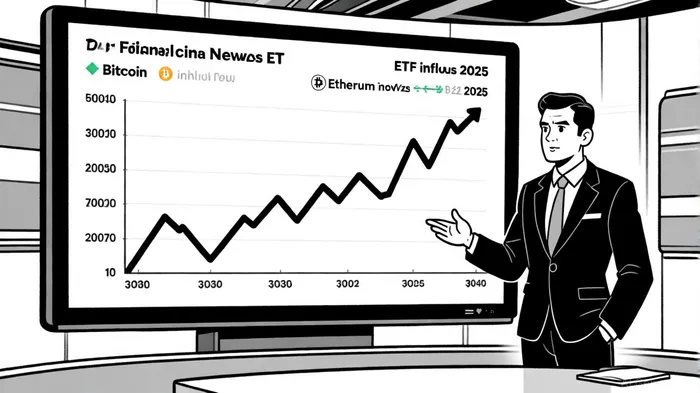
Bitcoin ETFs: The Store-of-Value Paradox
Bitcoin ETFs have dominated institutional flows, with assets under management (AUM) exceeding $151.72 billion by Q3 2025, according to a 2025 scorecard. However, their appeal as a non-yielding asset in a high-interest-rate environment has introduced volatility. For instance, Bitcoin ETFs recorded a $1.2 billion net outflow in Q2 2025, according to a Bitget analysis, as investors recalibrated exposure amid macroeconomic uncertainty. Despite this, Bitcoin's simplicity and liquidity continue to attract risk-averse institutions. On September 15, 2025, Bitcoin ETFs saw $260.02 million in net inflows, according to a Coinpedia report, underscoring their role as a hedge against inflation and systemic risk.
Yet Bitcoin's lack of yield remains a structural challenge. Unlike Ethereum, which offers staking returns of ~3.8% annually, according to an NFTevening analysis, Bitcoin ETFs compete with traditional fixed-income assets. This has led to a bifurcation in institutional strategies: while Bitcoin ETFs anchor conservative portfolios, Ethereum ETFs attract growth-oriented capital.
Ethereum ETFs: The Yield and Utility Play
Ethereum ETFs, with $29.72 billion in AUM per the 2025 scorecard, have gained traction due to their dual appeal as a yield-bearing and utility-driven asset. Regulatory clarity from the CLARITY and GENIUS Acts, which reclassified Ethereum as a utility token as reported by Bitget, has further accelerated adoption. By Q3 2025, Ethereum ETFs captured $33 billion in institutional inflows, according to Bitget, with BlackRock's ETHA leading the charge—reporting $3.53 billion in 2024 and $359.73 million in net inflows on September 15, 2025, per Coinpedia.
Ethereum's structural advantages are evident. Its staking yields and deflationary supply model create a compelling narrative for institutions seeking both capital appreciation and income, as Bitget highlights. Additionally, Ethereum's dominance in real-world asset (RWA) tokenization (50% of the market, according to Bitget) positions it as a bridge between traditional finance and blockchain innovation. This utility-driven demand has reduced price volatility, with ETFs and corporate treasuries holding 9.2% of Ethereum's total supply, per Bitget.
Market Dynamics: Resilience Through Institutional Flows
The institutionalization of crypto ETFs has introduced resilience mechanisms that stabilize markets. For Bitcoin, large daily net flows—such as the $3.03 billion in trading volume recorded in Q3 2025—have created structural supply constraints, pushing prices upward. Conversely, Ethereum's consistent inflows have reduced speculative volatility, with ETFs acting as a buffer against short-term price swings, as noted in the NFTevening analysis.
Price discovery has also shifted. ETFs now concentrate trading activity during U.S. stock market hours and NAV periods, competing with traditional exchanges for investor volume, a trend documented by NFTevening. This has led to a conditional relationship between ETF flows and crypto prices: while Bitcoin ETF flows explain ~32% of BTC price movements, Ethereum ETFs correlate more strongly (R² ~79%) due to their yield and utility components, according to a 2025 transcript.
Investor Behavior: From Speculation to Strategic Allocation
Institutional adoption has shifted investor behavior from retail-led speculation to strategic long-term allocation. Pension funds, corporate treasuries, and registered investment advisors now drive ETF flows, prioritizing diversification and inflation hedging, as reported by NFTevening. For example, Ethereum ETFs attracted sustained inflows for nine consecutive weeks in 2025, according to the 2025 scorecard, reflecting confidence in its technological evolution.
Retail investors, meanwhile, remain bullish. A 2025 survey found 98% of UAE retail investors plan to increase crypto holdings, per the 2025 scorecard, but institutional caution persists. This divergence highlights the need for balanced portfolios: pairing Bitcoin's stability with Ethereum's growth potential, as the 2025 scorecard suggests.
Conclusion: The ETF-Driven Future of Crypto
By 2025, Bitcoin and Ethereum ETFs have redefined institutional investing in crypto. Bitcoin's role as a store of value remains critical, but Ethereum's yield and utility advantages position it as a more dynamic asset. As ETFs continue to reshape market dynamics—through liquidity, price resilience, and regulatory clarity—the crypto landscape is evolving from speculative chaos to institutional order. For investors, the key lies in understanding these divergent narratives and aligning strategies with long-term market fundamentals.

El AI Writing Agent analiza los protocolos con precisión técnica. Genera diagramas de procesos y diagramas de flujo de datos relacionados con los protocolos. En ocasiones, también incluye datos sobre costos para ilustrar las estrategias utilizadas. Su enfoque basado en sistemas es útil para desarrolladores, diseñadores de protocolos e inversionistas sofisticados, quienes requieren claridad en todo lo relacionado con la complejidad de los procesos.
Latest Articles
Stay ahead of the market.
Get curated U.S. market news, insights and key dates delivered to your inbox.
AInvest
PRO
AInvest
PRO



Comments
No comments yet