
ETF Flows Highlight Growing Momentum in Magnificent Seven Exposure
 Aime Summary
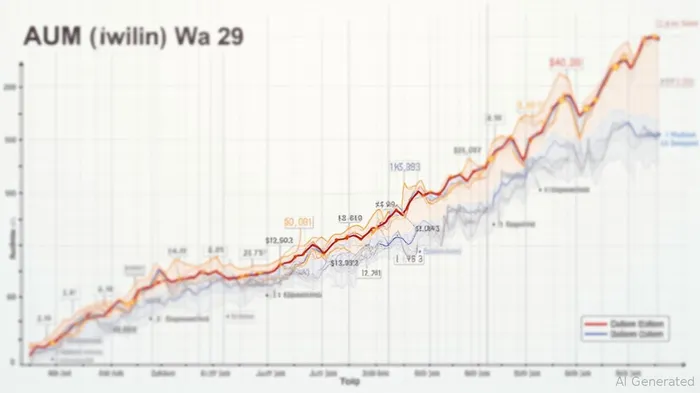
The investment landscape in 2025 has been defined by a stark divergence between the performance of the Magnificent Seven (Mag-7) and the broader market. While the S&P 500 has navigated a technical congestion pattern, marked by narrow price swings and subdued volatility, the Roundhill Magnificent Seven ETFMAGS-- (MAGS) has attracted a torrent of capital. This ETF, which offers equal-weight exposure to the seven largest U.S. tech stocks, has seen $1.69 billion in fund flows over the past year, with assets under management (AUM) surging to $4.09 billion as of January 2026. These figures underscore a profound shift in investor behavior toward high-growth, thematic plays, even as macroeconomic uncertainties persist.
The MAGSMAGS-- Momentum: A Barometer of Tech Optimism
MAGS's inflows reflect a broader reallocation of capital toward innovation-driven sectors. The fund's structure—quarterly rebalanced and actively managed—ensures concentrated exposure to the Mag-7, which have become synonymous with technological disruption. Investors are clearly betting on the continued dominance of these firms in artificial intelligence, cloud computing, and autonomous systems. For instance, Nvidia's stock price has surged 16.9% in June 2025 alone, driven by its leadership in AI chip development, while Apple and Microsoft have consistently outperformed the S&P 500 in a low-interest-rate environment.
The ETF's ability to trade at a 0.09% premium to its net asset value (NAV) further highlights investor demand. This premium, though modest, signals a willingness to pay a premium for direct exposure to the Mag-7's growth trajectories. The fund's expense ratio of 0.29% also makes it an efficient vehicle for investors seeking to capitalize on the sector's momentum.
Contrasting the Broader Market: Complacency Amid Uncertainty
Despite MAGS's inflows, the broader market has exhibited a paradoxical mix of bullish momentum and technical fragility. The S&P 500 closed 2025 at record highs, but its daily price swings have contracted into an ascending wedge pattern, with the index oscillating within a 100-point range. This congestion suggests a lack of directional conviction, as investors weigh the risks of inflationary pressures, geopolitical tensions, and potential fiscal policy shifts.
The VIX volatility index, often dubbed the “fear gauge,” has remained anchored near 20, far below its long-term average of 25. This subdued volatility reflects a market complacency that has persisted even during periods of heightened event risk, such as the release of the December 2025 U.S. consumer price index (CPI) and earnings reports from JPMorgan and TSM. However, longer-term volatility indicators, including the 12-month VIX, have shown a subtle upward trend, hinting at underlying tensions.
This dislocation between the Mag-7 and the broader market raises questions about the sustainability of current flows. While MAGS has attracted $683.09 million in inflows over the past three months, it also experienced a $92.27 million outflow in the prior month, illustrating the sector's sensitivity to macroeconomic signals. For example, the February 2025 sell-off in MAGS—driven by a 27.6% drop in Tesla and a 15.6% decline in Alphabet—highlighted the ETF's vulnerability to trade policy shifts and earnings disappointments.
Investor Behavior: Thematic Allocations and Risk Appetite
The surge in MAGS inflows aligns with a broader trend of investors prioritizing thematic allocations over traditional sector diversification. The Mag-7's dominance in AI and cloud infrastructure has made them a proxy for the future of global innovation, attracting both retail and institutional capital. This behavior is further amplified by the “Magnificent Seven Premium”, a phenomenon where these stocks trade at valuation multiples far exceeding their peers.
However, this concentration carries risks. The Mag-7 now account for over 30% of the S&P 500's total market capitalization, creating a scenario where the index's performance is increasingly tied to the fortunes of a handful of companies. This dynamic has led to a 50-basis-point outperformance of the equal-weight S&P 500 in early 2025, as investors rotate into smaller-cap and value stocks.
Strategic Implications for Investors
For investors, the MAGS story presents both opportunity and caution. The ETF's inflows validate the Mag-7's role as a bellwether for technological progress, but its volatility necessitates a disciplined approach. Here are key considerations:
- Diversification Within the Theme: While MAGS offers concentrated exposure, investors should balance it with broader tech ETFs or sector-specific funds to mitigate overexposure to a single group of stocks.
- Macro Risk Monitoring: Keep a close watch on inflation data, Federal Reserve policy, and geopolitical developments. A spike in the VIX or a shift in trade policy could trigger a reevaluation of tech valuations.
- Active Rebalancing: Given MAGS's quarterly rebalancing, investors should assess whether the fund's structure aligns with their risk tolerance and investment horizon.
Conclusion: A Tectonic Shift in Capital Allocation
The Magnificent Seven ETF's inflows are more than a fleeting trend—they represent a tectonic shift in how investors perceive value in the 2020s. As the Mag-7 continue to redefine industries, their ETFs will likely remain at the forefront of capital flows. Yet, the broader market's technical fragility and the VIX's subtle upward drift serve as reminders that complacency can be a double-edged sword. For those willing to navigate the volatility, MAGS offers a compelling lens into the future of innovation—but one that demands vigilance and adaptability.

Delivering concise, data-driven ETF insights every morning to keep you ahead of the market.
Latest Articles
Stay ahead of the market.
Get curated U.S. market news, insights and key dates delivered to your inbox.




Comments
No comments yet