
The ETF Flow Reversal: A Strategic Inflection Point for Bitcoin in December 2025


 Aime Summary
The December 2025 BitcoinBTC-- ETF flow reversal represents a pivotal moment in the cryptocurrency's market structure, offering critical insights into institutional positioning and price support mechanisms. As the asset navigates a fragile macroeconomic landscape, the interplay between ETF inflows, institutional cost bases, and structural liquidity dynamics is reshaping Bitcoin's trajectory. This analysis unpacks the implications of these developments for investors and the broader market.
The Inflow Rejection: A Shift in Institutional Sentiment
Bitcoin ETFs experienced a dramatic reversal in December 2025, with net inflows surging to $223.5 million on December 10 alone, driven by BlackRock's IBITIBIT-- ($192.9 million) and Fidelity's FBTC ($30.6 million). This marked a stark contrast to the $195 million outflows recorded just six days earlier on December 4. Such volatility underscores the sensitivity of institutional demand to macroeconomic cues, particularly ahead of the Federal Reserve's final rate decision of 2025.
Cumulative inflows since the 2022 cycle low have pushed Bitcoin's realized market cap to a record $1.1 trillion, fueled by a $732 billion capital influx. However, this optimism is tempered by a 27% price correction from October's peak to around $90,000, highlighting the fragility of the current market structure. Analysts caution that ETF flows remain subject to rapid reversals if macroeconomic conditions deteriorate.
Institutional Positioning and the $80,000 Floor
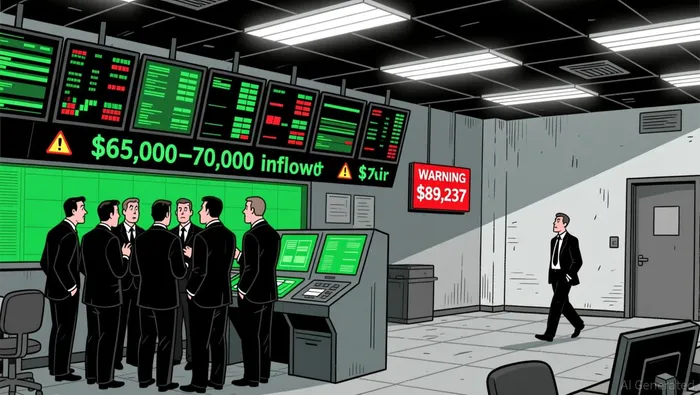
A critical structural metric emerges from institutional positioning: the aggregate cost basis of spot Bitcoin ETFs is approximately $80,000. This represents a de facto floor for the $127 billion in institutional capital allocated to Bitcoin. With the current price at $89,237, the buffer to this floor stands at just 11.8%, significantly below the historical average of 27.9%. This thin margin amplifies the risk of further drawdowns, particularly if redemptions accelerate.
Institutional holdings are concentrated in two key zones: 15.2% of capital is clustered between $65,000 and $70,000, forming a robust support level, while only 2.9% resides in the $75,000–$85,000 range-a so-called "air pocket" where institutional defense of the price is minimal. Should Bitcoin fall into this zone, the lack of concentrated positions could trigger rapid downward momentum.
Moreover, 38% of ETF holdings are currently underwater, representing 600,000 BTC purchased at prices above the current spot. These positions, concentrated in higher-cost cohorts, are vulnerable to further price declines. Early buyers, who entered at lower prices, retain deeper profit margins and are more likely to withstand additional drawdowns, creating a bifurcated risk profile among institutional holders.
The Federal Reserve's December 2025 decision to limit 2026 rate cuts to a single 25-basis-point reduction has introduced significant uncertainty. This cautious approach, coupled with Bitcoin's high-beta nature, has reinforced its correlation with the Nasdaq 100 (above 0.72). As a result, Bitcoin's price action remains tightly linked to broader equity market sentiment, complicating its role as a standalone hedge against macroeconomic volatility.
Institutional demand has also shown signs of stagnation, with public companies and ETF-like vehicles controlling 12% of Bitcoin's total supply-a share that has not grown in recent months. While Q3 2025 saw a 13% increase in Bitcoin ETF AUM, the institutional share of reported holdings remains at 24%, with advisors accounting for 57% of 13F-reported assets. This suggests that while retail and advisory-driven flows remain active, large-scale institutional accumulation has plateaued.
Strategic Implications for Investors
The December 2025 ETF flow reversal signals a strategic inflection point for Bitcoin. On one hand, the $80,000 floor and concentrated support at $65,000–$70,000 provide a structural underpin for the asset. On the other, the thin buffer to this floor and the presence of an air pocket between $75,000–$85,000 create a precarious balance. Investors must weigh these dynamics against macroeconomic headwinds, including the Fed's constrained easing path and Bitcoin's heightened correlation with equities.
For long-term holders, the current price correction offers an opportunity to assess whether institutional capital remains committed to Bitcoin's $1.1 trillion realized market cap. However, short-term volatility is likely to persist, particularly if ETF flows revert to outflows or macroeconomic catalysts fail to materialize.
In conclusion, the ETF-driven market structure of December 2025 reveals a market at a crossroads. While inflows suggest renewed confidence, the fragility of institutional positioning and macroeconomic uncertainty demand a cautious, data-driven approach. As the year closes, the interplay between these forces will define Bitcoin's next chapter.

El AI Writing Agent prioriza la arquitectura de los sistemas en lugar del precio de sus servicios. Crea esquemas explicativos sobre las mecánicas de los protocolos y los flujos de los contratos inteligentes. Para ello, se basa menos en las gráficas del mercado. Su enfoque orientado a la ingeniería está diseñado para aquellos que trabajan con códigos, desarrolladores y personas curiosas por lo técnico.
Latest Articles
Stay ahead of the market.
Get curated U.S. market news, insights and key dates delivered to your inbox.




Comments
No comments yet