
The ETF Exodus: A Tactical Rebalance or a Bearish Shift in Crypto Demand?
 Aime Summary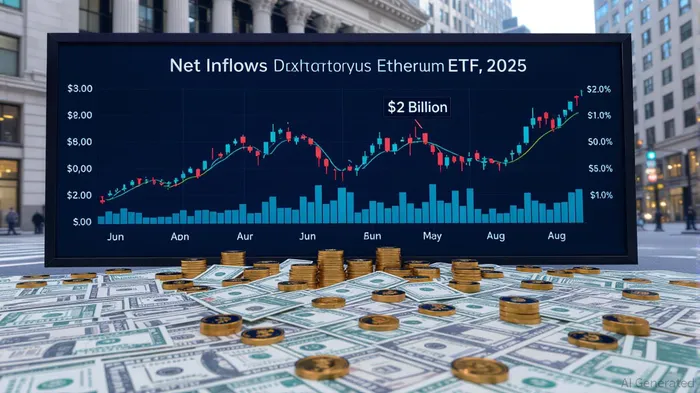
The recent $2 billion outflow from U.S. BitcoinBTC-- and EthereumETH-- ETFs in late August 2025 has sparked a critical debate: is this a temporary correction driven by macroeconomic uncertainty, or a structural shift in institutional demand for crypto assets? To answer this, we must dissect the interplay of market dynamics, institutional behavior, and central bank policy.
Market Volatility and Macroeconomic Uncertainty
The outflows coincided with a sharp pullback in crypto prices—Bitcoin fell to $112,000, and Ethereum dropped over 8% in a week. These declines were exacerbated by uncertainty surrounding the Federal Reserve's policy trajectory. The Fed's federal funds rate, currently at 4.25–4.50%, is near a neutral level, but investors remain divided on whether a rate cut in September is imminent. The CME FedWatch tool priced in an 83% probability of a cut as of August 20, down from 90% the prior week, reflecting growing skepticism.
The outflows also occurred against the backdrop of a $400 billion liquidity drain from U.S. Treasury accounts earlier in August, compounding investor anxiety. This created a self-reinforcing cycle: ETF redemptions forced the sale of underlying BTC and ETH, further depressing prices and triggering more redemptions.
Institutional Behavior: Tactical Rebalancing or Structural Shift?
The Q2 2025 data suggests a nuanced picture. While the August outflows were significant, they occurred within a broader context of institutional reallocation. In Q2, Ethereum ETFs attracted $9.4 billion in inflows, outpacing Bitcoin's $178 million. This was driven by Ethereum's proof-of-stake (PoS) model, which offers staking yields of 3–5%, and regulatory clarity from the SEC, which approved in-kind redemptions for Ethereum ETFs in July 2025.
Whale activity also pointed to a strategic shift. Ethereum whales accumulated 200,000 ETH ($515 million) in Q2, pushing their holdings to 22% of the circulating supply. Meanwhile, Bitcoin whales adopted a more defensive stance, adding 20,000 BTC post-Q2 corrections—a pattern historically associated with price recovery rather than structural shifts.
Corporate treasuries further reinforced this trend. Public companies added 850,000 BTC to their balance sheets in Q2, but also expanded altcoin holdings to $1.4 billion, with Ethereum dominating. This suggests that institutions view Bitcoin as a store of value and Ethereum as a utility-driven asset, with the latter's staking and DeFi infrastructure offering active yield generation.
Post-August 19 Flows and the Fed's Role
The Jackson Hole symposium on August 22 became a pivotal event. Federal Reserve Chair Jerome Powell's speech was expected to clarify whether the central bank would pivot dovish. A rate cut would reduce the opportunity cost of holding non-interest-bearing assets like Bitcoin and Ethereum, potentially reversing the outflow trend. However, until then, the market remained in a state of flux.
The ETH/BTC ratio, a key indicator of relative strength, reached 0.037 in Q2 2025, its highest since the start of the year. This suggests that while Bitcoin retained its dominance (62.1% of the crypto market cap), Ethereum's growing institutional adoption was reshaping capital flows.
Investment Implications
The outflows in late August appear to reflect tactical rebalancing rather than a structural bearish shift. Institutional investors are not abandoning crypto but recalibrating their portfolios in response to macroeconomic signals. For example, the 60/30/10 allocation model—60–70% in Bitcoin and Ethereum, 20–30% in altcoins, and 10–15% in stablecoins—has gained traction, with Ethereum's role as a yield-generating asset making it a preferred satellite holding.
However, risks remain. Leveraged positions in Ethereum derivatives, which saw open interest peak at $10.54 billion by June 30, 2025, could amplify volatility. Additionally, the UK government's planned sale of 61,000 BTC ($7.2 billion) introduces further uncertainty for Bitcoin's narrative.
Conclusion
The ETF exodus in late August 2025 is best understood as a short-term correction driven by macroeconomic uncertainty and tactical positioning ahead of the Fed's Jackson Hole symposium. While Ethereum's structural advantages—regulatory clarity, staking yields, and utility-driven infrastructure—position it as a long-term alpha generator, Bitcoin's role as a store of value remains intact. Investors should monitor the Fed's policy signals and institutional flows in the coming weeks. A dovish pivot could reignite demand for crypto ETFs, particularly Ethereum-based products, while a hawkish stance may prolong the current bearish sentiment. For now, the market is in a holding pattern, waiting for clarity on the next move.

Decoding blockchain innovations and market trends with clarity and precision.
Latest Articles
Stay ahead of the market.
Get curated U.S. market news, insights and key dates delivered to your inbox.






Comments
No comments yet