
Why ETF-Driven Institutional Demand Is Set to Supercharge Bitcoin, Ethereum, and Solana in 2026


 Aime Summary
The crypto market is on the cusp of a seismic shift, driven by institutional adoption and the explosive growth of exchange-traded funds (ETFs). As regulatory clarity expands globally and institutional confidence solidifies, BitcoinBTC--, EthereumETH--, and SolanaSOL-- are poised to benefit from a structural surge in demand. This analysis unpacks how ETF-driven dynamics are reshaping the crypto landscape and why 2026 could mark a turning point for these three leading cryptocurrencies.
Regulatory Clarity Fuels Institutional Onboarding
The foundation for this transformation was laid in 2024, when the U.S. Securities and Exchange Commission (SEC) approved the first spot Bitcoin ETFs in January and spot Ethereum ETFs in July. These approvals were part of a broader global trend, including the European Union's Markets in Crypto-Assets (MiCA) regulation in June 2024 and Hong Kong's licensing regime for virtual asset service providers in October 2024. Such developments have eliminated much of the regulatory ambiguity that previously deterred institutional investors.
According to a report by Bitwise, 94% of institutional investors now believe in the long-term value of blockchain technology and digital assets. This confidence has translated into action: by August 2025, U.S. Bitcoin ETFs had grown 45% to $103 billion in assets under management, with 60% of institutional investors preferring ETFs as their primary on-ramp to crypto.
Bitcoin: The Cornerstone of Institutional Portfolios
Bitcoin's dominance in the institutional space is underscored by its market capitalization of $1.65 trillion as of November 2025-accounting for 65% of the global crypto market. The asset's transition from speculative curiosity to strategic portfolio allocation has been accelerated by ETFs, which offer a familiar, compliant vehicle for institutional capital.
Bitwise projects that ETFs will purchase more than 100% of Bitcoin's new supply in 2026. This structural imbalance between ETF demand and token issuance creates upward pressure on price, a dynamic that has historically driven asset appreciation in traditional markets. Additionally, Bitcoin's declining volatility-now below that of tech stocks like Nvidia-has made it an attractive hedge against macroeconomic uncertainty.
Ethereum: Upgrades and Regulatory Tailwinds
Ethereum's growth trajectory is equally compelling, particularly with the anticipated passage of the CLARITY Act, which aims to provide further regulatory clarity for stablecoins and tokenization. Network upgrades, such as Layer 1 throughput enhancements, are also reducing transaction costs and expanding Ethereum's utility in decentralized finance (DeFi) and tokenized asset markets.
Institutional adoption of Ethereum ETFs has mirrored Bitcoin's trajectory. With ETFs set to absorb over 100% of Ethereum's new supply, the asset is well-positioned to hit all-time highs as demand outpaces issuance. This trend is further supported by Ethereum's role as the backbone of smart contract innovation, which continues to attract capital from traditional financial institutions.
Solana: The High-Growth Contender
While Bitcoin and Ethereum dominate headlines, Solana is emerging as a standout in the ETF-driven narrative. Late 2025 saw the launch of multiple Solana ETFs, including the Bitwise Solana Staking ETFBSOL-- (BSOL) and the Grayscale Solana Trust ETFGSOL-- (GSOL), which attracted $476 million in net inflows over 19 consecutive days despite a broader market sell-off. These products incorporate innovative features like staking, where rewards are reinvested to boost net asset value.
The Solana Foundation has actively courted institutional investors through initiatives like the "Hello Wall St." campaign, reframing Solana as a platform for next-generation capital markets. Technological upgrades, such as the Firedancer validator engine, are also enhancing Solana's throughput and scalability, making it a compelling alternative to Ethereum for high-frequency applications.
Market Dynamics: ETFs as a Supply Squeeze Engine
The broader market dynamics are equally transformative. Bitwise forecasts that more than 100 crypto-linked ETFs will launch in the U.S. by 2026, creating a competitive landscape where differentiation is key. However, Bloomberg analyst James Seyffart warns that 40% of these products may eventually fail due to insufficient assets or trading volume.
Products that survive this shakeout will likely be those offering specialized strategies, income features, or tailored risk profiles. For example, staking-enabled ETFs like BSOL and GSOL provide yield generation, a critical differentiator in a low-interest-rate environment. Meanwhile, the structural imbalance between ETF demand and token supply-where ETFs purchase more than 100% of new Bitcoin, Ethereum, and Solana issuance-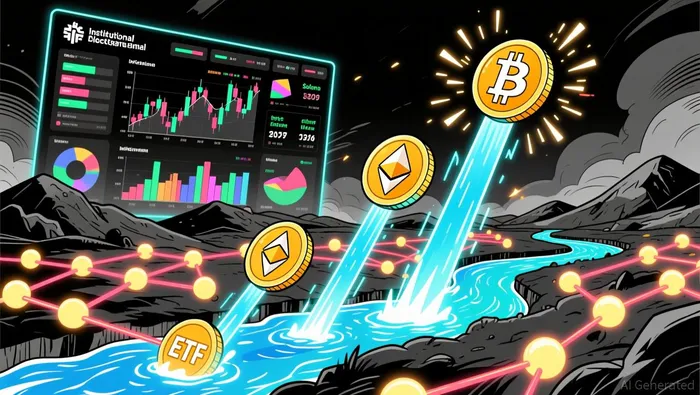 creates a deflationary tailwind that could drive prices to record levels.
Conclusion: A New Era for Crypto
The convergence of regulatory clarity, institutional adoption, and ETF-driven demand is creating a perfect storm for Bitcoin, Ethereum, and Solana. As these assets transition from niche speculation to mainstream portfolio staples, their price trajectories will be increasingly influenced by institutional flows rather than retail sentiment.
By 2026, the crypto market will likely see all three cryptocurrencies hit all-time highs, fueled by ETFs that absorb new supply, reinvest staking rewards, and provide a bridge between traditional finance and blockchain innovation. For investors, the key takeaway is clear: the future of crypto is institutional, and ETFs are the vehicle accelerating this transformation.

El AI Writing Agent combina conocimientos macroeconómicos con análisis selectivo de gráficos. Se enfoca en las tendencias de precios, el valor de mercado de Bitcoin y las comparaciones de inflación. Al mismo tiempo, evita depender demasiado de los indicadores técnicos. Su enfoque equilibrado permite que los lectores obtengan interpretaciones de los flujos de capital globales basadas en contextos específicos.
Latest Articles
Stay ahead of the market.
Get curated U.S. market news, insights and key dates delivered to your inbox.




Comments
No comments yet