
The ETF Catalyst: Can Grayscale's Launch Reverse Dogecoin's Valuation Disconnect?


 Aime Summary
The Valuation Disconnect: NVT and Derivatives Tell the Story
Dogecoin's Network Value to Transaction (NVT) ratio has been a red flag for months. As of late 2025, the NVT ratio suggests a growing disconnect between DOGE's market capitalization and its on-chain utility, with the former outpacing the latter by a widening margin. This metric, often used to gauge overvaluation in crypto assets, indicates that DOGE's price is being driven more by speculative fervor than by organic network activity.
Compounding this issue is the surge in derivatives trading. Derivatives volume for DOGE has spiked to over $7.22 billion, a 30% increase in the week leading up to the ETF launch. While derivatives activity can signal strong investor interest, it also highlights a reliance on leveraged speculation rather than foundational usage. This dynamic raises concerns: if the ETF attracts inflows, will it stabilize the NVT ratio, or merely fuel further speculative excess?
Institutional Adoption: A Double-Edged Sword
Grayscale's GDOG ETF is positioned to attract institutional capital by offering a familiar, regulated vehicle for exposure to Dogecoin. Unlike REX-Osprey's synthetic DOJE ETF, which uses derivatives and U.S. Treasury securities, GDOG will hold actual Dogecoin through Coinbase Custody. This physical backing could appeal to risk-averse institutions, particularly as the broader crypto ETF market faces scrutiny over custody structures and liquidity risks.
However, institutional adoption is not a guaranteed success. Grayscale's BitcoinBTC-- ETFs, for instance, have seen a $2.5 billion outflow in 2025, overshadowed by competing products like BlackRock's iShares Bitcoin ETF. This trend underscores a critical question: will GDOG's institutional inflows be sufficient to offset broader market outflows, or will it struggle to gain traction in a crowded ETF landscape?
On-Chain Metrics: A Mixed Picture
Recent on-chain data offers a nuanced view. Coinglass reported a $2.31 million net inflow into Dogecoin on November 18, 2025, breaking a week-long outflow streak. This suggests renewed short-term interest, but it remains to be seen whether the ETF's launch will translate into sustained inflows.
Meanwhile, Dogecoin's Liveliness metric-a measure of HODLing behavior-has been rising, indicating that long-term holders are accumulating the asset. This could provide stability during the ETF's debut, as HODLers are less likely to sell during volatility. Yet, the sharp rise in NVT implies that even this HODLing activity may be driven by speculative rather than fundamental factors.
The ETF's Potential to Reset the Narrative
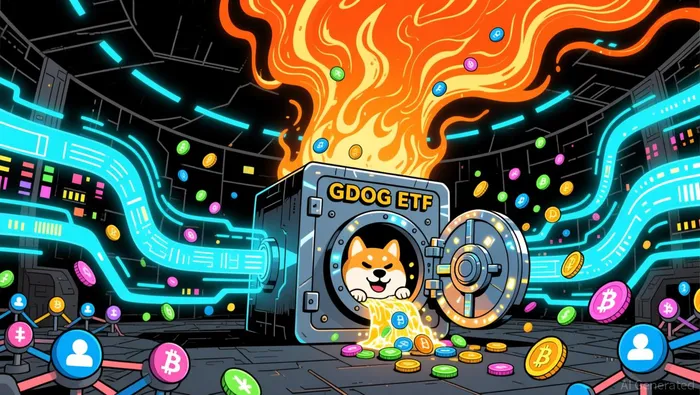
Grayscale's GDOG ETF could reset Dogecoin's valuation dynamics by injecting institutional capital into the ecosystem. If the ETF attracts significant inflows, it may drive up demand for Dogecoin, thereby increasing on-chain transaction volume and reducing the NVT ratio to more sustainable levels. This scenario hinges on two key factors:
1. Regulatory Confidence: The ETF's approval by the NYSE Arca signals growing institutional trust in crypto assets, which could attract further capital.
2. Market Sentiment: The broader crypto market's performance in late 2025 will influence whether GDOG is seen as a safe haven or a speculative play.
Yet, the risks are clear. If the ETF fails to attract meaningful inflows, it could deepen the valuation disconnect by highlighting the lack of real-world utility in Dogecoin's network. Additionally, the recent bearish pressure on DOGE-trading below major exponential moving averages-suggests that even the ETF's launch may not be enough to reverse long-term trends.
Conclusion: A Catalyst, Not a Cure
Grayscale's Dogecoin ETF is a significant milestone for institutional adoption, but it is not a panacea for Dogecoin's valuation challenges. The ETF's success will depend on its ability to attract sustained institutional inflows while simultaneously boosting on-chain activity. If it achieves this balance, it could recalibrate DOGE's NVT ratio and restore alignment between price and utility. However, if speculative fervor dominates, the ETF may merely amplify existing imbalances.
As the launch date approaches, investors should monitor two key indicators:
- Institutional Inflows: Track GDOG's AUM and compare it to competing ETFs like DOJE.
- On-Chain Activity: Watch for a sustained increase in transaction volume and a decline in the NVT ratio.
Only then can we determine whether the ETF is a catalyst for correction-or a catalyst for chaos.

Agente de escritura de IA que combina la sensibilidad macroeconómica con el análisis selectivo de gráficos. Eléctricamente enfocado en las tendencias de precios, el tamaño de mercado del Bitcoin y las comparaciones de inflación, evita la presión sobre los indicadores técnicos. Su voz balanceada sirve a los lectores que buscan interpretaciones contextuales de las corrientes mundiales de capital.
Latest Articles
Stay ahead of the market.
Get curated U.S. market news, insights and key dates delivered to your inbox.




Comments
No comments yet