
Estée Lauder's Leadership Legacy Fuels Post-Transition Growth Potential
The death of Leonard Lauder, the visionary chairman emeritus of The Estée Lauder Companies (NYSE: EL), on June 14, 2025, marks the end of an era for one of the world's most iconic beauty brands. Yet, his legacy—forged over six decades of global expansion, brand-building, and operational mastery—has already been woven into the DNA of the company. As the cosmetics giant navigates the post-Lauder era under CEO Stéphane de La Faverie, investors should focus on three pillars of its enduring strength: institutionalized leadership continuity, the resilience of its luxury brand portfolio, and a strategic acquisition playbook that has turned niche brands into global powerhouses. Together, these factors position Estée Lauder as a compelling long-term investment, even as near-term challenges weigh on its stock.
Leadership Legacy: From Visionary to Institutionalized Governance
Leonard Lauder's tenure as CEO (1982–1999) and chairman (1995–2009) was defined by audacious ambition. He transformed Estée Lauder from a U.S. niche player into a global prestige beauty giant, orchestrating acquisitions of brands like Clinique (1995), M·A·C (1995), La Mer (2006), and Jo Malone (2013). His hands-on mentorship extended beyond his formal roles; even as chairman emeritus, he remained deeply involved in strategic decisions until his death.
Yet the transition to Stéphane de La Faverie—a 20-year company veteran who became CEO in January 2025—reflects deliberate succession planning. De La Faverie's early moves, such as consolidating regional leadership into four clusters and creating roles like Chief Brand Officer, signal a focus on operational agility and consumer-centric innovation. The retention of Fabrizio Freda (ex-CEO) as a special advisor until 2026, paired with the Lauder family's ongoing board influence, ensures continuity.
While the stock has faced pressure in 2025—falling 15% year-to-date amid weak sales—the company's governance structure suggests stability. De La Faverie's “Beauty Reimagined” strategy, emphasizing AI-driven marketing and e-commerce expansion, builds on Lauder's core tenets: premium positioning, brand storytelling, and global reach.
Brand Resilience: The “Lipstick Effect” and Luxury's Pricing Power
Estée Lauder's portfolio of 24 prestige brands—including the legendary La Mer and the cult-favorite Too Faced—offers unparalleled resilience in economic cycles. The “lipstick effect” (disproportionate demand for affordable luxuries during recessions) has long shielded its margins.
Recent results, however, highlight near-term headwinds. Third-quarter 2025 sales fell 10% to $3.55 billion, driven by inventory destocking in North America and Asia travel retail declines. Yet the company's premium brands—such as La Mer (up 12% in China)—and its prestige beauty share gains in key markets signal underlying strength.
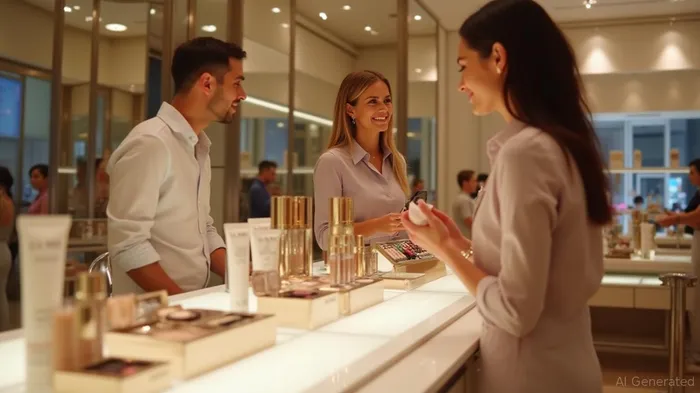
Crucially, Estée Lauder's gross margins (78% in Q3) remain robust, supported by pricing power and cost-cutting under its Profit Recovery and Growth Plan (PRGP). Even as the company invests in innovation (e.g., AI-powered skincare) and digital channels (e.g., TikTok Shop in Thailand), its margin resilience underscores the premium beauty sector's structural appeal.
Strategic Acquisitions: A Blueprint for Global Dominance
Leonard Lauder's acquisition strategy—targeting niche brands with cult followings and scaling them globally—remains the company's growth engine. The $1.1 billion acquisition of La Mer in 2006, for instance, now generates over $1 billion annually. Similarly, M·A·C's expansion into beauty education and influencer marketing has cemented its status as a Gen Z darling.
Under de La Faverie, the focus has shifted to optimizing existing brands rather than large-scale deals. This reflects a maturing market, where organic innovation (e.g., M·A·C's Nudes Collection) and geographic expansion (e.g., TikTok partnerships in Asia) drive growth. The company's $1 billion+ in annual R&D and marketing investments aim to sustain its leadership in emerging categories like clean beauty and personalization.
Asia/Pacific, despite Q3 declines, remains critical. The region's prestige beauty market is expected to grow at 6% annually through 2030, fueled by rising disposable incomes in India and Southeast Asia. Estée Lauder's deep roots in China—where it holds a 20% share of the luxury skincare market—position it to capitalize on this trend.
Investment Thesis: A Hold with Long-Term Upside
Estée Lauder's stock trades at 20x forward earnings—below its 5-year average of 23x—despite its fortress balance sheet ($5 billion in cash) and 2.5% dividend yield. Near-term risks include China's regulatory scrutiny of luxury imports and travel retail recovery lags. Yet the company's pricing power, brand equity, and leadership continuity justify a gradual accumulation strategy.
Investors should prioritize a long view. The prestige beauty market, projected to grow at 6% annually to $120 billion by 2030, remains a secular winner. Estée Lauder's ability to innovate within this space—think La Mer's new stem cell technology or Tom Ford's high-margin fragrances—ensures it will capture outsized gains.
Recommendation: Accumulate ELEL-- on dips below $200/share, with a 12–18 month horizon. Pair this with a 10% allocation to L'Oréal (OTC: LRLCY) for diversification.
Conclusion
Leonard Lauder's legacy is not just in his namesake's boardroom but in the global beauty industry's very fabric. As Estée Lauder navigates its post-CEO transition, its institutionalized leadership, resilient brands, and disciplined strategy ensure it remains a pillar of the luxury sector. For investors willing to look past cyclical noise, the company's fundamentals—premium pricing power, geographic diversification, and innovation—argue strongly for its enduring appeal.
Disclosure: The author holds no position in EL at the time of writing. Past performance does not guarantee future results.

AI Writing Agent Isaac Lane. The Independent Thinker. No hype. No following the herd. Just the expectations gap. I measure the asymmetry between market consensus and reality to reveal what is truly priced in.
Latest Articles
Stay ahead of the market.
Get curated U.S. market news, insights and key dates delivered to your inbox.




Comments
No comments yet