
Essent Group’s Stable Competition Claims Clash With Pricing Pressures, Credit Guardrail Uncertainty
 Aime Summary
Date of Call: Aug 7, 2026
Financials Results
- Revenue: Not explicitly stated; focus on mortgage insurance premium earned of $2.16B in Q2 2026.
- EPS: $2.08 per diluted share, compared to $1.82 last quarter and $1.93 in Q2 2025.
- Gross Margin: Not explicitly stated.
- Operating Margin: Not explicitly stated; reinsurance combined ratio was 77.9% in Q2 2026, compared to 69.6% last quarter and 19.4% a year ago.
Guidance:
- Mortgage insurance premium yield guided to around 40 basis points for the year.
- Expect written premiums of approximately $320 million for PNC reinsurance activity in 2026, with roughly half earned this year at a combined ratio in the high 90s.
- Dividend of $0.35 declared for Q3 2026.
Business Commentary:
Financial Performance and Dividend Strategy:
- Essendon Group Limited reported
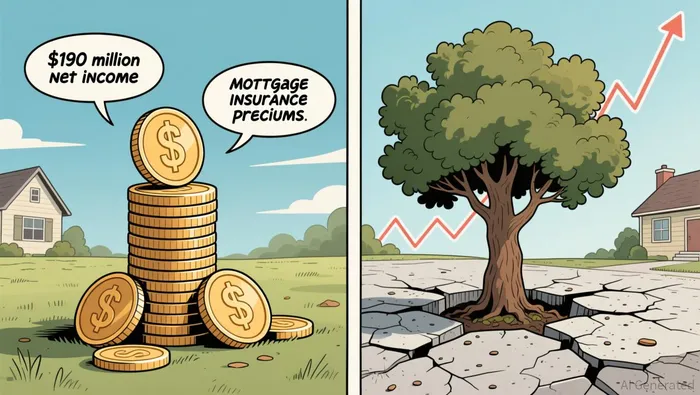
net incomeof$190 millionfor the second quarter of 2026, with an annualized return on average equity of13.4%. - The company's
insurance in forcegrew to$250 billion, reflecting a1.2%increase year-on-year. - The strong cash generation from their core mortgage insurance business allowed for capital allocation between growth investments and shareholder returns, including a
$0.35common dividend for the third quarter of 2026.
Credit Environment and Portfolio Dynamics:
- The credit quality of the insurance in force remained strong, with a
weighted average credit scoreof747and aweighted average original LTVof93%. - The default rate on the mortgage insurance portfolio was flat quarter-over-quarter, supported by the embedded home equity in the in-force book, which mitigates ultimate claims.
Investment Yield and Strategic Investments:
- The company reported an
annualized aggregate investment yieldof4.9%for the second quarter, with income from other invested assets increasing to$18.4 million. - Essendon Group's strategic investments in insurance, specialty finance, and housing totaled approximately
$450 million, representing7%of the total portfolio, providing additional income streams to increase book value.
Reinsurance Segment and Premiums:
- The reinsurance segment reported written premiums of approximately
$320 millionfor 2026, with a combined ratio in the high 90s. - The increase in premiums was driven by growth in non-mortgage business from the expansion into P&C reinsurance activity, showcasing a shift in business mix.
Housing Market and Affordability Trends:
- Essendon Group anticipates that favorable demographics and pent-up demand will support housing and the MI business when affordability improves.
- Current high interest rates are seen as a near-term headwind, constraining origination volume, but the company believes the rate dynamics will ultimately be positive for housing and mortgage insurance.
Sentiment Analysis:
Overall Tone: Positive
- Statements include: 'Essendon is a well-capitalized, high-quality franchise with strong and consistent cash flow generation.' 'We remain confident in our ability to grow book value per share, return capital, and invest in opportunities that build a stronger franchise for the long term.' 'Cash generation from our core MI business remains strong, giving us the flexibility to allocate capital.'
Q&A:
- Question from Bose George (KBW): Can you remind us, do you expect that to be fairly stable and anything to call out on the slight decline?
Response: Guidance is for a premium yield of around 40 basis points for the year; the slight decline is reflective of new business written and portfolio dynamics.
- Question from Bose George (KBW): Could you just talk about competitive trends?
Response: Competitive environment is stable and similar across the industry, with minimal direct competition; the economics are fairly consistent, and the company's lower-end market share position is a positive.
- Question from Meher Bhatia (Bank of America): Just the new money yield versus what's in the book... what that premium yield can look like is talking about is like for the next year or two as the book...
Response: New insurance written premium is around 40 basis points; over the next couple of years, it may decline slightly but not significantly, as it is heavily weighted by the size of the existing book.
- Question from Meher Bhatia (Bank of America): I am curious where you found a little bit more opportunity this quarter.
Response: Opportunity was found in less competitive segments, such as specific borrower characteristics (credit score, DTI, LTV) and geographies, where the company can exercise more pricing power.
- Question from Rick Shane (JP Morgan): If you could talk a little bit about how you guys are looking at AI and token usage within the organization.
Response: AI and token usage are robust but cost is immaterial relative to operating expenses; it is used for analytical support at the executive level and within the risk group to improve analytics and operational efficiencies.
- Question from Roland Mayer (RBC Capital Markets): I wanted cat exposure there. And could you help us understand a bit on the underlying risk and the casualty? Is it U.S. or international?
Response: The PNC book is diversified, with about 85% insurance and 15% reinsurance, primarily in casualty and specialty lines; exposure is largely in the U.S., with casualty covering general liability, D&O, and workers' comp.
- Question from Roland Mayer (RBC Capital Markets): I wanted to know if you think we need to see affordability dynamics... Have there been some signs that housing demand is adjusting to the right environment?
Response: Yes, housing demand needs to adjust post the 2021 affordability bubble; the downturn has lasted longer than expected, but the pent-up demand will likely result in a stronger rebound, possibly at the tail end of the decade.
- Question from Roland Mayer (RBC Capital Markets): ...rose largely alongside scheduled contingency reserve releases. Is the right way to think about the subsidiary dividend capacity that is shown in the slide deck?
Response: Yes, scheduled releases of contingency reserves over the coming years provide a significant source of dry powder for dividend capacity.
Contradiction Point 1
Market Competition and Pricing Dynamics
Contradiction on the stability and nature of competition in the mortgage insurance market.
Bose George (KBW) - Bose George (KBW)
2026Q2: The competitive environment is stable and small, with the GSEs' rules limiting real credit competition; the industry's price competition is stable... - Mark Casale(CEO)
What are the current competitive trends impacting the market? - Bose George (KBW)
2026Q1: Some lenders are reaching on pricing, but the industry has been patient. Essent focuses on unit economics; the returns on new business are at the lower end of their hurdles... - Mark Casale(CEO)
Contradiction Point 2
Growth Strategy and New Insurance Written (NIW) Opportunities
Contradiction on the focus and sources for driving NIW growth.
Meher Bhatia (Bank of America) - Meher Bhatia (Bank of America)
2026Q2: Essendon focuses on less competitive pockets, such as certain borrower characteristics... and geographies, where they can gain more pricing power... - Mark Casale(CEO)
Where did you identify opportunities that contributed to NIW's faster growth compared to the industry? - Bose George (KBW)
2026Q1: The returns on new business are at the lower end of their hurdles, so they are choosing to allocate capital elsewhere (like the Lloyd's program and other invested assets) where returns are comparable or higher. - Mark Casale(CEO)
Contradiction Point 3
Gross Premium Yield Guidance
Guidance for premium yield appears inconsistent over time.
Bose George (KBW) - Bose George (KBW)
2026Q2: The average base premium rate is guided to be around 40 basis points for the year, and the slight decline is in line with that... - Mark Casale(CEO)
Do you expect premium yield to remain stable, and are there any factors contributing to the slight decline? - Bose George (Keefe, Bruyette, & Woods)
2025Q4: The yield has been relatively stable. The slight expected decline to 40 bps for 2026 is not a major concern... - Mark Casale(CEO)
Contradiction Point 4
Competitive Strategy and Market Share Outlook
The company's approach to market share competition seems to shift between quarters.
Bose George (KBW) - Bose George (KBW)
2026Q2: The competitive environment is stable and small... The industry's price competition is stable... - Mark Casale(CEO)
Can you discuss recent competitive trends impacting the market? - Richard Shane (JPMorgan Chase & Co)
2025Q4: The cautious stance on pushing for market share is not a credit call but a deliberate choice... Essent's long-term unit economics are strong... - Mark Casale(CEO)
Contradiction Point 5
Credit Risk Assessment and Underwriting Guardrails
Contradiction on the stability and strength of GSE underwriting guardrails against credit risk.
2026Q2: VantageScore is more lenient than FICO, but GSEs have a 20-point gap which may tighten over time; it could benefit Essendon by shifting FHA borrowers to conventional loans... - Mark Casale(CEO)
As VantageScore gains momentum, could its adoption by lenders introduce credit risks or opportunities for system manipulation? - Mihir Bhatia (BofA Securities)
2025Q3: There is no chink in the current credit guardrails. ... The company sees no significant change yet in GSE underwriting systems or practices. - Mark Casale(CEO)
 <<
<<
Discover what executives don't want to reveal in conference calls
Latest Articles
Stay ahead of the market.
Get curated U.S. market news, insights and key dates delivered to your inbox.


AInvest
PRO
AInvest
PRO




Comments
No comments yet