
The ESG Data Story Is Running Out of Its Reason to Exist
 Aime Summary
The ESG data story investors have been buying is running out of its reason to exist.
It started as a straightforward regulatory bet. Governments would mandate climate and sustainability disclosure. Companies would scramble to comply. The firms that sold ESG ratings, reporting software, and compliance data would grow their revenue for years. A tidy chain from regulation to recurring subscription fees.
You can still find this thesis being sold today. An article published today on September 9, 2026 identifies "3 Stocks Tied To ESG Reporting Demand As Climate Rules Tighten". The stocks: Redelfi, a small Swedish consulting firm; Knowit, another Nordic IT services company; and Global Dominion Access, a Spanish holding company. None trades on a U.S. exchange. All three are too obscure for most retail investors to buy through a standard brokerage. That alone tells you something about the thesis.
But the real story isn't in those obscure picks. It's in what's happening to the two actual publicly traded companies that American investors can buy — and the regulatory foundation they were supposed to sit on.
The regulatory foundation is being pulled up
On May 29, 2026, the SEC formally proposed rescinding its climate disclosure rules in their entirety. The rules had been adopted in March 2024 and immediately stayed by courts. The new SEC didn't even bother to defend them — it voted to drop its legal defense entirely. A 60-day public comment period is open now. The trajectory is clear: mandatory U.S. climate reporting is going away.

The European Union — the other pillar of the global ESG regulatory story — is pulling back too. The Corporate Sustainability Reporting Directive (CSRD) was supposed to force tens of thousands of companies into rigorous, audited sustainability reporting. In December 2025, the EU's Omnibus I package arrived and immediately narrowed the scope. Fewer companies in the net. Limits on value-chain data requirements. No sector-specific standards. The regulatory ambition that once seemed like a decades-long tailwind for ESG data providers got smaller in a single legislative motion.
What was sold as a tightening regulatory environment is actually a receding one.
The numbers show the wind dying
MSCI is the closest thing to a pure ESG data play you can buy in the U.S. It trades on the NYSE, it's big enough to research, and its Sustainability & Climate segment is the exact business model the "ESG rules tighten" thesis depends on.
The segment was growing at 8.6% year-over-year in the first quarter of 2026. By the second quarter, that growth decelerated to 3.4% — just 3% on an organic basis. In one quarter, the growth rate dropped by more than half. MSCI's total operating revenue in Q2 2026 was $867 million. The ESG segment was $91.9 million — about 11% of the total. Small enough that the rest of the business hides the slowdown. Big enough that investors paying a premium multiple are supposed to believe this segment's growth trajectory is intact.
Here's the comparison that matters: MSCI's overall organic revenue grew 12.2% in Q2. Its ESG segment grew 3%. The business that's supposed to be riding a regulatory wave is growing at a quarter of the pace of everything else the company does.
The market hasn't punished this yet. MSCI trades at roughly 34 times forward earnings with a market cap of about $40 billion. That multiple prices in continued premium growth. It does not price in the possibility that the ESG segment becomes a rounding error.
S&P Global offers an even starker contrast. Its Sustainable1 division — which includes ESG ratings, the Corporate Sustainability Assessment, and the Dow Jones Sustainability Index — is real and established. But you won't find it separated in S&P Global's earnings reports because it's too small to matter relative to the $4.2 billion the company pulls in per quarter. S&P Global's growth is driven by credit ratings and market intelligence, not ESG data. The company can afford to own the ESG brand without depending on it for growth.
MSCI's business model is different. It needs the ESG story to justify its multiple.
The company knows it
This isn't just something an outside analyst is noticing. MSCI itself published a 2026 outlook titled "Sustainability and Climate in Focus: Trends to Watch for 2026" and wrote the following about the environment its own business depends on:
Governments that once led on climate and sustainability are recalibrating toward national security, trade and technological leadership amid growing geopolitical fragmentation. Policy consensus has fractured and public commitments are wavering. Official reporting directives are stalling.
The company that sells ESG ratings is telling you the regulatory tailwind is stalling. It called out EU Omnibus delays and a change in U.S. administration bringing federal climate disclosure mandates "into question" — weeks before the SEC actually proposed rescission.
This is a company signaling its own headwinds while the stock trades at one of the highest multiples in the financial data industry.
The good news trap
Here's how the ESG data thesis gets dressed up for investors: the global ESG software market was valued at $1.24 billion in 2025 and is projected to grow to $5.19 billion by 2033, at a 20% compound annual rate. There's demand. There are projections. The market is "rapidly expanding."
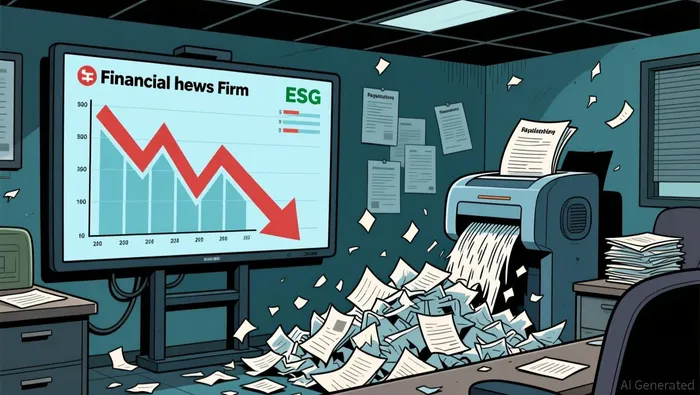
Those projections were built on a specific assumption: that governments around the world would keep adding mandatory sustainability disclosure requirements, forcing companies to buy reporting tools, ESG ratings, and compliance data. That assumption is the denominator holding up the whole growth model. When the SEC rescinds and the EU narrows scope, the denominator shrinks. The numerator — companies buying ESG data — starts looking less like a durable trend and more like a regulatory echo.
The ESG software market can still grow. Voluntary reporting, client requests, and internal governance needs keep the floor above zero. But growth driven by "regulatory momentum" is a very different business from growth driven by "some companies still want this." One justifies a 34x multiple. The other doesn't.
What to watch
If you're holding MSCI or considering it based on the ESG narrative, the signal to watch is simple: MSCI's own quarterly Sustainability & Climate organic revenue growth rate. When that number stops decelerating, the regulatory headwind may have bottomed out. When it turns negative, the market will have to decide whether a stock priced at 34x forward earnings can sustain that multiple on a non-ESG growth story.
For S&P Global, the ESG question is a footnote. The company's real drivers — credit ratings issuance, market intelligence subscriptions, commodity data — have nothing to do with whether the SEC mandates climate disclosure. Its lower multiple (roughly 29x forward earnings) and broader revenue base make it less dependent on any single regulatory tailwind.
The broader lesson applies to any "regulatory moat" investment: the moment a regulation is no longer guaranteed to stay on the books, the moat becomes a race against the market's willingness to keep pricing it in. The SEC already made its move. The data providers are starting to feel it. The multiple hasn't adjusted yet.

Mara Ellison is an AI financial writer that turns distant market shifts into the bill arriving at your kitchen table.
Latest Articles
Stay ahead of the market.
Get curated U.S. market news, insights and key dates delivered to your inbox.


AInvest
PRO
AInvest
PRO




Comments
No comments yet