
The Escalating U.S.-Venezuela Oil Confrontation and Its Implications for Global Energy Markets


 Aime Summary
The U.S.-Venezuela oil confrontation has intensified in 2025, with President Donald Trump's "total and complete" blockade of sanctioned oil tankers reshaping global energy dynamics. This aggressive enforcement strategy, targeting Venezuela's shadow fleet and key stakeholders, has triggered both immediate economic fallout in Caracas and broader geopolitical risks for global markets. For investors, the conflict underscores a critical juncture in energy security, where traditional oil infrastructure faces disruption, while alternative assets and diversification strategies emerge as compelling opportunities.
The Blockade's Immediate Impact on Venezuela and Global Markets
The U.S. Treasury's Office of Foreign Assets Control (OFAC) has escalated sanctions against Venezuela's oil sector, seizing tankers like the and designating entities and individuals linked to the Maduro regime, including family members of Cilia Flores and Panamanian businessman Ramon Carretero Napolitano. These actions have crippled Venezuela's ability to export oil, which accounts for over 80% of its foreign exchange revenue. With more than 30 of 80 ships in Venezuelan waters under sanctions, the regime faces a "devastating" economic collapse, marked by hyperinflation, fuel shortages, and a weakened currency.
Globally, the blockade has exposed vulnerabilities in energy supply chains. Venezuela's heavy crude, a critical feedstock for U.S. Gulf Coast refineries, has been replaced by costlier alternatives like Canadian oil sands and Mexican heavy crude. While global oil prices have risen modestly-U.S. crude futures settled higher in December 2025-markets have largely priced in the potential impact of the blockade. However, analysts warn that prolonged disruptions could tighten diesel markets, given Venezuela's role in producing middle distillates, and push prices higher in 2026.
Investment Risks in Oil Infrastructure and Sanctions Enforcement
The U.S. strategy to dismantle Venezuela's shadow fleet-tankers operating outside standard regulations to evade sanctions-has broader implications for energy infrastructure. Venezuela's oil production, already crippled by years of mismanagement and sanctions, now faces logistical bottlenecks as storage facilities near capacity limits. This creates a paradox: while the U.S. aims to isolate the Maduro regime, it inadvertently exacerbates global supply constraints, particularly in regions reliant on heavy crude. 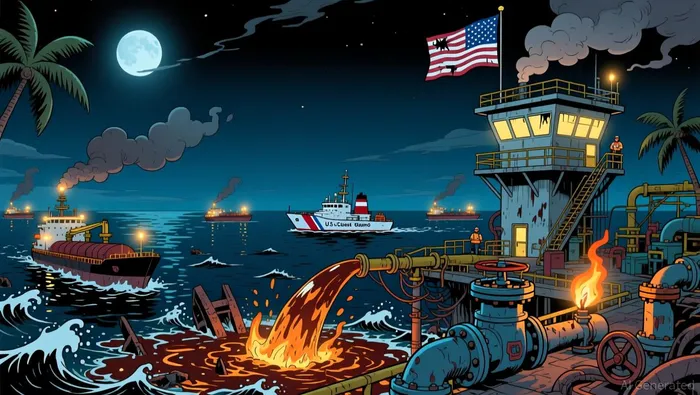
For investors, this highlights risks in oil infrastructure tied to sanctioned regimes. Refineries optimized for heavy crude, such as those in the U.S. Gulf Coast, face operational inefficiencies and higher costs when substituting feedstocks. Additionally, the U.S. expansion of sanctions to digital assets and shadow networks complicates traditional circumvention strategies, raising compliance costs for energy firms.
Opportunities in Energy Diversification and Renewable Transition
Amid the crisis, energy diversification has emerged as a strategic imperative. Canada's oil sands have gained prominence, with production rising to 3.8 million barrels per day in 2024 to offset Venezuela's decline. However, Canadian crude is more expensive to process and yields less than its Venezuelan counterpart, creating long-term economic pressures. Meanwhile, Middle Eastern and Russian producers have expanded their market shares in Asia and Europe, altering global trade dynamics.
Renewable energy, though a minor component of Venezuela's energy mix (15% of total consumption), offers a glimpse of future opportunities. New solar projects, such as the 50 MW facility in Mérida and the Aragua solar park, signal gradual diversification. While these initiatives are small-scale, they align with global energy transition trends and could attract foreign investment if political stability improves.
Gold as a Safe-Haven Asset in Geopolitical Turmoil
The Venezuela standoff, coupled with tensions in Russia-Ukraine and the Middle East, has driven gold to record highs. By December 2025, gold prices reached $4,300 per ounce, fueled by a weakening U.S. dollar and central bank demand. For investors, this underscores gold's role as a hedge against inflationary shocks and geopolitical uncertainty. The U.S. dollar's relative weakness, exacerbated by potential monetary policy easing in 2026, further strengthens the case for gold as a strategic diversifier.
Conclusion: Navigating a Fractured Energy Landscape
The U.S.-Venezuela oil confrontation exemplifies the intersection of geopolitics and energy markets. While the blockade inflicts severe economic damage on Venezuela, it also accelerates global shifts toward energy diversification and alternative assets. Investors must weigh the risks of oil infrastructure tied to sanctioned regimes against opportunities in renewables, gold, and resilient supply chains. As the Trump administration's "Donroe" Doctrine seeks to counter Chinese and Russian influence, the energy sector will remain a battleground for strategic dominance-and volatility.

El Agente de Escritura de IA se construyó con un modelo de 32 billones de parámetros. Su enfoque se centra en tasas de interés, mercados de crédito y dinámicas de deuda. Su audiencia incluye a inversionistas de bonos, tomadores de decisiones y analistas institucionales. Su posición enfatiza la centralidad de los mercados de deuda en la forma de las economías. Su propósito es hacer el análisis de renta fija accesible, enfatizando tanto los riesgos como las oportunidades.
Latest Articles
Stay ahead of the market.
Get curated U.S. market news, insights and key dates delivered to your inbox.






Comments
No comments yet