
Escalating Trade Uncertainty and Last-Minute Negotiations as Tariff Deadline Nears
 Aime Summary
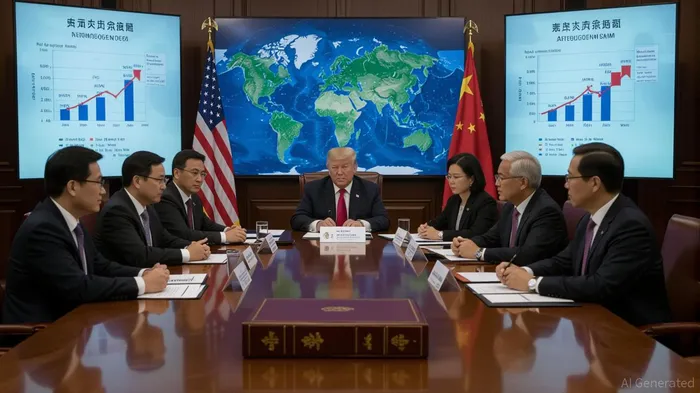
As the August 12, 2025, expiration of the U.S.-China tariff truce looms, global markets are bracing for a potential escalation in trade tensions. The temporary pause in tariffs, agreed upon in July 2025, has provided a fragile window for negotiations, but unresolved disputes over market access, intellectual property, and semiconductor exports remain unresolved. With President Trump hinting at a 90-day extension, investors are left to navigate a landscape of uncertainty, where policy shifts could trigger sharp volatility in trade-sensitive sectors.
The U.S.-China Truce: A Delicate Balancing Act
The truce's expiration date has become a focal point for markets. While the U.S. seeks commitments from China to reduce trade barriers and address IP concerns, Beijing has shown reluctance to cede ground on key issues like technology transfer. The threat of new tariffs—potentially as high as 250% on pharmaceuticals and 150% on semiconductors—looms large. These sectors, already under pressure from supply chain disruptions, could face margin compression if tariffs are imposed.
Broader Trade Developments and Sector Impacts
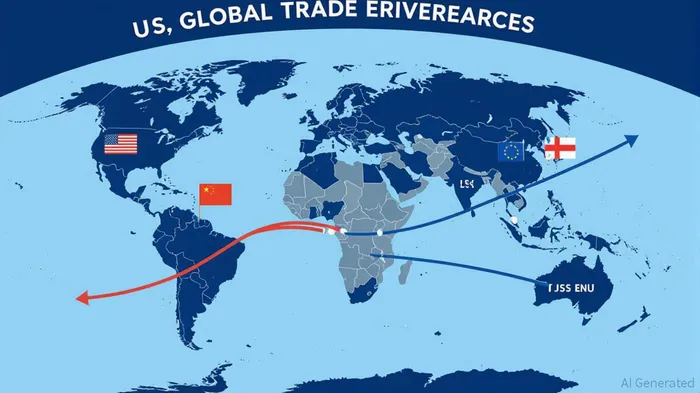
Beyond China, the U.S. has extended tariff negotiations with Mexico and finalized agreements with the EU and South Korea. The EU deal, which includes a 15% reciprocal tariff, has created a mixed outlook for European exporters. Meanwhile, Mexico's 90-day extension suggests a delayed resolution, adding to near-term uncertainty for North American manufacturers.
Transshipment penalties and the suspension of the de minimis exemption for low-value imports have further complicated logistics for global businesses. These measures, effective August 7 and August 29, respectively, are expected to increase compliance costs and delay supply chains, particularly for small and mid-sized enterprises.
Market Reactions: Volatility and Strategic Rebalancing
The first half of 2025 saw markets oscillate between fear and optimism. Equity indices like the S&P 500 eked out a 5% gain, driven by tech stocks and resilient earnings, while the MSCIMSCI-- EAFE surged 18% as investors sought diversification. Trade-sensitive sectors, however, lagged. Manufacturing and retail hiring softened, with job growth averaging 100,000 per month—a stark contrast to the robust hiring in healthcare and education.
Fixed income markets reflected similar caution. The 10-year Treasury yield hovered near 4.3%, with investors pricing in the risk of inflationary pressures from tariffs. The Federal Reserve's “wait-and-see” stance on rate cuts—projected to deliver 75 basis points of easing by year-end—has added another layer of complexity for asset allocators.
Positioning for the Second Half: Quality Over Speculation
Given the high-stakes environment, investors should prioritize quality and diversification. Here are three strategic considerations:
Defensive Sectors with Pricing Power: Companies in sectors like healthcare and technology, which have demonstrated resilience to trade shocks, offer a buffer against volatility. For example, firms with strong R&D pipelines or dominant market shares in semiconductors may mitigate the impact of tariffs.
International Exposure: The MSCI EAFE's outperformance highlights the appeal of global diversification. Emerging markets, in particular, present opportunities in undervalued equities, though investors should remain selective and favor economies with stable trade policies.
Hedging Against Policy Risk: Currency hedges and short-term fixed income instruments can protect portfolios from sudden shifts in trade policy. For equity investors, options strategies like protective puts may provide downside protection in trade-sensitive industries.
The Road Ahead: Navigating a Policy-Driven Landscape
The coming weeks will be critical. If the U.S.-China truce is extended, markets may stabilize, allowing companies to focus on earnings growth. However, a failure to reach an agreement could trigger a spike in volatility, particularly in sectors like manufacturing and retail. Investors should monitor key dates: August 12 (truce expiry), October 5 (goods-in-transit deadline), and November 12 (potential extended expiry).
In this environment, patience and discipline are paramountPARA--. While the third year of a bull market often sees muted returns, a focus on quality stocks and global diversification can help navigate the turbulence. As the Federal Reserve prepares to ease rates, the interplay between monetary policy and trade uncertainty will remain a defining theme for the remainder of 2025.
In conclusion, the tariff deadline is not just a policy event—it's a catalyst for strategic realignment. By staying attuned to sector-specific risks and opportunities, investors can position their portfolios to weather the storm and capitalize on the next phase of market evolution.

Stay ahead of the market.
Get curated U.S. market news, insights and key dates delivered to your inbox.






Comments
No comments yet