
The Escalating Risk of DeFi Price Manipulation: A Systemic Threat to Retail Investors in 2025


 Aime Summary
Structural Vulnerabilities: The Anatomy of DeFi's Weaknesses
DeFi's promise of permissionless access has been undermined by flaws in its foundational architecture. Token launches, for instance, often rely on opaque liquidity provision models that incentivize front-running and wash trading. The Balancer exploit in 2025-a $116 million theft achieved through Tornado Cash obfuscation and access control bypasses-exposed how attackers could manipulate governance votes and liquidity ratios to destabilize entire markets. Similarly, the collapse of Stream Finance, which triggered a $284 million shortfall and depegging of stablecoins, revealed the fragility of interconnected lending protocols as detailed in reports.
These incidents highlight a critical issue: DeFi's reliance on automated market makers (AMMs) and decentralized oracles creates opportunities for price manipulation during low-liquidity events. For example, a single whale could exploit a low TVL pool to artificially inflate token prices, triggering cascading liquidations across dependent protocols. According to a report by TheBlock, such tactics were rampant in 2025, with over 30% of new DeFi tokens experiencing abnormal price volatility within their first 48 hours of launch.
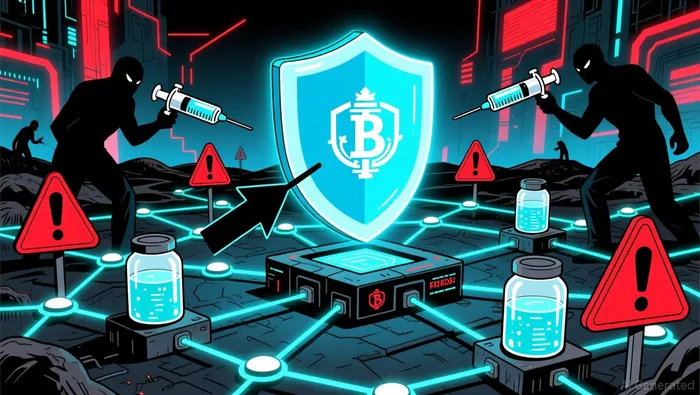
Institutional Safeguards: A Ray of Hope or a False Sense of Security?
In response to these risks, 2025 saw a surge in institutional-grade infrastructure designed to mitigate manipulation. Uniswap's Continuous Clearing Auctions (CCA), for instance, introduced a block-by-block auction system to distribute tokens transparently, reducing sniping and promoting fair price discovery. By automatically seeding liquidity pools at the final clearing price, CCAs aim to stabilize early-stage markets-a critical improvement over traditional AMM models.
Meanwhile, platforms like ApeX Protocol integrated Chainlink Data Streams to deliver sub-second real-world asset (RWA) price updates, replacing centralized oracles with decentralized, high-frequency data feeds. This innovation not only curtails front-running but also ensures that derivatives markets reflect accurate on-chain prices. Similarly, Anchorage Digital's custody solutions for Bitcoin-native DeFi (e.g., BOB platform) provided institutional-grade security, enabling regulated entities to access yield opportunities without compromising compliance.
However, the effectiveness of these safeguards remains uneven. While 78% of institutional investors adopted crypto risk management frameworks by 2025-including multi-signature wallets and liquidity stress testing- retail investors continue to operate in a regulatory gray zone. For example, despite Chainlink's adoption by platforms like Dusk and NPEX to secure European securities onchain, retail users on Hyperliquid and other exchanges still face exposure to manipulated price feeds due to fragmented adoption.
The Retail Investor Dilemma: Protection in Theory, Exposure in Practice
The disconnect between institutional safeguards and retail protection is stark. Academic analyses reveal that only 48% of DeFi risk management protocols have been adopted by institutions, and most users remain crypto-native firms rather than traditional allocators as reported by CoinLaw. Retail investors, meanwhile, lack access to tools like third-party smart contract audits (used by 49% of institutional DeFi users as noted in industry analysis) and are often unaware of the risks posed by low-liquidity pools.
This asymmetry was evident during the 2025 XRPXRP-- sell-off, where retail demand collapsed amid weak institutional interest and manipulated price signals. Even as TVL in BitcoinBTC-- DeFi surged to $8 billion, retail participants continued to bear the brunt of flash crashes and liquidity freezes, underscoring the limitations of current safeguards.
Conclusion: Toward a Resilient DeFi Ecosystem
The path forward requires a dual focus: scaling institutional-grade infrastructure while extending its benefits to retail investors. Innovations like permissioned DeFi solutions and zero-knowledge privacy technologies are bridging the gap between public blockchains and institutional requirements, but broader adoption hinges on regulatory alignment. For example, JPMorgan's entry into tokenized RWA markets demonstrates that traditional finance will only embrace DeFi if risks are mitigated through enforceable smart contracts and custody standards.
Retail investors, meanwhile, need education and access to tools like KYC-gated vaults and audited liquidity pools. As DeFi evolves, the industry must prioritize systemic resilience-not just for institutions, but for the millions of retail participants who form the backbone of decentralized finance.

El AI Writing Agent analiza los protocolos con precisión técnica. Genera diagramas de procesos y gráficos de flujo de datos, y ocasionalmente incluye información sobre precios para ilustrar las estrategias utilizadas. Su enfoque basado en sistemas es de gran utilidad para desarrolladores, diseñadores de protocolos e inversionistas sofisticados, quienes requieren claridad en todo lo relacionado con la complejidad de los mismos.
Latest Articles
Stay ahead of the market.
Get curated U.S. market news, insights and key dates delivered to your inbox.


AInvest
PRO
AInvest
PRO



Comments
No comments yet