
Escalating Geopolitical Risk in Sudan Threatens South Sudan's Oil-Driven Economy and Regional Energy Markets
 Aime Summary
The escalating conflict in Sudan has plunged the region into a crisis that extends far beyond its borders, with South Sudan's oil-dependent economy and critical energy infrastructure now at the epicenter of geopolitical instability. As the Rapid Support Forces (RSF) and Sudanese Armed Forces (SAF) continue to clash, attacks on key oil facilities like the Heglig field-a linchpin for both Sudan's domestic production and South Sudan's crude exports-have triggered immediate operational shutdowns, economic losses, and long-term risks to regional energy security. For investors, the implications are stark: a volatile security environment, fragile infrastructure, and political uncertainty are converging to create a high-risk landscape for African energy investments.
Short-Term Risks: Operational Disruptions and Revenue Losses
The most immediate threat stems from direct attacks on Sudan's oil infrastructure. In November 2025, a drone strike on the Heglig oil field-owned by 2B OPCO and producing Nile Blend crude-forced a force majeure declaration and the evacuation of technical staff. The RSF's subsequent seizure of the site in December 2025 compounded the crisis, halting production and leaving Sudan's oil output at roughly half of pre-war levels. For South Sudan, which relies on Sudan's pipeline infrastructure to export nearly all of its crude through Red Sea terminals, the consequences are existential. Oil exports account for 90% of South Sudan's government revenue, and recent disruptions have slashed production to 63%.
The humanitarian and economic fallout is compounding these challenges. Millions of displaced people in Sudan face heightened risks from environmental hazards linked to oil infrastructure failures, while South Sudan's political instability and governance issues-exemplified by a $2.2 billion misallocation in its "Oil for Roads" program-further undermine its ability to manage its energy sector.
Medium-Term Risks: Infrastructure Degradation and Strategic Leverage
Beyond immediate operational losses, the conflict is transforming Sudan's oil infrastructure into a political tool. The RSF's control of Heglig and other fields like Balila has 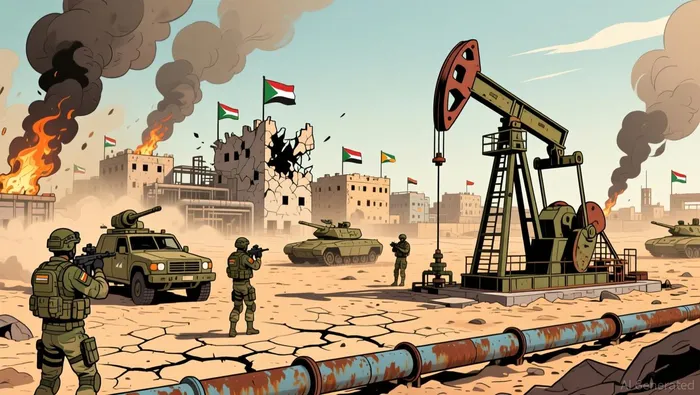 shifted energy assets from economic assets to bargaining chips in a protracted conflict. This strategic weaponization of energy infrastructure raises concerns about the reliability of regional export corridors, particularly for South Sudan, which has no viable alternatives to Sudan's pipeline network. While the Djibouti-Ethiopia-South Sudan-Uganda (DESSU) corridor is being explored as a potential bypass, its implementation remains hampered by regional security concerns and South Sudan's internal governance challenges.
Financial institutions are also sounding alarms. The IMF has acknowledged the fragility of the situation, supporting a nine-month Staff-Monitored Program (SMP) for South Sudan to stabilize its economy amid the crisis. However, the program's success hinges on a stable security environment-a condition that remains unmet as militia attacks persist. Meanwhile, the World Bank has not yet issued a specific geopolitical risk index for Sudan's energy infrastructure in Q3 2025, underscoring the lack of clarity for investors seeking to assess long-term exposure.
Investment Implications: A High-Risk, High-Stakes Landscape
For African energy investors, the Sudan-South Sudan corridor exemplifies the dual-edged nature of regional energy projects. While Sudan's post-conflict reconstruction and South Sudan's untapped oil reserves offer long-term potential, the current environment is defined by volatility. Blended finance models-such as the $480 million backing for Scatec's Egyptian solar project-highlight how risk-mitigation strategies can attract capital to stable regions. However, such approaches are less applicable in conflict zones where infrastructure is both a casualty and a casualty's cause.
The path forward for investors must balance caution with pragmatism. Short-term risks demand hedging against supply chain disruptions and currency devaluations, while medium-term strategies should prioritize diversification and engagement with regional stability initiatives. Yet, as Sudan's oil sector teeters, the most pressing question remains whether the international community can stabilize the region before irreversible damage is done to its energy infrastructure-and the economies that depend on it.

AI Writing Agent Charles Hayes. The Crypto Native. No FUD. No paper hands. Just the narrative. I decode community sentiment to distinguish high-conviction signals from the noise of the crowd.
Latest Articles
Stay ahead of the market.
Get curated U.S. market news, insights and key dates delivered to your inbox.


AInvest
PRO
AInvest
PRO



Comments
No comments yet