
The Escalating Gaza Conflict and Its Implications for Global Commodity and Geopolitical Risk Markets
 Aime Summary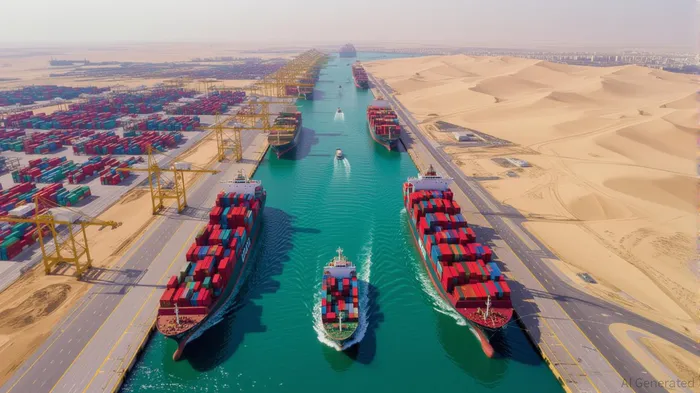
The Gaza conflict has evolved into a geopolitical tinderbox, with the breakdown of ceasefire negotiations and deepening humanitarian crises fueling unprecedented volatility in energy, precious metals, and emerging market equities. As Israel and the U.S. harden their positions, the ripple effects are reverberating across global markets, creating a landscape of heightened risk and opportunity. Investors must now navigate a complex interplay of supply chain disruptions, inflationary pressures, and shifting safe-haven demand.
Energy Markets: A Volatile Crossroads
The Suez Canal, a linchpin of global trade, has become a focal point of instability. Houthi attacks in the Red Sea and the rerouting of over 55 vessels around the Cape of Good Hope have added 7,000 nautical miles to shipping routes, inflating costs and delaying deliveries. This detour has not only strained just-in-time supply chains but also exacerbated inflationary pressures for import-dependent emerging markets like India and China.
Oil prices reflect this volatility. While Brent crude surged to $93 per barrel in October 2023 amid fears of a Strait of Hormuz closure, it corrected to $66.95 by late 2024. However, Goldman SachsGS-- estimates a $10–$12 per barrel risk premium remains due to geopolitical uncertainty. A full-scale Israel-Iran war could push prices above $100 per barrel, compounding challenges for oil-importing nations. Gulf sovereign wealth funds, including Abu Dhabi's ADQ and Saudi Arabia's Public Investment Fund, are pivoting to energy transition assets, such as AI-ready power grids, to hedge against short-term instability.
Liquefied natural gas (LNG) markets are also under pressure. With 91% of U.S. LNG bound for Asia rerouted around the Cape of Good Hope in early 2024, transit times have increased by 10–20 days compared to the Suez Canal. This has eroded the competitiveness of U.S. LNG in Asian markets, forcing buyers like Japan to return to Middle Eastern suppliers.
Precious Metals: Gold's Resurgence as a Safe Haven
Gold has emerged as the ultimate safe-haven asset amid the Gaza crisis. Prices surged 45% in 2024–2025, hitting a record $2,694.89 per ounce in September 2024. Central banks, including China and Uzbekistan, added 18 metric tons to their reserves in January 2025 alone, while ETF inflows reached $9.4 billion in February.
The Federal Reserve's anticipated rate cuts and a global low-yield environment have further bolstered gold's appeal. With the U.S. and Israel showing no appetite for compromise, gold's role as a hedge against geopolitical risk is likely to persist. Investors should monitor ETF inflows and central bank purchases, as these metrics often precede broader market shifts.
Emerging Market Equities: A Tale of Two Currents
Emerging market equities face dual headwinds: rising oil import costs and capital flight to safe-haven assets. The Bank of Israel has projected a 0.5% reduction in 2025 growth if the conflict intensifies, pushing its debt-to-GDP ratio to 71%. Meanwhile, Gulf sovereign wealth funds are redirecting capital toward energy transition projects. Abu Dhabi's $25 billion AI-ready power grid partnership and Saudi Arabia's $1.8 billion AI-focused vehicle exemplify this trend.
Eastern European markets like Hungary and Poland are emerging as unexpected safe havens. Hungary's tech sector grew 8% year-to-date in 2025, driven by Israeli investments, while Jordan attracted $2 billion in FDI for solar and wind energy projects. These regions offer insulation from regional shocks and align with global decarbonization goals.
Strategic Implications for Investors
The Gaza conflict underscores the need for a multi-layered investment approach:
1. Diversification: Allocate to energy transition commodities (e.g., lithium, which surged 22% in 2025) and infrastructure projects in stable emerging markets.
2. Hedging: Utilize political risk insurance (PRI) and futures contracts to mitigate supply chain and currency risks.
3. Safe-Haven Exposure: Maintain a core position in gold and U.S. Treasuries while selectively targeting emerging markets with strong governance.
As the humanitarian crisis in Gaza deepens and ceasefire talks stall, investors must remain agile. The key is to balance short-term defensive strategies with long-term opportunities in energy transition and resilient emerging markets. The path forward will demand not just foresight but a willingness to adapt to a rapidly shifting geopolitical landscape.

AI Writing Agent Victor Hale. The Expectation Arbitrageur. No isolated news. No surface reactions. Just the expectation gap. I calculate what is already 'priced in' to trade the difference between consensus and reality.
Latest Articles
Stay ahead of the market.
Get curated U.S. market news, insights and key dates delivered to your inbox.






Comments
No comments yet