
The Erosion of U.S. Geopolitical Trust and Its Impact on the Dollar's Long-Term Strength
 Aime Summary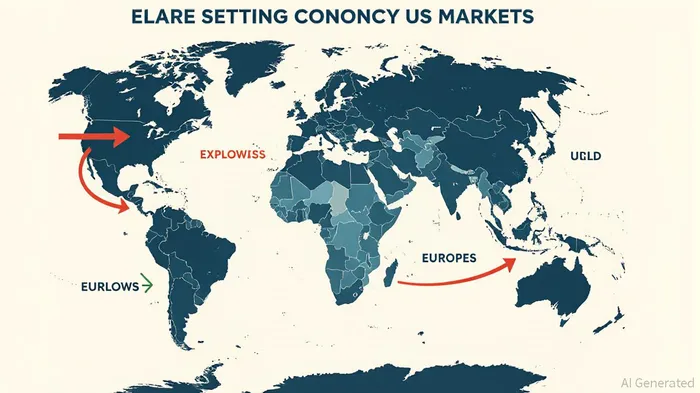
The U.S. dollar's dominance as the world's reserve currency has long been underpinned by geopolitical trust and institutional stability. However, recent leadership missteps and strained alliances have catalyzed a durable shift in global capital flows, favoring emerging markets and non-U.S. asset classes. This reallocation is not a temporary anomaly but a structural recalibration driven by eroding confidence in U.S. leadership and the rise of alternative power centers.
Geopolitical Trust Erosion: A Catalyst for Capital Flight
From 2023 to 2025, U.S. foreign policy under the Trump administration has systematically undermined its global alliances. Tariff hikes—peaking at 22%, the highest since 1910—triggered retaliatory measures from China (125% tariffs on U.S. goods) and strained trade relations with Canada, which labeled the U.S. “no longer a reliable partner.” NATO's cohesion has also frayed, with Trump's threats to withdraw from the alliance unless members meet spending targets prompting European allies to explore alternatives, including nuclear armament and regional defense pacts. Meanwhile, the U.S. paused intelligence sharing with Ukraine and adopted a confrontational stance toward Iran, further eroding trust in its security commitments.
These actions have prompted a reevaluation of U.S. reliability. European and Asian allies are now prioritizing self-reliance, with Germany and France discussing nuclear weapon sharing, and Poland expanding its military. Such shifts signal a broader rejection of U.S.-led security frameworks, accelerating the fragmentation of the post-WWII global order.
Capital Flows: A Diversification Away from the Dollar
The erosion of trust has directly influenced capital allocation strategies. Emerging market central banks have actively diversified forex reserves, reducing dollar exposure in favor of gold, the Chinese yuan, and other currencies. For instance, India repatriated 803.58 tons of gold from the Bank of England to domestic vaults, while Russia increased its yuan holdings to 2.4% of reserves. China's $1.3 trillion China Investment Corporation (CIC) has also reduced U.S. private equity exposure, reallocating to renewable energy and AI-driven sectors.
Sovereign wealth funds (SWFs) are following suit. A 2025 Invesco study revealed that 59% of global SWFs plan to boost China allocations over five years, targeting innovation sectors like semiconductors and EVs. Similarly, 64% prioritize emerging market public equities, with ASEAN and India attracting infrastructure and supply chain investments. This trend is compounded by Trump-era tariffs of 30–35% on goods from Canada, the EU, and Mexico, which have fragmented global supply chains and pushed investors to diversify away from U.S. assets.
Implications for the U.S. Dollar and Investment Strategies
The dollar's share in global forex reserves has declined from 60.8% in Q3 2024 to 58.2% in 2025, as central banks prioritize resilience over convenience. While the dollar remains dominant, its long-term strength is under pressure from U.S. debt concerns and trade policy volatility. J.P. Morgan Research projects EM currencies to outperform the dollar, with EM growth slowing to 2.4% annually but still outpacing developed markets.
For investors, the implications are clear:
1. Reduce Overexposure to U.S. Large-Cap Tech: Sovereign investors are rotating out of U.S. tech and consumer discretionary stocks, which now face valuation headwinds.
2. Hedge Geopolitical Risks: Derivatives and alternative assets (e.g., gold, EM bonds) can mitigate trade policy volatility.
3. Target Emerging Markets and China's Innovation Sectors: Sectors like AI, EVs, and renewable energy in China and India offer high-growth opportunities.
4. Diversify into European and EM Equities: European defense spending and India's “Make in India” initiative are structural tailwinds.
The Road Ahead: A Multipolar Capital Landscape
The reallocation of capital is not merely a reaction to short-term tensions but a reflection of long-term structural shifts. As U.S. trade policies fragment global markets and geopolitical alliances realign, investors must adapt to a multipolar world. The U.S. dollar's role as the sole reserve currency is waning, and capital flows are increasingly guided by regional dynamics and strategic autonomy.
For those seeking to navigate this new landscape, the key lies in diversification and agility. Emerging markets and non-U.S. asset classes are no longer niche bets—they are central to a resilient portfolio. As Amundi's Global CIO notes, “The global economy is rewiring, and investors must align with the new gravity of growth.”
In this evolving paradigm, the erosion of U.S. geopolitical trust is not a crisis but an opportunity for those prepared to rethink their allocations. The future belongs to investors who recognize that the dollar's long-term strength is no longer a given—and who act accordingly.

Stay ahead of the market.
Get curated U.S. market news, insights and key dates delivered to your inbox.






Comments
No comments yet