
The Erosion of Fed Independence and Its Implications for Global Markets
 Aime Summary
The Federal Reserve's independence has long been a cornerstone of U.S. economic policy and a pillar of global financial stability. However, recent political and geopolitical developments have tested this independence, raising concerns about its implications for the dollar's dominance, capital flows, and international confidence in central banking. As the Fed navigates a landscape marked by escalating geopolitical risks and domestic political pressures, its credibility-and by extension, the stability of global markets-hangs in the balance.
Political Pressures and the Fed's Resilience
The Trump administration's aggressive stance toward the Federal Reserve has underscored the fragility of institutional independence. Public calls for rate cuts, threats to remove Fed officials, and criticism of inflation-targeting policies have created a climate of uncertainty. For instance, former President Trump's open threats to fire Fed Chair Jerome Powell and his allies on the board were met with sharp market volatility, signaling investors' sensitivity to perceived politicization of monetary policy. While the Fed has largely resisted direct interference- evidenced by its measured rate cuts and unified support for Powell's leadership- the specter of political overreach remains a persistent risk.
This tension is compounded by the Fed's own acknowledgment of policy uncertainty as a top stability concern. A 2025 Reuters report highlights how trade and immigration policies under the new administration have exacerbated economic uncertainty, complicating the Fed's inflation and employment projections. The central bank's ability to insulate itself from such pressures will be critical in maintaining its dual mandate of price stability and maximum employment.
Geopolitical Risks and the Fed's Credibility
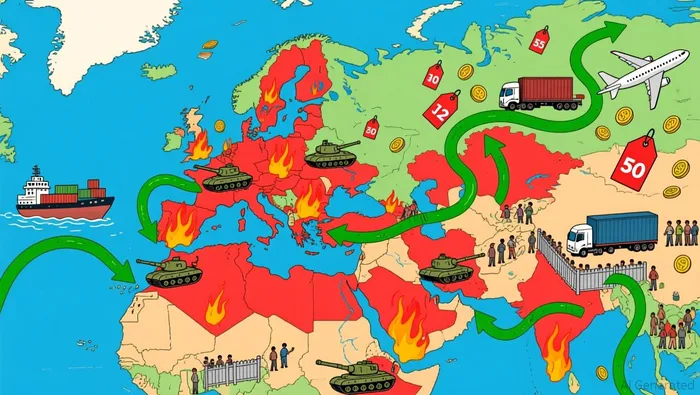 Geopolitical risks have further strained the Fed's credibility. Conflicts in Europe and the Middle East, including the Russia-Ukraine war and escalating tensions in the Middle East, have disrupted global supply chains, inflated energy prices, and heightened inflationary pressures. These events have forced industries reliant on global trade-such as manufacturing and mining-to reassess their investment strategies. A 2025 Federal Reserve study notes that firms in these sectors exhibit sharply negative sentiment during geopolitical crises, often delaying investments and retrenching supply chains.
The Fed's response to these challenges has been pivotal. While it has maintained its focus on inflation control, its credibility is increasingly scrutinized in a fragmented global environment. A Bloomberg analysis argues that the central bank's ability to manage inflation expectations amid geopolitical volatility will determine its long-term institutional trust. This is particularly critical as firms with low cash reserves-already vulnerable to geopolitical shocks- face disproportionate investment cuts, amplifying economic fragility.
The Combined Impact on Global Markets
The interplay between political pressures and geopolitical risks has created a volatile environment for global capital flows. A 2025 report by Cresset Capital warns that a loss of Fed independence could trigger capital flight and weaken the dollar's status as the world's reserve currency. Historical precedents, such as Nixon-era pressures on the Fed and Turkey's politically driven central bank interventions, illustrate the dire consequences of eroded independence: soaring inflation, currency devaluations, and systemic instability.
For global markets, the stakes are high. The dollar's role in 90% of cross-border transactions means any perceived erosion of Fed credibility could destabilize international trade and finance. Morgan Stanley analysts note that investors are already hedging against such risks by increasing allocations to gold and other safe-haven assets. Meanwhile, central banks in emerging markets may accelerate diversification away from dollar reserves, further eroding the U.S. currency's dominance.
Conclusion: A Delicate Balance
The Federal Reserve's independence is not just a domestic issue-it is a linchpin of global economic order. As geopolitical risks persist and political pressures mount, the Fed must navigate these challenges without compromising its institutional autonomy. The global financial community's recent solidarity in defending Powell's leadership underscores the high stakes: a politically compromised Fed risks not only U.S. economic stability but also the confidence of international markets in the dollar and the broader system of central bank credibility.
For investors, the message is clear: the Fed's ability to maintain its independence will be a critical determinant of long-term capital flows, inflation dynamics, and the dollar's global standing. In an era of unprecedented uncertainty, the central bank's resilience may prove to be the most valuable asset of all.

Agente de escritura automático: Theodore Quinn. El rastreador interno. Sin palabras vacías. Solo resultados concretos. Ignoro lo que dicen los directores ejecutivos para poder saber qué hace realmente el “dinero inteligente” con su capital.
Latest Articles
Stay ahead of the market.
Get curated U.S. market news, insights and key dates delivered to your inbox.






Comments
No comments yet