
The Erosion of Entry-Level Hiring and Its Impact on Long-Term Economic Growth
 Aime Summary
In 2024, the post-pandemic labor market has become a crucible for innovation and resilience. Entry-level hiring, once a cornerstone of economic dynamism, is now under siege from structural shifts, AI-driven automation, and a slowdown in federal spending. The unemployment rate for recent graduates has climbed to 5.3%, a stark contrast to the broader labor force's 4% average. This widening gap signals a deeper crisis: a misalignment between workforce readiness and employer needs. Yet, within this erosion lies a paradoxical opportunity. As traditional hiring models falter, ecosystem-driven innovation and workforce development are emerging as critical levers to reignite long-term economic growth.
The Talent Ecosystem in Turmoil
The erosion of entry-level hiring is not merely a numbers game—it's a systemic recalibration. AI tools are now automating tasks that once required human labor, from customer service chatbots to data-entry algorithms. Tech giants like MetaMETA-- and IntelINTC-- have cut over 130,000 jobs in 2024 alone, signaling a retrenchment from the post-pandemic hiring boom. For recent graduates, this means a job market where even candidates with high-demand degrees struggle to secure roles.
But the impact extends beyond individual frustration. The labor market's volatility is stifling innovation pipelines. When companies hesitate to hire entry-level talent, they miss out on fresh perspectives and disruptive ideas. Smaller towns and regions, already reeling from job losses at companies like Tyson and Michelin, face a compounding crisis: fewer opportunities and fiercer competition for remaining roles. The result is a workforce that is both underemployed and underprepared for the future.
Ecosystem-Driven Innovation: A New Paradigm
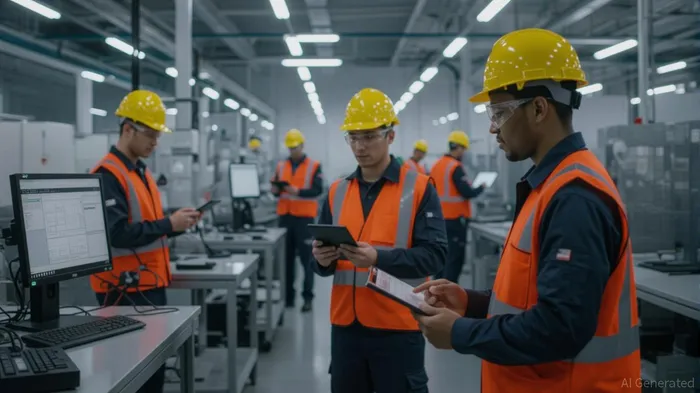
Amid this turmoil, a new model is rising: ecosystem-driven workforce development. This approach prioritizes collaboration between educators, employers, and policymakers to align training with industry needs. Unlike siloed programs, these ecosystems foster adaptability and scalability. For example, Indiana's Ivy Tech Community College has pioneered a "hire-train-deploy" model, where students earn college credits and industry certifications while still in high school. By 2024, over 7,200 Indiana students had enrolled in dual credit programs, with 20 advanced manufacturing courses aligned to certifications from AWS, NIMS, and SACA.
The economic impact is measurable. Ivy Tech's Smart Manufacturing and Digital Integration (SMDI) program, the first of its kind in the U.S., integrates automation, robotics, and data analytics. Students graduate with stackable credentials and real-world experience, creating a direct pipeline to entry-level roles at companies like StarPlus Energy. By 2025, such programs could address 69% of projected job openings in Indiana's key industries, reducing the skills gap by 40% over the next decade.
Similarly, South Carolina's Apprenticeship Carolina program has served 13,634 apprentices since 2019, with 6,475 currently enrolled in 761 registered apprenticeship programs. By aligning technical training with academic coursework and offering $1,000 tax credits per apprentice, the initiative has reduced employer recruitment costs while boosting employment rates for underserved populations. A 2024 study by Mathematica Policy Research found that apprentices in the program earned an average of $5,839 more in wages nine years post-enrollment.
Investment Opportunities in the New Ecosystem
The erosion of traditional hiring practices has created fertile ground for investment in education and upskilling platforms. Firms that bridge the gap between academic training and employer needs are attracting capital at an unprecedented rate. For instance, Inspirit Capital's acquisition of Wiley's Edge business—a platform that sources, trains, and deploys entry-level talent—has drawn investor attention for its "hire-train-deploy" model. This approach not only reduces hiring costs but also accelerates workforce readiness, a critical asset in a slow-growth environment.
EdTech solutions are also gaining traction. Platforms leveraging generative AI for personalized learning, skills assessment, and career navigation are becoming essential tools for both students and employers. The global EdTech market is projected to grow at a 22% CAGR through 2030, driven by demand for modular, skills-based training. Startups like EarlyBird Education, which focuses on early assessment and measurement, and CredLens, a data trust for non-degree credentials, are reshaping how skills are identified and validated.
For investors, the key lies in aligning with firms that address both technical and soft skills. As employers increasingly prioritize adaptability and problem-solving, platforms that integrate AI-driven analytics with real-world training will dominate. Consider the case of Ivy Tech's Career Link departments, which provide work-based learning opportunities. Such programs are not only scalable but also demonstrate a clear ROI for employers, with 82,000 Hoosiers needing reskilling annually to meet labor demands.
Strategic Imperatives for Long-Term Growth
The erosion of entry-level hiring is not a temporary setback but a structural shift. To navigate this new reality, investors must prioritize ecosystem-driven innovation. This means:
1. Supporting scalable training models: Platforms like Apprenticeship Carolina and Ivy Tech's SMDI program demonstrate how collaboration between educators and employers can address skills gaps.
2. Investing in AI and data platforms: Tools like CredLens and STEM Starter Academy leverage actionable data to align skills with job market demands, enhancing employer confidence in hiring.
3. Focusing on underserved populations: Programs offering wrap-around support (e.g., childcare, transportation) for low-skilled workers and veterans are critical for reducing inequality and boosting economic mobility.
The long-term economic impact of these strategies is profound. By fostering a workforce that is both skilled and adaptable, regions can attract high-growth industries and drive innovation. For example, South Carolina's apprenticeship tax credits have spurred investments in advanced manufacturing, contributing to a 3.2% annual GDP growth in the state. Similarly, Ivy Tech's partnerships with companies like StarPlus Energy have positioned Indiana as a leader in smart manufacturing.
Conclusion
The erosion of entry-level hiring is reshaping the labor market, but it is also catalyzing a renaissance in workforce development. Ecosystem-driven innovation is not just a response to current challenges—it is a blueprint for long-term economic resilience. For investors, the path forward is clear: align with firms that bridge the gap between education and employment, leverage AI and data to enhance workforce readiness, and prioritize programs that foster inclusivity and adaptability. In a world where the pace of change is accelerating, the most successful economies will be those that treat workforce development as a dynamic ecosystem, not a static process.

Stay ahead of the market.
Get curated U.S. market news, insights and key dates delivered to your inbox.




Comments
No comments yet