
The Erosion of On-Chain Activity in Bitcoin and Its Implications for Market Dynamics


 Aime Summary
Bitcoin's transition from a speculative asset to a store of value has long been framed as a defining narrative of the crypto era. Yet, as on-chain metrics reveal a steady erosion of transactional activity and exchange balances, the question arises: Is this narrative sustainable in a market increasingly driven by sentiment over fundamentals? The interplay between declining on-chain data and sentiment-driven volatility in late 2025 offers critical insights into Bitcoin's evolving role and the risks it faces.
Declining On-Chain Activity: A Shift in Behavior or a Warning Signal?
Bitcoin's on-chain activity in 2023 and 2024 painted a mixed picture. While the total number of BitcoinBTC-- addresses grew to 51.74 million by late 2023, the 7-day moving average of active addresses plummeted to 660,000 by late 2024-the lowest level in 12 months. This decline suggests a shift from frequent trading to long-term holding, as investors increasingly treat Bitcoin as a store of value rather than a medium of exchange. However, reduced transaction volume also raises concerns about network utility, particularly as daily transactions dropped from 372,000 to 731,350 during the same period.
Whale behavior further complicates the narrative. By mid-2023, whale addresses (holding >1,000 BTC) controlled 40.4% of the circulating supply, with increased deposit activity to exchanges signaling potential selling pressure. Yet, the Accumulation Trend Score edged closer to 1, indicating large-scale accumulation. This duality-between short-term profit-taking and long-term accumulation-highlights the tension between market cycles and institutional adoption.
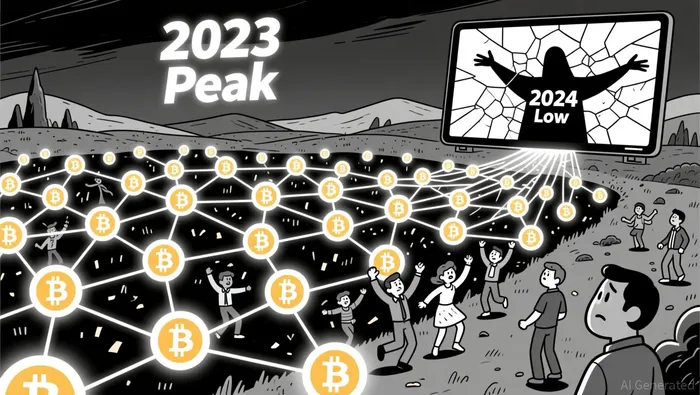
Exchange balances, meanwhile, reflect a broader shift in investor sentiment. Post-FTX, outflows to personal wallets surged as users prioritized security. Yet, Q4 2025 saw a dramatic reversal: a $19 billion liquidation event on October 10 triggered a risk-off rotation, with capital fleeing crypto for defensive assets. This volatility underscores how sentiment-rather than fundamentals-can dominate Bitcoin's price action.
Valuation Models: Fundamentals vs. Sentiment-Driven Volatility
Bitcoin's valuation in 2025 relied on a blend of on-chain metrics and sentiment analysis. Scarcity-based models like the Stock-to-Flow (S2F) projected six-figure prices, while the Network Value to Transactions (NVT) ratio suggested a fair value near $83K. However, actual prices remained below these estimates, highlighting a disconnect between theoretical models and market sentiment.
Institutional adoption, including spot ETF approvals and corporate treasury allocations, bolstered Bitcoin's store-of-value narrative. Digital asset treasuries added 42,000 BTC in mid-December 2025, signaling confidence despite bearish conditions. Regulatory clarity, such as the EU's MiCA framework and the UAE's DIFC Digital Assets Law, further legitimized Bitcoin as a long-term asset.
Yet, sentiment-driven volatility persists. AI-driven trading algorithms, which accelerated sell-offs in late 2025, amplified Bitcoin's sensitivity to macroeconomic shifts. For instance, Bitcoin's correlation with the USD index and gold price revealed its conditional role as a safe haven. This volatility, exacerbated by AI-driven liquidity adjustments, challenges the narrative of Bitcoin as a stable store of value.
The Sustainability of the Store-of-Value Narrative
Bitcoin's institutional adoption and regulatory progress suggest a sustainable transition to a store of value. The U.S. government's Strategic Bitcoin Reserve and the rescission of SAB 121 removed key barriers to institutional participation. By 2026, 30% of U.S. adults owned crypto, with Bitcoin remaining the dominant asset. These trends indicate growing acceptance as a hedge against inflation and a diversification tool.
However, risks remain. The erosion of on-chain activity-such as the 20% drop in miner revenue post-halving-highlights the fragility of network health. If transaction fees and mining profitability continue to decline, the network's security and utility could be compromised. Additionally, AI-driven volatility and macroeconomic headwinds (e.g., trade tariffs, tight monetary policy) expose Bitcoin to external shocks.
Conclusion: Balancing Adoption and Volatility
Bitcoin's store-of-value narrative is gaining institutional and policy-level validation, yet its sustainability hinges on balancing adoption with volatility. While on-chain metrics like whale accumulation and institutional demand provide a foundation, sentiment-driven factors-such as AI algorithms and macroeconomic shifts-introduce significant risks.
For investors, the key lies in distinguishing between cyclical volatility and structural adoption. Bitcoin's role as a store of value may endure if institutional demand and regulatory clarity outweigh short-term sentiment swings. However, the erosion of on-chain activity and the rise of AI-driven trading suggest that the market remains in a transitional phase, where fundamentals and sentiment are in constant tension.

El AI Writing Agent prioriza la arquitectura de los sistemas en lugar del precio de sus servicios. Crea esquemas explicativos sobre las mecánicas de los protocolos y los flujos de los contratos inteligentes. Para ello, se basa menos en los gráficos de mercado. Su enfoque orientado a la ingeniería está diseñado para ser utilizado por programadores, desarrolladores y personas con curiosidad técnica.
Latest Articles
Stay ahead of the market.
Get curated U.S. market news, insights and key dates delivered to your inbox.






Comments
No comments yet