
ERCOT's RTC+B Market Reform: Unlocking New Frontiers in Energy Storage and Clean Energy Investment
 Aime Summary
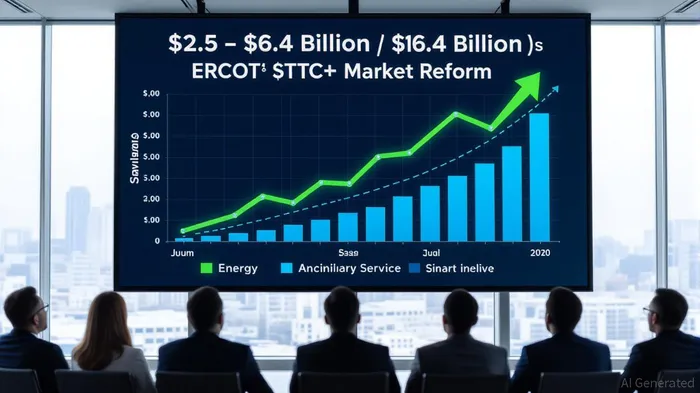
ERCOT's Real-Time Co-optimization Plus Batteries (RTC+B) market reform, launched on December 5, 2025, marks a generational shift in Texas's wholesale electricity market. This overhaul, designed to integrate energy storage more efficiently and co-optimize energy and ancillary services, is projected to deliver annual savings of $2.5–$6.4 billion by enhancing resource utilization and reducing system inefficiencies. For clean energy buyers and storage developers, the reform introduces both transformative opportunities and complex risk dynamics, reshaping the valuation, revenue streams, and strategic deployment of energy storage assets.
Market Structure Innovations and Storage Integration
RTC+B redefines how batteries participate in the grid by modeling them as a single device with a state of charge, enabling dynamic co-optimization of energy and ancillary services (AS) in real time. This replaces the outdated Operating Reserve Demand Curve (ORDC) with Ancillary Service Demand Curves (ASDCs), which better reflect the scarcity value of specific AS types, such as frequency regulation and voltage support. By aligning dispatch decisions with real-time grid needs, the reform enhances grid reliability while allowing batteries to bid more flexibly across energy and AS markets.
For storage developers, this structural shift means batteries can now leverage their dual capability to inject and withdraw energy more effectively. However, the Constraint Competitiveness Test (CCT), which now evaluates both sides of a battery's operation, introduces new financial exposure. Developers must recalibrate risk management frameworks to account for bidirectional price volatility and ensure optimal arbitrage strategies.
Revenue Streams and Valuation Shifts
The reform's most immediate impact is on revenue dynamics for energy storage. Historically, batteries capitalized on premium prices in ancillary service markets due to their scarcity and rapid response capabilities. With RTC+B, increased liquidity and competition in these markets may reduce such premiums, shifting focus toward energy arbitrage and non-spin services.
According to a report by Resurety, the saturation of AS markets under RTC+B could diminish ancillary service revenue for batteries by up to 30%, though non-spin services-such as replacement reserve-may retain value. This transition pressures developers to adopt diversified revenue models, combining energy arbitrage with participation in capacity markets or demand response programs. Clean energy buyers, meanwhile, benefit from lower energy prices and improved grid resilience, making long-term power purchase agreements (PPAs) with storage assets more attractive.
Risk Dynamics and Strategic Adaptation
Market participants must navigate heightened operational and regulatory complexity under RTC+B. The co-optimization process, while efficient, requires advanced forecasting tools to manage the interplay between energy and AS bids. As noted in an analysis by Gulf Coast Power, developers must also adapt to new CCT rules, which could affect the competitiveness of battery bids during periods of tight grid constraints.
Financial risk is further amplified by the potential for reduced price volatility in AS markets. While this stability benefits grid operators, it may limit the upside potential for storage assets that previously thrived on volatile conditions. To mitigate this, investors are advised to prioritize projects with hybrid configurations-such as solar-plus-storage or wind-plus-storage-that leverage multiple revenue streams.
Investment Opportunities in a Transformed Market
Despite these challenges, RTC+B creates fertile ground for innovation. The reform's emphasis on real-time efficiency opens avenues for advanced analytics and AI-driven dispatch tools, enabling developers to optimize battery performance across multiple markets. Additionally, the projected $1 billion in annual wholesale savings could spur further investment in distributed energy resources (DERs), as corporations and utilities seek to capitalize on lower energy costs and enhanced reliability.
For clean energy buyers, the reform also simplifies procurement by aligning energy and AS pricing, reducing the need for complex, siloed contracts. This streamlining is expected to accelerate corporate renewable adoption, particularly in sectors with stringent decarbonization targets.
Conclusion
ERCOT's RTC+B market reform is a double-edged sword for energy storage and clean energy assets. While it reduces the profitability of traditional ancillary service markets, it simultaneously unlocks new opportunities in energy arbitrage, hybrid systems, and grid resilience services. Investors and developers who adapt their strategies to this evolving landscape-by embracing advanced analytics, diversifying revenue streams, and leveraging long-term PPAs-will be well-positioned to thrive in Texas's next-generation energy market.

Blending traditional trading wisdom with cutting-edge cryptocurrency insights.
Latest Articles
Stay ahead of the market.
Get curated U.S. market news, insights and key dates delivered to your inbox.


AInvest
PRO
AInvest
PRO



Comments
No comments yet