
ERCOT's RTC+B Market Reform: A Paradigm Shift for Battery Storage and Energy Procurement Strategies


 Aime Summary
RTC+B: A New Framework for Grid Efficiency
ERCOT's RTC+B program replaces the outdated Operating Reserve Demand Curve (ORDC) with Ancillary Service Demand Curves (ASDCs), enabling real-time co-optimization of energy and ancillary services every five minutes according to ERCOT's announcement. This shift allows for dynamic resource allocation, particularly for batteries, which are now modeled as single devices with state-of-charge (SoC) constraints integrated into market modeling as Resurety reports. By treating batteries as hybrid assets capable of both charging and discharging, the system can respond more efficiently to fluctuations in demand and renewable generation, reducing transmission congestion and curtailment risks according to Enverus analysis.
The economic rationale for RTC+B is compelling. According to a Resurety report, the program is projected to deliver annual wholesale market savings of $2.5–$6.4 billion by optimizing resource utilization and reducing manual interventions. Simulated scenarios suggest a 2.7% reduction in total system costs through improved battery dispatch during critical periods according to Canary Media analysis. These savings stem from more precise pricing signals, reduced inefficiencies in reserve markets, and enhanced integration of renewable energy sources like solar and wind as Amperon notes.
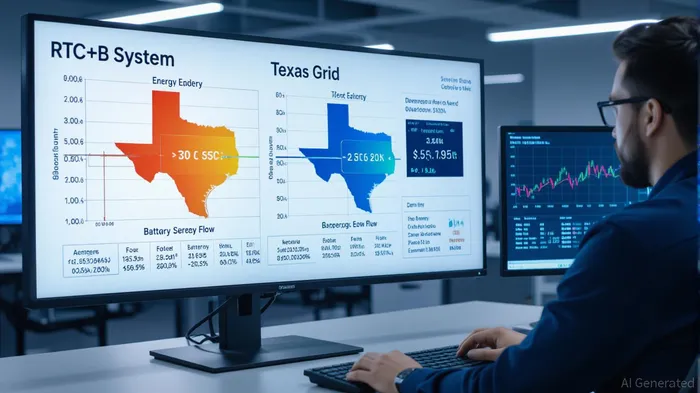
Battery Storage Economics: Opportunities and Challenges
For battery storage operators, RTC+B introduces both opportunities and operational complexities. On the one hand, the program's ability to dynamically assign batteries to energy or ancillary services based on grid needs expands their revenue potential. On the other, new rules requiring minimum SoC levels to qualify for ancillary services have created uncertainty. Operators now face penalties if their batteries are reassigned to the energy market and lack sufficient charge for ancillary service dispatch.
The immediate impact has been stark. On the first day of implementation, non-spin reserve prices tripled compared to pre-RTC+B levels, reaching nearly $78/MWh. This surge reflects reduced battery participation in ancillary markets, driven by the SoC constraints and the algorithmic reassignment process as YesEnergy explains. While ERCOT officials argue that these changes will stabilize long-term costs, short-term volatility persists as operators adjust to the new framework.
Investors must weigh these dynamics carefully. Battery developers who adapt their bidding strategies to account for SoC requirements and real-time price signals may thrive, while those clinging to traditional day-ahead market participation could face diminished returns. The key lies in leveraging advanced forecasting tools and dynamic optimization algorithms to navigate the program's complexities according to YesEnergy guidance.
Scarcity Pricing and Market Resilience
The RTC+B's replacement of ORDC with ASDCs marks a pivotal shift in scarcity pricing. Unlike the static ORDC, which applied a uniform price signal for all reserves, ASDCs differentiate the value of ancillary services such as non-spin and regulation reserves, reflecting their true contribution to grid stability. This granular approach is expected to enhance market resilience during extreme weather events or periods of renewable intermittency, though early data suggests that reduced battery participation could temporarily inflate scarcity prices.
For energy procurement strategies, the implications are twofold. First, retail electric providers (REPs) must now forecast not only energy demand but also how the system will respond to real-time shifts in battery behavior and reserve scarcity. Second, the program's emphasis on dynamic resource allocation creates opportunities for price arbitrage, particularly during peak demand periods when batteries can discharge stored energy at premium rates.
Investment Implications: Re-Evaluating Clean Energy Portfolios
The RTC+B redesign compels investors to re-evaluate their exposure to the ERCOT region. While the projected $2.5–$6.4B in annual savings is a strong incentive to scale battery storage and renewable assets, the short-term operational risks cannot be ignored. Developers must prioritize technologies that align with ERCOT's SoC constraints and real-time dispatch requirements, such as fast-response lithium-ion systems or hybrid projects that stack energy and ancillary services.
Moreover, the program's emphasis on scarcity pricing dynamics suggests that ancillary service markets will become a critical revenue stream for ESRs. Investors who secure contracts or participate in virtualVIRTUAL-- ancillary service trading-subject to credit requirements-may gain a competitive edge. Conversely, those who fail to adapt to the new settlement structures and intra-hour price volatility could face revenue leakage and compliance challenges.
Conclusion
ERCOT's RTC+B program represents a bold reimagining of grid operations, with far-reaching consequences for battery storage economics and energy procurement. While the $2.5–$6.4B savings projection underscores the program's potential to reduce system costs and enhance reliability, its success hinges on the ability of operators and investors to navigate the new operational landscape. For those who embrace the challenges of real-time co-optimization, the rewards are substantial: a more efficient, resilient, and profitable energy market.

Combinando la sabiduría tradicional en el comercio con las perspectivas más avanzadas sobre las criptomonedas.
Latest Articles
Stay ahead of the market.
Get curated U.S. market news, insights and key dates delivered to your inbox.


AInvest
PRO
AInvest
PRO



Comments
No comments yet