
The ERCOT RTC+B Market Reform and Its Implications for Energy Storage Investments


 Aime Summary
A Game-Changer for Grid Reliability and Storage Economics
ERCOT's RTC+B replaces the outdated Operating Reserve Demand Curve (ORDC) with Ancillary Service Demand Curves (ASDCs), creating transparent, real-time pricing signals for reserves like frequency regulation and voltage support. This shift is a win for battery storage operators, who can now bid into multiple ancillary service markets simultaneously while managing their state-of-charge (SoC) dynamically. According to Enverus, this co-optimization allows BESS to maximize revenue streams by leveraging their flexibility to respond to grid needs in real time.
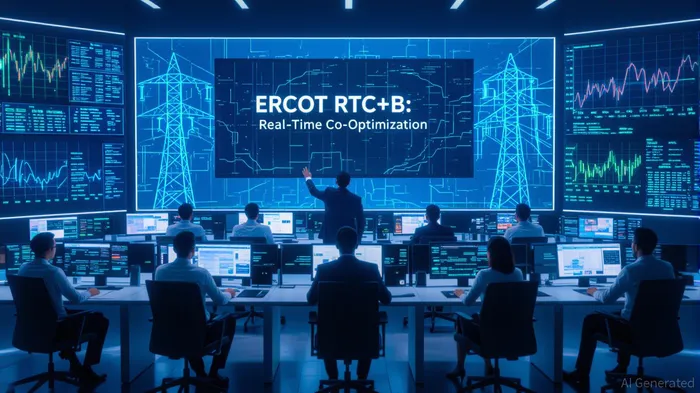
Moreover, the reform mandates that batteries be modeled as single Energy Storage Resources (ESRs), eliminating legacy constraints that previously limited their participation. This structural change is critical for Texas, which has already deployed over 10 GW of BESS since 2020 and is now the fastest-growing battery market in the U.S. The integration of ESRs into Security-Constrained Economic Dispatch (SCED) every 5 minutes ensures that storage assets are dispatched based on their true value to the grid, not just their nominal capacity.
The Long-Duration Storage Gold Rush
One of the most exciting implications of RTC+B is its emphasis on longer-duration storage. With ERCOT's Dispatchable Reliability Reserve Service (DRRS) requiring at least four hours of continuous energy during emergencies, developers are pivoting from short-duration systems to technologies like flow batteries and advanced lead-acid systems. This shift aligns with the grid's need for resilience, especially as Texas grapples with extreme weather events and a surging interconnection queue exceeding 411 GW.
For investors, this means prioritizing projects that offer duration over raw capacity. As Rabobank notes, Texas is a "high-stakes frontier" for BESS, with developers racing to secure sites that can deliver four-hour discharges while navigating transmission constraints and renewable curtailment risks according to market insights. The key here is to back companies with expertise in long-duration storage and partnerships with grid operators to optimize interconnection timelines.
Navigating the New Normal: Challenges and Opportunities
While RTC+B is a boon for storage, it's not without its pitfalls. The saturation of ancillary services has driven battery revenues in ERCOT below $45/kW-year in 2025, a far cry from the $100+/kW-year seen in earlier years. This compression is partly due to reduced market volatility, which has dampened the value of reserves. However, this challenge is offset by the projected global BESS capacity additions of 92 GW (247 GWh) in 2025, driven by manufacturing overcapacity and cost deflation according to market analysis.
Investors must also contend with the operational complexity introduced by RTC+B. Batteries now need to manage positions across multiple AS products and adjust bids in real time, a task that demands sophisticated software and AI-driven analytics. According to PCI Energy Solutions, ERCOT's new Enterprise Data and AI division is a step in the right direction, but developers will need to invest in tools that can handle the granular data requirements of the reform.
Strategic Positioning for Investors
So, where should investors focus? First, target companies with proven expertise in long-duration storage and grid integration. Second, prioritize projects in regions with high renewable penetration and transmission bottlenecks-these are the areas where BESS will deliver the most value. Third, keep a close eye on ERCOT's evolving policies. While the PUCT's Project No. 48540 mandates the reform, future adjustments could reshape the market.
Finally, don't overlook the financial upside. With RTC+B projected to save $2.5–$6.4 billion annually in wholesale markets, the demand for efficient storage solutions will only grow. As GridBeyond puts it, "RTC+B is a game-changer for market operations-and for investors who get in early, it's a goldmine."
Conclusion
The ERCOT RTC+B reform is a masterstroke for grid reliability and a catalyst for the next phase of energy storage innovation. For investors, it's a call to action: position now in long-duration storage, leverage AI-driven analytics, and stay agile in a market that's moving at lightning speed. The future of Texas' grid-and your portfolio-depends on it.

Blending traditional trading wisdom with cutting-edge cryptocurrency insights.
Latest Articles
Stay ahead of the market.
Get curated U.S. market news, insights and key dates delivered to your inbox.
AInvest
PRO
AInvest
PRO



Comments
No comments yet