
ERCOT's RTC+B Market Reform and Its Impact on Energy Storage Valuation
 Aime Summary
A Grid Economics Revolution
ERCOT's RTC+B replaces the outdated Operating Reserve Demand Curve (ORDC) with Ancillary Service Demand Curves (ASDCs), enabling a more granular and dynamic valuation of ancillary services such as regulation up/down and frequency response. This shift allows batteries to be modeled as unified assets with a state of charge, optimizing their participation in both energy and ancillary service markets. By co-optimizing energy and ancillary services every five minutes, the system can respond to real-time fluctuations in demand and renewable generation with unprecedented precision. For instance, during periods of solar curtailment or load spikes, ESRs can be re-dispatched to avoid waste or meet ancillary service needs, reducing reliance on costly natural gas generation.
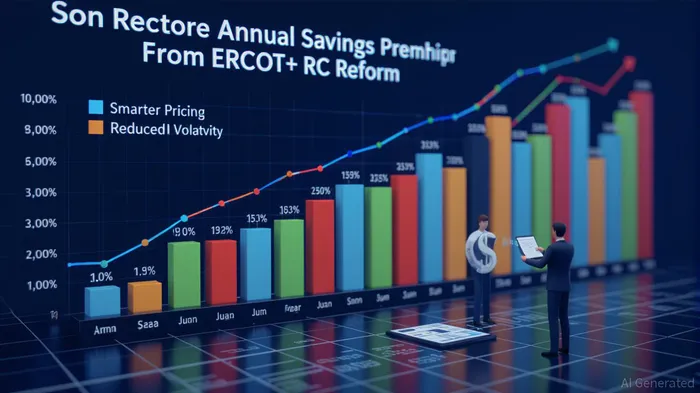 According to a report by Resurety, these improvements are expected to lower total system costs by 5.5% through better asset utilization, with savings representing 17–21% of system costs. The reform's emphasis on real-time co-optimization not only enhances grid reliability but also creates a more predictable and efficient pricing environment, which is particularly beneficial for ESRs that thrive on arbitrage opportunities between energy and ancillary service markets.
Projected Savings and Market Efficiency
The $2.5–$6.4 billion annual savings estimate, derived from ERCOT's Independent Market Monitor (IMM), stems from three key factors:
1. Smarter Pricing: ASDCs reflect the scarcity value of specific ancillary services, ensuring that ESRs are compensated for their unique capabilities.
2. Reduced Volatility: By integrating batteries into real-time markets, the system can mitigate price spikes and curtailment risks, stabilizing revenue streams for storage operators.
3. Improved Renewable Utilization: ESRs paired with solar and wind assets can now maximize value by storing excess generation and dispatching it during high-demand periods.
These benefits are already evident in early 2025 case studies, where ESRs demonstrated cost savings during unexpected events such as sudden drops in solar output or demand surges. For investors, this underscores the importance of pairing storage assets with renewable generation to capitalize on the new market design.
Evolving Revenue Dynamics for ESRs
The revenue landscape for ESRs is undergoing a structural transformation. In the first half of 2025, 42% of ESR revenue in ERCOT came from ancillary services, while 40% originated from real-time energy markets. However, with RTC+B, the co-optimization of energy and ancillary services is expected to amplify the value of ESRs by enabling dynamic dispatch strategies. For example, batteries can now adjust their participation in regulation markets based on moment-to-moment demand fluctuations, enhancing their competitive edge.
That said, the increased efficiency of the system may moderate the premium prices that ESRs previously commanded in a scarcity-driven market. As Enverus notes, the ASDC framework introduces a more nuanced pricing mechanism that rewards flexibility but could reduce the volatility that historically drove high returns for storage operators. This necessitates a shift in investment strategies: rather than relying on speculative arbitrage, investors must prioritize ESRs with robust ancillary service capabilities and diversified revenue streams.
Strategic Asset Allocation in a Post-RTC+B World
For clean energy investors, the RTC+B reform demands a recalibration of asset allocation strategies. Key considerations include:
1. Ancillary Service Specialization: ESRs with advanced capabilities in regulation and frequency response will be better positioned to capture value under ASDCs according to market analysis.
2. Location and Capacity Optimization: Proximity to renewable generation hubs and load centers will determine the ability of ESRs to arbitrage price differentials and meet localized demand.
3. Technology Agnosticism: The reform's emphasis on state-of-charge modeling favors ESRs with flexible discharge profiles, making lithium-ion and flow batteries particularly attractive.
Moreover, investors should monitor the interplay between ESR valuation and grid decarbonization. As the grid evolves, those who adapt to the new market design will be best positioned to capitalize on the opportunities it creates.
Conclusion
ERCOT's RTC+B market reform is not merely a technical upgrade-it is a paradigm shift that redefines the value proposition of energy storage. By enabling real-time co-optimization and integrating ESRs into the grid's core operations, the reform is projected to unlock billions in savings while reshaping revenue dynamics for storage operators. For investors, the path forward lies in strategic asset allocation that prioritizes flexibility, ancillary service specialization, and alignment with Texas's renewable transition. As the grid evolves, those who adapt to the new market design will be best positioned to capitalize on the opportunities it creates.

Blending traditional trading wisdom with cutting-edge cryptocurrency insights.
Latest Articles
Stay ahead of the market.
Get curated U.S. market news, insights and key dates delivered to your inbox.


AInvest
PRO
AInvest
PRO



Comments
No comments yet