
ERCOT's RTC+B Market Reform and Its Impact on Energy Storage Valuation
 Aime Summary
Grid modernization has long been a cornerstone of clean energy transitions, but few developments in recent years have reshaped asset economics as profoundly as ERCOT's Real-Time Co-Optimization Plus Batteries (RTC+B) market reform. By redefining how energy storage resources (ESRs) participate in wholesale markets, this reform is not merely a technical upgrade-it is a catalyst for revaluing clean energy assets in ways that could redefine the economics of grid-scale storage for years to come.
A Paradigm Shift in Market Design
ERCOT's RTC+B, implemented in December 2025, replaces the traditional model where ancillary services (AS) were procured in the Day-Ahead Market (DAM) and fixed in real time. Instead, it co-optimizes energy and AS in real time, treating batteries as unified assets with explicit state-of-charge (SoC) parameters. This shift addresses a critical inefficiency: the inability of legacy markets to dynamically respond to fluctuations in renewable generation or load. By integrating SoC into market-clearing algorithms, batteries can now re-dispatch in real time to meet regulation needs, absorb surplus solar output, or mitigate congestion, all while avoiding the rigid constraints of fixed-day-ahead allocations.
The economic implications are striking. According to a report by Enverus, scenarios modeled under RTC+B show total system cost reductions of 2.7% during demand spikes and 5.5% in cases of solar variability, such as early sunsets or cloud cover. These savings stem from reduced curtailment of renewables, lower reliance on manual operator interventions, and more precise pricing of ancillary services. For instance, in a "Solar Cliff" case study, RTC+B enabled batteries to preemptively adjust for solar shortfalls, avoiding price spikes that would have otherwise occurred under the old market structure.
Reshaping Storage Valuation Metrics
The reform's impact on energy storage valuation is multifaceted. First, it enhances the levelized cost of storage (LCOS) by increasing asset utilization. By allowing batteries to participate in up to five ancillary service products simultaneously-such as regulation, spinning reserves, and voltage support-RTC+B expands revenue streams according to analysis. This diversification reduces dependence on single-use cases like peak shaving, which are inherently cyclical. Second, the replacement of the Operating Reserve Demand Curve (ORDC) with Ancillary Service Demand Curves (ASDCs) introduces clearer price signals for scarcity. Unlike ORDC, which indirectly applied scarcity costs to energy prices, ASDCs directly reflect the value of AS, ensuring storage operators are compensated for their actual contributions to grid stability.
However, the reform also introduces new risks. The increased pace of real-time dispatch requires advanced automation and SoC management tools, raising operational complexity for smaller operators. Moreover, while RTC+B reduces market volatility, it may also compress margins for premium ancillary services, as batteries are called upon less frequently for high-price events according to market analysis. This duality-enhanced flexibility versus tighter margins-demands a nuanced approach to valuing storage assets. 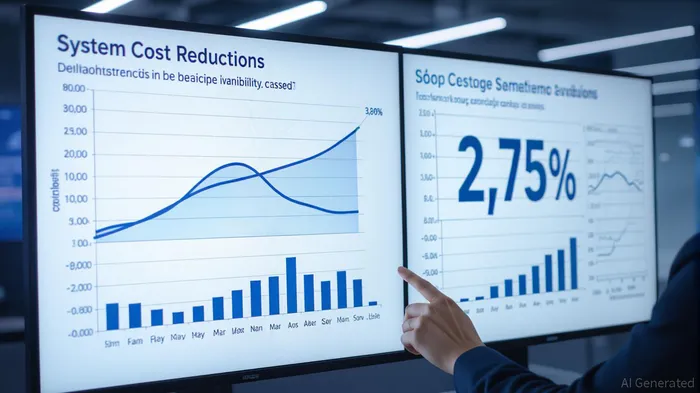
Grid Modernization as a Force Multiplier
ERCOT's Grid Research, Innovation, and Transformation (GRIT) initiative further amplifies the economic benefits of RTC+B. By developing tools like the Security Constrained Unit Commitment (SCUC)-Based Storage Tool and multi-interval optimal power flow models, GRIT is creating frameworks to optimize storage deployment at scale. For example, Gridmatic's 2023 ERCOT Storage Report highlighted projects like Endurance Park, where optimized storage systems outperformed traditional benchmarks by leveraging real-time data and AI-driven dispatch algorithms. These innovations are not just theoretical-they are already translating into tangible improvements in capacity payments and internal rates of return (IRR).
Quantitative data underscores this trend. With nearly 100 GW of solar and battery resources in development, ERCOT's Independent Market Monitor projects annual wholesale market savings of $2.5–$6.4 billion by 2025. For storage operators, this translates to a 10–15% uplift in IRR for projects designed to exploit RTC+B's co-optimization features. Yet, as one industry analyst notes, "The true value of RTC+B lies in its ability" to turn storage from a marginal asset into a systemic enabler of grid resilience.
Challenges and the Path Forward
Despite its promise, RTC+B is not without hurdles. The transition to real-time co-optimization requires significant capital for software upgrades and workforce training, particularly for operators accustomed to day-ahead markets. Additionally, the reform's emphasis on SoC management could disadvantage older battery fleets with limited state-of-health monitoring capabilities.
Nevertheless, the long-term outlook remains bullish. As ERCOT's battery capacity nears 10 GW in 2025-with over 180 GW in development-the market is poised to absorb these challenges. For investors, the key takeaway is clear: grid modernization initiatives like RTC+B are not just reducing costs-they are redefining the economic value proposition of clean energy assets, creating new opportunities for those who can adapt to the speed and complexity of real-time markets.

Combina la sabiduría del comercio tradicional con los conocimientos más avanzados sobre criptomonedas.
Latest Articles
Stay ahead of the market.
Get curated U.S. market news, insights and key dates delivered to your inbox.






Comments
No comments yet