
ERCOT's RTC+B Market Reform and Its Impact on Energy Storage Investment: Identifying Undervalued Battery and Hybrid Storage Assets in the Evolving ERCOT Landscape
 Aime Summary
ERCOT's Real-Time Co-Optimization Plus Batteries (RTC+B) market reform, which went live on December 5, 2025, represents a seismic shift in Texas's wholesale electricity market. By integrating battery storage as a unified asset with a state-of-charge model, the reform enables real-time co-optimization of energy and ancillary services, enhancing grid flexibility and reducing volatility. While projected savings of $2.5–$6.4 billion and improved reliability are compelling, the reform also reshapes revenue dynamics for energy storage. For investors, this creates both challenges and opportunities-particularly in identifying undervalued battery and hybrid storage assets in a market undergoing rapid transformation.
Market Dynamics Post-RTC+B: A New Paradigm for Storage
The RTC+B framework replaces the outdated ORDC with Ancillary Service Demand Curves (ASDCs), pricing ancillary services based on their specific value to grid stability. This shift has already reduced volatility in real-time markets, with energy arbitrage opportunities for Battery Energy Storage Systems (BESS) declining sharply-from $149/kW in 2023 to just $17/kW in 2025.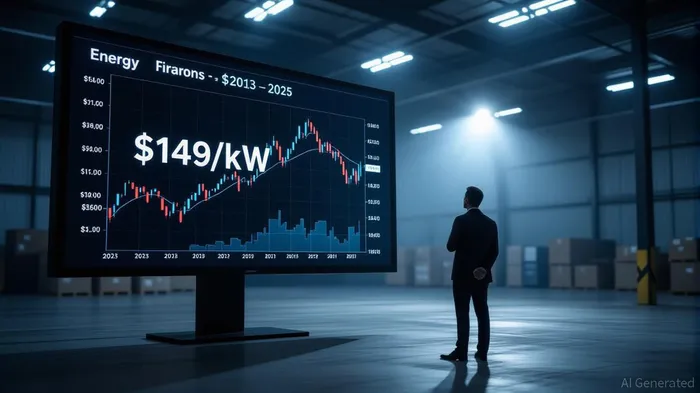 Ancillary service revenues have also plummeted by nearly 90% over two years due to market saturation, compressing margins for operators.
However, the reform's benefits are undeniable. By modeling batteries as a single device with a state of charge, ERCOT has streamlined their participation in real-time markets, enabling faster responses to grid fluctuations. This is particularly valuable as Texas's renewable energy penetration grows, with solar and wind now accounting for over 40% of generation. The integration of batteries into co-optimized markets also reduces curtailment risks for renewables, making hybrid projects more attractive.
Undervalued Assets: Deployment Gaps and Revenue Potential
Despite the market's maturation, deployment gaps persist. Over 180 GW of battery projects are in development or under construction in ERCOT, but many remain undervalued due to outdated revenue assumptions. For example, merchant BESS revenues in mature markets like ERCOT averaged below $45/kW-year in 2025, far below the pre-RTC+B levels. This undervaluation stems from three key factors:
- Regional Deployment Gaps: While ERCOT has seen record battery additions (2,054 MW in Q3 2025), certain regions-particularly those with high renewable penetration but limited storage-remain underserved. Nodes with frequent curtailment or price volatility offer untapped potential for hybrid systems that combine solar/wind with storage.
- Hybrid Projects: Co-located solar-storage systems can mitigate curtailment and improve energy arbitrage, yet many such projects are still priced using pre-RTC+B models that ignore the new market's efficiency gains.
- Ancillary Service Opportunities: The ASDC framework creates granular pricing for ancillary services, but operators who fail to adapt their bidding strategies risk missing high-value opportunities. For instance, 42% of H1 2025 storage revenue came from ancillary services, yet many operators remain locked into static, pre-RTC+B strategies.
Strategic Investment Opportunities
For investors, the key lies in leveraging the RTC+B framework's strengths while mitigating its risks. Here are three actionable insights:
- Target Nodes with High Volatility: Projects located at nodes with frequent price spikes or renewable curtailment can capitalize on real-time arbitrage and ancillary service opportunities. For example, the West Texas Interconnection (WTI) and South Texas nodes have shown persistent volatility, making them ideal for hybrid systems.
- Adopt Dynamic Bidding Strategies: The ASDC model rewards operators who submit node-specific forecasts and optimize dispatch based on real-time conditions. Advanced analytics tools can help identify high-value intervals, even in a low-volatility environment.
- Focus on Hybrid Projects: Combining BESS with solar or wind not only diversifies revenue streams but also enhances grid resilience. The RTC+B's emphasis on co-optimization makes these projects more competitive, particularly in regions with high renewable penetration.
Conclusion: A Market in Transition
ERCOT's RTC+B reform is a double-edged sword for energy storage. While it reduces scarcity premiums and compresses margins, it also unlocks new revenue streams through real-time co-optimization and ancillary service granularity. For investors, the challenge is to identify undervalued assets-particularly hybrid projects and underutilized nodes-and adapt to the new market's demands. As the grid evolves, those who embrace the RTC+B's flexibility will find themselves at the forefront of Texas's energy transition.

Blending traditional trading wisdom with cutting-edge cryptocurrency insights.
Latest Articles
Stay ahead of the market.
Get curated U.S. market news, insights and key dates delivered to your inbox.


AInvest
PRO
AInvest
PRO



Comments
No comments yet