
ERCOT's RTC+B Market Reform and Its Impact on Energy Storage Assets
 Aime Summary
Valuation Reimagined: Efficiency Gains and Revenue Shifts
RTC+B treats batteries as unified assets with a state-of-charge (SoC), enabling simultaneous optimization of energy and ancillary services. This co-optimization framework replaces the previous Operating Reserve Demand Curve (ORDC) with Ancillary Service Demand Curves (ASDCs), allowing for more precise pricing of services like frequency regulation and voltage support. For investors, this means batteries can now respond dynamically to real-time market signals, improving their ability to arbitrage price differentials and avoid curtailment of renewable energy.
However, the reform's efficiency-driven design may erode traditional revenue streams. A report by Enverus highlights that average annual battery revenue in ERCOT plummeted from $149 per kilowatt in 2023 to just $17 per kilowatt in 2025, driven by reduced scarcity pricing and market saturation. While the Independent Market Monitor (IMM) projects $2.5–$6.4 billion in annual wholesale savings, these gains come at the cost of lower margins for storage operators, who must now compete in a more commoditized market.
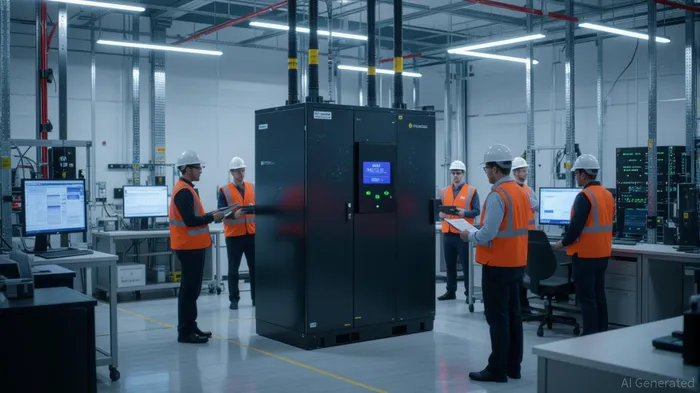
Case studies from Enverus further illustrate the duality of RTC+B's impact. In scenarios involving solar generation fluctuations or demand spikes, the co-optimization framework reduced total system costs by up to 5.5% through smarter resource dispatch. Yet, these benefits are contingent on operators adopting advanced automation and optimization strategies to navigate the high-frequency dispatch cycles inherent in the new system.
Risk Profiles: Operational Complexity and Market Volatility
The transition to RTC+B introduces operational risks tied to the "single-model" treatment of batteries. Under this framework, ESRs must maintain sufficient SoC to fulfill all committed services simultaneously, limiting their ability to stack multiple ancillary services. This constraint, coupled with the need for real-time data submission (e.g., SoC and ancillary service deployment factors), demands robust digital infrastructure-a barrier for smaller operators.
Regulatory risks also persist. The Constraint Competitiveness Test (CCT), which evaluates the economic viability of battery portfolios under RTC+B, adds another layer of complexity to project financing. Meanwhile, market volatility remains a wildcard. Ascend Analytics notes that ERCOT's grid is "on a weather-dependent knife's edge," with demand growth outpacing supply and creating potential shortages during peak periods. While batteries can profit from ancillary service markets during scarcity events, the reform's emphasis on price convergence between day-ahead and real-time markets may reduce the frequency of such opportunities.
Expert Projections: A Mixed Outlook for 2025–2026
Industry experts remain divided on the long-term implications of RTC+B. On one hand, the reform's ability to integrate renewables and reduce curtailment is expected to enhance the value proposition of hybrid projects, where batteries pair with solar or wind assets. On the other, the decline in scarcity-driven premiums raises concerns about the internal rate of return (IRR) for standalone battery projects.
According to a report by Resurety, the projected $2.5–$6.4 billion in annual savings could stabilize grid costs but may also compress battery margins as the market adjusts to its new equilibrium. For now, operators are advised to adopt hedging strategies and prioritize site selection in high-demand zones to mitigate revenue uncertainty.
Conclusion: Navigating the New Normal
ERCOT's RTC+B reform is a double-edged sword for battery investors. While it enhances grid efficiency and unlocks new revenue streams through dynamic dispatch, it also intensifies competition and operational complexity. The key to success lies in leveraging the reform's flexibility to optimize asset performance while mitigating risks through strategic planning and technological investment. As the market matures, the true impact on levelized cost of electricity (LCOE) and IRR will depend on how quickly operators adapt to this redefined landscape.

Blending traditional trading wisdom with cutting-edge cryptocurrency insights.
Latest Articles
Stay ahead of the market.
Get curated U.S. market news, insights and key dates delivered to your inbox.






Comments
No comments yet